John 14:15-21 If You Love Me...
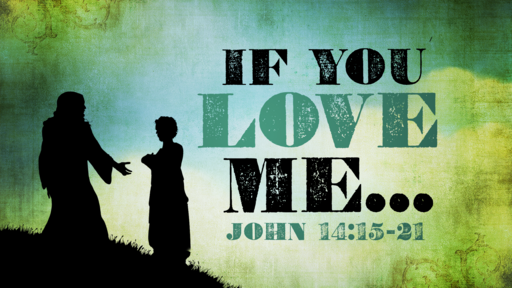

John 14:15-21 (Evangelical Heritage Version)
15“If you love me, hold on to my commands. 16I will ask the Father, and he will give you another Counselor to be with you forever. 17He is the Spirit of truth, whom the world cannot receive because it does not see him or know him. You know him because he stays with you and will be in you.
18“I will not leave you as orphans; I am coming to you. 19In a little while the world will see me no longer, but you will see me. Because I live, you also will live. 20In that day you will know that I am in my Father, and you in me, and I in you. 21The one who has my commands and holds on to them is the one who loves me. And the one who loves me will be loved by my Father. I too will love him and show myself to him.”
If You Love Me...
I.
The boy was not a musical genius; after all, he was only 8. Still, his mother thought there was some musical potential in him. It might be beneficial, she thought, for him to listen to a true musical genius play.
So it was that she took her young son to a concert by a brilliant pianist. They were seated, waiting for the concert to start. While they were waiting, the mom turned and spoke to another woman she knew.
The boy slipped out of the row and made his way to the beautiful nine-foot concert grand piano sitting on the stage. He sat down at the bench. About that time, his mother turned around in her seat and saw her son, hands poised, ready to begin playing the concert grand. She couldn’t even get out a gasp before his hands came down on the keys, playing Chopsticks. Mom was mortified. Her son was playing with great enthusiasm—he loved to play—but his efforts fell far short of what the crowd had come to hear.
“If you love me...” (John 14:15, EHV). So Jesus began today’s Gospel. Some languages have many words for love. Greek has three. English has only one. One of the three Greek words for love isn’t used in the Bible at all. Phileo, from which Philadelphia gets its name, means brotherly love. Phileo is used only 26 times in the New Testament. Agape is the third word for love. It is used 258 times in the New Testament. Agape is the kind of love that doesn’t expect anything in return. Agape is the word Jesus uses for love in today’s Gospel.
The English word love is often used to imply feelings and emotions. You feel love for your mother, for example. Think about Paul’s famous “love chapter,” 1 Corinthians 13. Paul doesn’t talk about love as a feeling, but as a bunch of actions. That’s what Jesus is speaking of here: love him, he says; do that with a series of actions, not just emotions.
That was going to be difficult for the disciples. Jesus had just told his disciples, moments before our text: “I am going to the Father” (John 14:12, EHV). The disciples understood what Jesus meant—he was leaving them. He spoke those words before Good Friday ever happened. Perhaps in the days and hours after Good Friday they remembered these words and thought Jesus was gone from them forever. Their lives were a mess for those three days; they wondered what would become of them; they thought all hope was gone.
Jesus said in last week’s Gospel: “I am going to prepare a place for you. 3And if I go and prepare a place for you, I will come again and take you to be with me, so that you may also be where I am” (John 14:2-3, EHV). Those words were ominous to the disciples. Jesus said he would come and get them—eventually—but in the meantime they felt like they would be orphaned—left all alone, to their own devices.
That’s scary. We see unbelief all around us, just like Paul found in Athens. Paul said: “As I was walking around and carefully observing your objects of worship, I even found an altar on which had been inscribed, ‘To an unknown god’” (Acts 17:23, EHV). Our world is filled with sophisticated ways to deny and reject Jesus.
We feel like the disciples: orphaned, abandoned. “If you love me, hold on to my commands” (John 14:15, EHV). The disciples heard which word Jesus chose for love and realized that their own love for Jesus fell far short. We feel it, too. Our love feels conditional and emotional rather than agape—a love that acts selflessly for Jesus. It’s like the boy playing Chopsticks on the piano. It might be enthusiastic, but it just isn’t all that impressive.
After all, by nature sin lives inside us. Our righteous acts fall far short. Action-oriented love is beyond us. How can we possibly live for the One who lives when we so clearly do not?
II.
Back to the 8-year-old enthusiastically banging out Chopsticks on the concert grand piano. The pianist the crowd was waiting for was Ignacy Paderewski. The story goes that he heard the boy on the piano, came out and sat down next to him on the bench. He whispered to the boy to keep playing, and with one arm on each side of the boy improvised a brilliant accompaniment to the boy’s playing. The audience burst into applause.
Way back in Exodus and Deuteronomy Moses listed God’s Moral Law for all people of all time, summarized in the Ten Commandments. Both times there was a preamble; God said: “I am the LORD your God, who brought you out from the land of Egypt, where you were slaves” (Exodus 20:2, Deuteronomy 5:6 EHV). Moses recorded exactly the same words from God to his people in both places. It was important that God’s people should see God’s love, even before they heard his righteous decrees. Really, it is impossible for people to keep God’s commands without him and his love first wrapping around us.
That is also the sense in which Jesus says: “If you love me, hold on to my commands” (John 14:15, EHV). Holding on to Jesus’ commands is not something we do as if there were a new set of rules and regulations he was handing down to his followers. Instead, holding on to his commands is something we do out of love. His arms are already wrapped around us in all that he willingly did in our place.
“I will not leave you as orphans” (John 14:18, EHV), Jesus told his followers, then and now. It is only possible to hold on to his commands because: “I will ask the Father, and he will give you another Counselor to be with you forever. 17He is the Spirit of truth” (John 14:16-17, EHV). Jesus does not leave us as orphans; he does not abandon us to try with our own feeble, but enthusiastic, efforts to hold on to his commands.
Love that loves even when love isn’t deserved. Self-sacrificing love. Love in action. All of those describe the kind of love Jesus spoke of when he said: “If you love me.” Self-sacrificing love in action when love isn’t even deserved is exactly what Jesus demonstrated on the cross. All human beings were unlovable. We wanted nothing to do with God and his love.
Jesus willingly came into this world for us anyway. We were slaves to sin; Jesus kept God’s Moral Law perfectly in our place. Peter says in today’s Second Reading: “Christ also suffered once for sins in our place, the righteous for the unrighteous, to bring you to God” (1 Peter 3:18, EHV). Demonstrating his love for you and me, Jesus suffered and died for our sins to buy us out of our slavery to sin.
This same Jesus, who loved us so much he gave his life for us, now asks the Father to “Give you another Counselor to be with you forever. 17He is the Spirit of truth... he stays with you and will be in you” (John 14:16-17, EHV). The beautiful music of our faith is not our enthusiastic banging on the keys, but the Holy Spirit living in us, working our response to all the Lord Jesus has done for us.
III.
As Jesus spoke to the disciples, he knew he was soon going to show his selfless love with his death on the cross. He knew that he would leave them at his Ascension into heaven. But he wanted them to know—he wanted us to know—that the Counselor, the Spirit of truth, stays with us and lives in us forever.
That Spirit of truth guides us as we read God’s Word. He opens the Scriptures to us to deepen our understanding and to empower us to hold on to Jesus’ commands, as he asked us to do.
“I will ask the Father, and he will give you another Counselor to be with you forever” (John 14:16, EHV). Did you notice the whole Triune God in this verse? We are not orphans; we are united with the Triune God.
“In that day you will know that I am in my Father, and you in me, and I in you. 21The one who has my commands and holds on to them is the one who loves me. And the one who loves me will be loved by my Father. I too will love him and show myself to him” (John 14:20-21, EHV). The Father loves us, and Jesus shows himself to us, all while the Holy Spirit continues to live inside us.
IV.
Back to the story of Ignacy Paderewski reaching around the young boy to join in and make beautiful music. The story isn’t exactly accurate. It was inspired by this poster. Paderewski’s wanted to help people Poland affected by World War II, and organized a meeting to raise funds for some aid. It shows him encouraging “Johnny the Wanderer” as he sits at the keyboard. Reality is a little different than the story. Reality is even more poignant. The master musician both encouraged other musicians, and worked hard in other ways to improve the lives of people.
“Because I live, you also will live” (John 14:19, EHV). Our Triune God stands beside us and lives in us and wraps his arms around us as we live for the Lord Jesus and show our love for him by holding on to his commands.
Paul said to the people of Athens: “What you worship as unknown—this is what I am going to proclaim to you” (Acts 17:23, EHV). That’s one of the best ways we show our love for Jesus and hold on to his commands—we share the good news of what he has done for the world. Even though the Bible is the most widely distributed literature in the history of the world, people still don’t know it or misunderstand it. Make known to others the “unknown God.”
Our love, though it is imperfect now, is made holy by the Holy Spirit living in us. One day we will see him fully and love perfectly. Until then, our Chopsticks is accompanied by the Master—and the world hears beautiful music that glorifies the Father. As the Psalm of the Day said: “Shout praise to God, all the earth! 2Make music to the glory of his name! Make his praise glorious!” (Psalm 66:1-2, EHV).
Amen.
