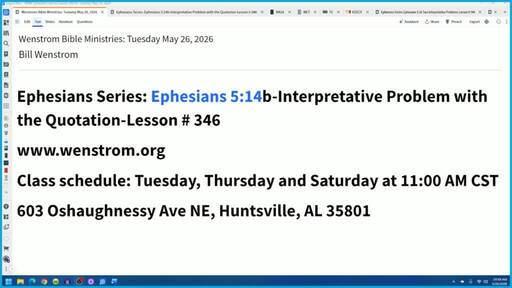
Ephesians 5.14b-Interpretative Problem with the Quotation

Wenstrom Bible Ministries
Pastor-Teacher Bill Wenstrom
Tuesday May 26, 2026
Ephesians Series: Ephesians 5:14b-Interpretative Problem with the Quotation
Lesson # 346
Ephesians 5:12 For these unfruitful activities being practiced by them secretly are a shameful disgrace to even mention. 13 However, because each and every one of these things are being habitually exposed by those who are characterized by spiritual light, they are being habitually revealed (as sin to those characterized by spiritual darkness and disobedience) by those who are characterized by spiritual light. 14 For anyone who for their own benefit makes it their habit of revealing (to those characterized by spiritual darkness that their unfruitful activities practiced secretly are sin against a holy God) is characterized by spiritual light. Therefore, it says, “Those who sleep, awake forever! Correspondingly, rise from the dead ones! Consequently, the one and only Christ will as a certainty shine upon you.” (Lecturer’s translation)
Ephesians 5:14 is composed of the following:
(1) Causal clause: pan gar to phaneroumenon phōs estin (πᾶν γὰρ τὸ φανερούμενον φῶς ἐστιν), “For anyone who for their own benefit makes it their habit of revealing (to those characterized by spiritual darkness that their unfruitful activities practiced secretly are sin against a holy God) is characterized by spiritual light.” (Lecturer’s translation)
(2) Marker of an Inferential Quotation: dio legei (διὸ λέγει), “Therefore, it says” (Lecturer’s translation)
(3) Command: egeire, ho katheudōn (ἔγειρε, ὁ καθεύδων), “Those who sleep, awake forever!” (Lecturer’s translation)
(4) Command: kai anasta ek tōn nekrōn (καὶ ἀνάστα ἐκ τῶν νεκρῶν), “Correspondingly, rise from the dead ones!” (Lecturer’s translation)
(5) Result clause: kai ⸂epiphausei soi ho Christos (καὶ ἐπιφαύσει σοι ὁ Χριστός), “Consequently, the one and only Christ will as a certainty shine upon you.” (Lecturer’s translation)
There is another interpretive difficulty in Ephesians 5:14 with regards to the quotation the apostle Paul employs.
Some say it is an early Christian hymn while others suggest that the hymn is heavily influenced by several passages in Isaiah and even some include a passage in Jonah.
Needless to say there are many suggestions as to the origin of the content of this quotation.
Harold Hoehner writes “There has been a great deal of debate on the source of the quotation. It has been identified as a quotation from Isa 26:19 (“You who dwell in the dust, awake and shout for joy!”); 60:1 (“Arise, shine; for your light has come, and the glory of the Lord has risen upon you.”); Jonah 1:6 (“How can you sleep? Arise, call on your god!”); or from the Secrets of Enoch (“Be of good cheer, Enoch, be not afraid; rise up and stand before My face for ever.”). A careful look at the Greek in these texts reveals little resemblance to Eph 5:14. Most consider this quotation to be an early hymn, possibly a baptismal hymn. In support of this is the parallelism which is ‘comparable to that of Hebrew poetry.’”
There is support that Paul is quoting from an early Christian hymn interpretation.
J. M. Lunde makes a compelling argument for this view, he writes “This Christologically-reformulated amalgamation bears the trademarks of Christian theological interpretation, leading many scholars to assign it to prior Christian tradition.75 Moritz lists several form critical reasons for this: (1) the rhythmic beat and the homoioteleuton of the first two lines (καθεύδων and νεκρῶν); (2) the Semitic ordering of the verbs (imperative, imperative, future tense); (3) its suitability for worship contexts; (4) the fact that ἐπιφαύσει is a hapax; (5) the shift from the second person plural verbs in the preceding verses to the singular forms in the citation; and (6) the stylistic introduction (διὸλέγει) and conclusion (οὖν). Added to these is the unusual replacement of the “LORD” in the text with ‘Christ,’ implying its genesis within early Christianity. The cumulative weight of these observations has led most to assume the Christian tradition hypothesis. Arnold’s comment is representative of this consensus: The best interpretation is that Paul is here citing an early Christian hymn, which in turn had been deeply influenced by a Christological interpretation of the two passages from Isaiah. The fact that Paul is citing a hymn from the worship of the early church is the consensus view and has had a long history in the interpretation of this passage. The plausibility that this consensus is correct must be admitted. The compelling nature of this point of view is evinced by the large number of scholars who hold to it, though undoubtedly several have adopted this consensus without careful, critical assessment. The truth is, until additional evidence surfaces regarding this supposed source, uncertainty will remain.”
In response to the early Christian hymn view, the NET Bible makes the following comment, they write “The following passage has been typeset as poetry because many scholars regard this passage as poetic or hymnic. These terms are used broadly to refer to the genre of writing, not to the content. There are two broad criteria for determining if a passage is poetic or hymnic: ‘(a) stylistic: a certain rhythmical lilt when the passages are read aloud, the presence of parallelismus membrorum (i.e., an arrangement into couplets), the semblance of some metre, and the presence of rhetorical devices such as alliteration, chiasmus, and antithesis; and (b) linguistic: an unusual vocabulary, particularly the presence of theological terms, which is different from the surrounding context’ (P. T. O’Brien, Philippians [NIGTC], 188-89) Classifying a passage as hymnic or poetic is important because understanding this genre can provide keys to interpretation. However, not all scholars agree that the above criteria are present in this passage, so the decision to typeset it as poetry should be viewed as a tentative decision about its genre.”
I believe that in Ephesians 5:14 Paul is summarizing the contents of Isaiah 60.
If you recall, he did this same thing in Ephesians 4:8 because in this verse we noted, he summarizes the contents of Psalm 68.
Here in Ephesians 5:14, I believe he is in fact summarizing the contents of Isaiah 60 because the former is addressing the evangelization of unregenerate Gentiles by the godly lifestyle of members of the Gentile Christian community (cf. Eph. 2:11).
Correspondingly, the contents of Isaiah are describing the evangelization of unregenerate Gentiles who exercise faith in the Messiah and as a result worship Him during His millennial reign.
Thus, this quotation in Ephesians 5:14 is not alluding to Isaiah 26, which does address the evangelization of the Gentiles, nor does Isaiah 26, and 52.
In fact, Isaiah 60 speaks of regenerate Gentiles bringing tribute to the Messiah in Jerusalem during His millennial reign.
Isaiah 60:1 “Arise! Shine! For your light arrives! The splendor of the Lord shines on you! 2 For, look, darkness covers the earth and deep darkness covers the nations, but the Lord shines on you; his splendor appears over you. 3 Nations come to your light, kings to your bright light. (NET)
Notice in Isaiah 60:1-2 that the Lord is shining on the Gentiles nations who were prior to faith in the Messiah in spiritual darkness.
Isaiah 60:3 prophesies that the Gentiles and their kings come to the light of the Messiah, which is a figurative reference for trusting in the Messiah.
Isaiah 60:4-22 is a prophecy of regenerate Gentiles worshipping Jesus Christ during His millennial reign.
The Gentiles who trusted in Jesus Christ as their Savior during the last three and a half years of Daniel’s seventieth week and who survived the events of this period and Second Advent will enter into the Lord’s millennial kingdom and the contents of Matthew 25 makes this clear.
Those Gentiles who trusted in Jesus Christ during this period and were martyred because of their faith in Jesus, will also reign with Christ during His millennial reign.
Unregenerate Gentiles will face eternal condemnation and they are the goats in this passage while the sheep are regenerate Gentiles.
As we noted, the fact that this text in Isaiah 60 says that the Lord’s light shines on them implies that they have trusted in Him as Savior, whereas in Ephesians 5:14 Paul is changing the text like he did with Psalm 4 in Ephesians 4:8.
In the former, he changes the text to Christ “will in the future” shine on the Gentiles because he is addressing the Gentile Christian community’s evangelization of unregenerate Gentiles by living their lives in obedience to His Spirit inspired apostolic teaching.
