Jesus Christ Will Evaluate the Christian's Stewardship of Their Time, Talent, Treasure and Truth (Doctrinal Bible Church in Huntsville, Alabama)

Doctrinal Bible Church
Pastor-Teacher Bill Wenstrom
Wednesday June 24, 2026
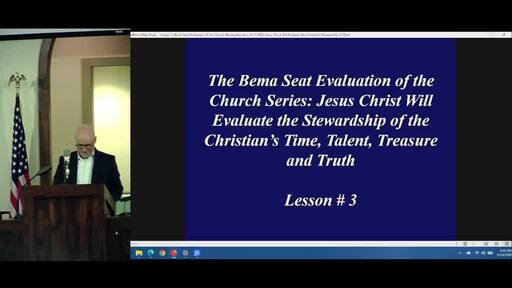
The Bema Seat Evaluation of the Church Series: Jesus Christ Will Evaluate the Stewardship of the Christian’s Time, Talent, Treasure and Truth
Lesson # 3
In Romans 14:11, Paul cites Isaiah 45:23 to affirm the certainty that each and every Christian must present himself to the Lord Jesus Christ at His Bema Seat in order to have their works evaluated by the Lord to determine if they merits rewards or not.
Then, in Romans 14:12, Paul draws an inference from these statements in Romans 14:10-11 and teaches that each and every church age believer without exception will have to give an account of himself to the Son of God.
Romans 14:10 You, then, why do you judge your brother? Or why do you look down on your brother? For we will all stand before God’s judgment seat. 11 It is written: “ ‘As surely as I live,’ says the Lord, ‘every knee will bow before me;
every tongue will confess to God.’ ” 2 So then, each of us will give an account of himself to God. (NIV84)
The believer is subject to giving an account to the Lord in order that his service and stewardship of his time, talent, truth and treasure can be evaluated by the Lord to determine if he was faithful in his service or not and to determine if his stewardship was profitable or not.
This will take place at the Bema Seat Evaluation of the church, which will be conducted by the Lord Jesus Christ immediately after the rapture.
Every Christian must give an account to the Lord or in other words, each must be held responsible by the Lord for his service, which involves a four-fold stewardship: (1) Time: Were they profitable in how they used their time on earth that the Lord gave them? (2) Talent: Were they profitable in how they used their spiritual gift the Lord gave them? (3) Truth: Were they profitable in how they used the truth the Lord gave them? (4) Treasure: Were they profitable in how they used their finances that the Lord gave them?
They are to be good stewards with their talent (they are to operate in their spiritual gifts) and treasure (they are to financially support each other when necessary) and truth (they are to apply the Word of God in their relationships with each other).
At the Bema Seat, the believer’s service, as expressed through their stewardship in these four areas, will be evaluated by the Lord Jesus Christ to determine if they were a faithful and profitable steward in these four areas or not.
If they were a faithful and profitable servant and steward with their time, spiritual gift, truth and finances that were given to them by the Lord as trusts, they will receive a reward from the Lord and if they were not, they will not receive a reward.
Therefore, the Bema Seat does not refer to the believer offering an explanation for actions in life since no explanation could alter or change what the believer said or did in life.
To give an account to the Lord does not mean that the believer will be giving an explanation as to why he did not do something or did do something.
It will not be a time for explanations or excuses but rather it will be a time when his actions as related to his service and stewardship in life will be evaluated to determine if they were a good steward with their time, talent, truth, and treasure that the Lord gave to them as trusts to be invested for His kingdom.
To give an account to the Lord is thus making oneself accountable to the Lord in order to have one’s service and stewardship evaluated by the Lord to determine if they merit rewards or not.
1 Corinthians 3:11-15 and 2 Corinthians 5:10 reveal that the believer’s works as related to service will be evaluated by the Lord to determine if they merit rewards or not.
There is nothing in these passages mentioning the believer giving an explanation for what he did since no explanation could justify or change that which the believer said and did in life.
Therefore, in Romans 14:12, Paul is teaching us that each and every member of the body of Christ will be required to give account of himself at the Bema Seat Evaluation of the church, which will be conducted by the Lord Jesus Christ.
This refers to the evaluation by the Lord Jesus Christ of the believer’s four-fold stewardship.
Time: Galatians 6:9 Let us not lose heart in doing good, for in due time we will reap if we do not grow weary. 10 So then, while we have opportunity, let us do good to all people, and especially to those who are of the household of the faith.”
Talent: 1 Peter 4:10 As each one has received a special gift, employ it in serving one another as good stewards of the manifold grace of God.
Treasure: Luke 6:38 “Give, and it will be given to you. They will pour into your lap a good measure -- pressed down, shaken together, and running over. For by your standard of measure it will be measured to you in return.”
Truth: Colossians 4:5 Conduct yourselves with wisdom toward outsiders, making the most of the opportunity. 6 Let your speech always be with grace, as though seasoned with salt, so that you will know how you should respond to each person.
A steward is a manager, not an owner.
He is one who manages the property of another.
God is the owner and we are the managers of the various stewardships He has given and this includes the whole of life, of course.
But to be good stewards of His grace, we must know the precise areas of stewardship for which God is holding us accountable.
Stewardship is one of four concepts related to Christian fellowship:
(1) Relationship with Christ: We are all permanently united together by the common (eternal) life that we share as a result of regeneration and the Baptism of the Spirit (Acts 2:42; 1 C. 1:9; 1 Jn. 1:3).
(2) Partnership: We are to work together for a common purpose to obtain common objectives for the glory of God and the gospel of Jesus Christ (cf. Phil 1:27; Phlp. 1:5; Gal. 2:9; Heb. 1:9).
(3) Companionship: We are to communicate with one another and have fellowship with one another sharing with one another the things (viewpoint and thinking) of Christ (Acts. 2:42; Heb. 10:25; 2 Tim. 2:2; 1 Thess. 5:11; Rom. 1:11-12; 2 Tim. 2:2; 1 Thess 5:11; Phlm. 6).
(4) Stewardship: We must recognize that all we have belongs to the Lord and has been given to us as trusts from God to invest for His purposes.
Good stewardship stems from recognizing our relationship to Jesus Christ, but it also means recognizing our partnership in Christ’s enterprise on earth. (Rom. 12:13; 15:27; Gal. 6:6; Phil. 4:15; Rom. 15:26; 2 Cor. 8:4; 9:13; Heb. 13:16; 1 Tim. 6:18).
As stewards we must recognize that all we have belongs to the Lord and has been given to us as trusts from God to invest for His purposes.
Believers need to be willing to share their material possessions for the promotion of the gospel and to help those in need.
Everything that we are and possess as believers in the Lord Jesus Christ, both spiritually and materially, namely, our time, talent and treasure are in fact, trusts given to us by God which we are to invest for God’s kingdom and glory (1 Pet. 1:17; 2:11; 4:10-11; Luke 19:11-26).
In any good partnership, the partners share equally in both privileges and responsibilities, the assets and liabilities, and the blessings and burdens.
What kind of partnership would it be if one partner took all the income and enjoyed all the privileges while the other partner did all the work and paid all the bills?
No one would enter into a partnership like that, yet that is what goes on in the church today.
Partners are to share and share alike in all the aspects of their enterprise.
They may not do the same things since there are diverse spiritual gifts distributed to individuals in the body of Christ.
In fact, members of any partnership will be much more successful in their enterprise if they work and share according to their abilities, expertise, and training, but still share the load.
The Lord Jesus Christ taught His disciples to be profitable rather than unprofitable servants of God.
A profitable servant is obedient whereas the unprofitable servant is disobedient (Matthew 24:47-51; 25:14-30).
