Matthew 22:15-22 Whose Image?
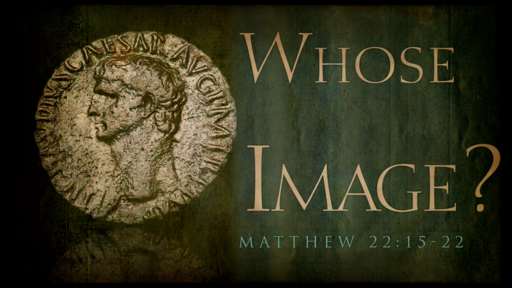

Matthew 22:15-22 (Evangelical Heritage Version)
15Then the Pharisees went out and plotted together how to trap him in his words. 16They sent their disciples to him along with the Herodians. “Teacher,” they said, “we know that you are truthful and teach the way of God in accord with the truth. You are not concerned about gaining anyone’s approval because you are not swayed by appearances. 17So tell us, what do you think? Is it lawful to pay taxes to Caesar or not?”
18But Jesus knew their evil purpose and said, “Why are you testing me, hypocrites? 19Show me the coin used for the tax.”
They brought him a denarius.
20He asked them, “Whose image and inscription is this?”
21“Caesar’s,” they replied to him.
Then he said to them, “Therefore give to Caesar the things that are Caesar’s, and to God the things that are God’s.”
22When they heard this, they were amazed. Then they left him and went away.
Whose Image?
I.
You may use a piece of plastic most of the time to access it, but if you’re like me, you may even have some in your wallet. Whether it’s physical or digital, every bill or coin you own makes a claim before you have spent any of it: “In God we Trust.” On the one hand, our nation borrows God’s name to back it’s money, but on the other hand it leaves every individual free to decide what we actually believe. In fact, though our money says “In God we Trust,” many people have decided to trust nothing at all.
Matthew tells us today about two groups of people: the Pharisees and the Herodians. You may never have thought very much about these two groups of people. The two groups represented fundamentally opposed visions of authority and allegiance.
The Herodians could perhaps be considered more political. They supported Roman domination and Herod wielding Rome’s power. They accepted Caesar’s requirements for taxes without much question. As for their feelings about religion, the Herodians professed Judaism, but they didn’t observe the requirements of the Old Testament Ceremonial Law and they added pagan Roman practices to their religious views.
In the view of the Pharisees, Judaism was to be dominant over the government. They felt God alone deserved ultimate loyalty, and earthly powers should submit to divine rule. The Pharisees despised Roman taxation and were resistant to paying taxes to foreign rulers.
It would seem the two groups had nothing in common, but there was one thing both could agree on: Jesus was a threat.
Matthew laid it all out succinctly: “Then the Pharisees went out and plotted together how to trap him in his words. 16They sent their disciples to him along with the Herodians” (Matthew 22:15-16, EHV).
Their plot unfolded during Holy Week. Both groups had witnessed Jesus’ triumphant entry into Jerusalem, with crowds of people waving palm branches and spreading their cloaks on the path in front of his donkey.
Jesus’ populism could signal the coming of a new kingdom. If that happened, the dynasty of Herod would fall, which would doom the Herodians. As for the Pharisees, that new kingdom would probably see Jesus establishing himself as the long-promised Messiah; that would eliminate their religious influence over the people.
Despite their differences, both groups were united in their hatred of Jesus. To both, a temporary alliance made perfect sense.
“‘Teacher,’ they said, ‘we know that you are truthful and teach the way of God in accord with the truth. You are not concerned about gaining anyone’s approval because you are not swayed by appearances. 17So tell us, what do you think? Is it lawful to pay taxes to Caesar or not?’” (Matthew 22:16-17, EHV).
The very phrasing of their question was brilliant! Butter Jesus up, first. “Everybody knows you’re honest, Jesus; you’re not going to pick sides just because of what one group or the other might say. Give us your proper verdict about taxation. Is it lawful to pay taxes, or not?”
If Jesus said yes, taxation was lawful, he would immediately be labeled a collaborator with Rome. Those who had marched into Jerusalem with him and laid their cloaks on the ground in front of him, hailing him as the Messiah, would immediately abandon him. If he said no, he could be accused by the Herodians of treason. They could hand him over to the authorities as a threat to Roman order.
This weekend we celebrate our nation’s birthday. It’s the 250th anniversary of the signing of the Declaration of Independence. The details have changed from the Pharisees and Herodians, but you can still feel a tension. Wrap your faith so completely in the flag that God and country become nearly indistinguishable, or treat every government, every party, every election, as an enemy to be resisted at every turn.
Pick a side, we’re told—by people on every side of every argument. Everyone wants to know: whose image do you actually trust? Which kingdom owns you?
II.
The Pharisees and the Herodians must have felt smug when they asked their question. It was a clever trap. No matter which side Jesus picked, there would be a gotcha moment. Jesus doesn’t flinch; nor does he pick either side of the trap they chose for him.
“But Jesus knew their evil purpose and said, ‘Why are you testing me, hypocrites? 19Show me the coin used for the tax.’ They brought him a denarius. 20He asked them, ‘Whose image and inscription is this?’” (Matthew 22:18-20, EHV).
Jesus points to the denarius—a typical day’s wages. Caesar’s face was on one side. On the other an inscription claiming Caesar was the divine son of a god was stamped right into the metal every one of them carried without a second thought.
“‘Caesar’s,’ they replied to him. Then he said to them, ‘Therefore give to Caesar the things that are Caesar’s...’” (Matthew 22:21, EHV). If the coin already belongs to Caesar’s kingdom, with Caesar’s claim written on it, then “give to Caesar what is Caesar’s.” Pay the tax.
But Jesus didn’t stop there. “‘...and to God the things that are God’s’” (Matthew 22:21, EHV). The real question wasn’t about the coin at all.
Who’s image is stamped on you? Before the United States of America existed, before Rome existed, God made Adam and Eve in his image, in his likeness. You and I still carry an inscription older and deeper than any government’s. The One who created you put his stamp on you before any government got the chance to try.
Daniel recognized that centuries before the Pharisees and Herodians conspired to trap Jesus. Nebuchadnezzar renamed Daniel with a Babylonian name honoring one of their gods. He answered to that name and served the Babylonian government faithfully. But Daniel knew that he really belonged to the true God. When they wanted him to eat foods that were forbidden to God’s people, he refused. Daniel knew which parts of him bore Nebuchadnezzar’s stamp and which had never belonged to Babylon and never would.
III.
The image we bear has been badly defaced. Not by Caesar, not by congress, not by whichever political party currently frustrates you the most, or which decisions within government outraged you this week. Our image has been defaced by our own sin.
We have chosen cheaper currencies throughout our whole lives: approval, comfort, being proven right, winning an argument, the election, the culture. Every transaction leaves a mark. The image of God stamped at creation was quickly defaced. The fall into sin damage and lost the image of perfection human beings were created in. It’s scratched and dented, unrecognizable under the wear of a lifetime.
No government could ever restore it. No government made it in the first place. Congress can’t reissue an image only God can mint.
Only the One who stamped the image could ever buy it back. Jesus—true God and true man, the eternal Son of God who took on our flesh—stood obedient where we were never obedient. He stood on trial later that Holy Week—both before a religious court of the High Priest of Judaism, and Pilate’s court, representing the government of Rome.
There was no safe answer available to Jesus in either courtroom, because in reality, he was standing trial in the courtroom of God. He stood obedient where we were never obedient. He chose the door that led to the cross—on purpose—for us. He carried every defaced coin of our lives—every idol, every compromise, every time we gave to some lesser Caesar what belonged to God alone. He paid for every one of them in full.
Paul says to the Corinthians: “You are not your own, 20for you were bought at a price” (1 Corinthians 6:19-20, EHV). Bought outright. Ownership settled forever. The image restored; not by your effort or mine, but by Jesus’ blood.
Paul said in today’s Second Reading: “Everyone must submit to the governing authorities. For no authority exists except by God, and the authorities that do exist have been established by God... 4[Government] is God’s servant for your benefit... 6For this reason you also pay taxes, because the authorities are God’s ministers, who are employed to do this very thing” (Romans 13:1, 4, 6, EHV). Whether you voted for them or against them, whether you complain about them or defend them, they are established by God for your benefit. But they are not the ultimate authorities, because that was never their right in the first place.
IV.
So—250 years. That’s worth real, unembarrassed gratitude.
Vote, when the time comes, according to your conscience shaped by God’s Word. Serve on the jury when you are called to do so. Pay your taxes without resentment, as Jesus directed.
Thank God, specifically and by name, for a country where you still get to say what you believe out loud, in public, on a Sunday morning or at any worship service, without asking anyone’s permission first. That’s a genuine gift from God’s own hand. Paul meant it when he called government good and God-given, rather than a necessary evil to be tolerated.
Whose image is this?
Look in your wallet and you’ll find Caesar’s answer—some president or other notable figure in our nation’s history. If the earth endures long enough, this nation will eventually be relegated to history, just as every nation is.
Whose image is this?
Look in the mirror and you’ll find God’s answer. That image looking back at you from the mirror was defaced by sin, but bought back at the cost of God’s One and only Son. That’s the image that is now stamped on you forever. God himself paid the price to have you back. That’s whose image is yours—who’s image you are. Amen.
