FROM BEHIND THE VEIL (20)
Notes
Transcript
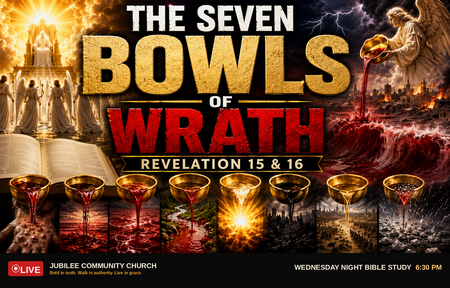
THE SEVEN BOWLS OF WRATH—Revelation 15-16
THE SEVEN BOWLS OF WRATH—Revelation 15-16
1 Then I saw another sign in heaven, great and amazing, seven angels with seven plagues, which are the last, for with them the wrath of God is finished.
INTRODUCTION
INTRODUCTION
The vision of the seven bowls represents the final judgments of God before Christ's return. Revelation 15 provides the heavenly prelude—the saints singing victory, the temple filled with God's presence, and the bowls being prepared. Revelation 16 unfolds the actual pouring of these judgments upon the earth. In a post-tribulation framework, these bowls occur during the final phase of the tribulation, representing God's complete and terrible judgment against those who have rejected Christ and worshipped the beast.
I. THE HEAVENLY VISION AND PREPARATION
I. THE HEAVENLY VISION AND PREPARATION
Revelation 15:1–4 “1 Then I saw another sign in heaven, great and amazing, seven angels with seven plagues, which are the last, for with them the wrath of God is finished. 2 And I saw what appeared to be a sea of glass mingled with fire—and also those who had conquered the beast and its image and the number of its name, standing beside the sea of glass with harps of God in their hands. 3 And they sing the song of Moses, the servant of God, and the song of the Lamb, saying, “Great and amazing are your deeds, O Lord God the Almighty! Just and true are your ways, O King of the nations! 4 Who will not fear, O Lord, and glorify your name? For you alone are holy. All nations will come and worship you, for your righteous acts have been revealed.””
A. The Song of the Overcomers (15:1-4)
A. The Song of the Overcomers (15:1-4)
The vision of seven angels with seven plagues (15:1)
Greek: (plague, stroke, wound)—emphasizes the severity and direct impact of God's judgmentplēgē
These are described as the "last" plagues, indicating finality
Those who had conquered the beast singing the Song of Moses and the Lamb (15:2-3)
The "Song of Moses" recalls Exodus 15:1-18, God's deliverance at the Red Sea
: Who are these overcomers? Pre-trib view sees them as raptured saints; post-trib view sees them as tribulation saints who refused the mark and survived to this pointTheological controversy
Scripture interprets Scripture: Compare with Revelation 7:9-17 (the great multitude from the tribulation) and 20:4 (those beheaded for the witness of Jesus)
The Lamb's victory is already assured; the bowls are judgment against those who rejected Him
The content of their song emphasizes God's justice and holiness
"Just and true are your ways, O King of the nations" (15:3)
Hebrew concept of (righteousness/justice)—God's judgments are not arbitrary but righteous (tzedakah).
B. The Temple Filled with God's Glory
B. The Temple Filled with God's Glory
Revelation 15:5–8 “5 After this I looked, and the sanctuary of the tent of witness in heaven was opened, 6 and out of the sanctuary came the seven angels with the seven plagues, clothed in pure, bright linen, with golden sashes around their chests. 7 And one of the four living creatures gave to the seven angels seven golden bowls full of the wrath of God who lives forever and ever, 8 and the sanctuary was filled with smoke from the glory of God and from his power, and no one could enter the sanctuary until the seven plagues of the seven angels were finished.”
The tabernacle of witness opened in heaven (15:5)
Greek: —the tent of testimonyskēnē tēs martyrias
This recalls the earthly tabernacle and emphasizes God's covenant faithfulness
Seven angels emerging from the temple with the seven bowls (15:6-7)
They are clothed in linen, pure and spotless
Given golden bowls full of God's wrath
Greek: (wrath, fierce anger)—not mere displeasure but divine judgment against sinthymos
The temple filled with smoke from God's glory (15:8)
No one can enter until the plagues are finished
: God's judgment is complete and unstoppable; mercy is suspendedTheological significance
Parallel: Isaiah 6:4, where the temple is filled with smoke and the foundations shake
II. THE SEVEN BOWLS POURED OUT
II. THE SEVEN BOWLS POURED OUT
A. Overview and Structure
A. Overview and Structure
The seven bowls parallel the seven trumpets (Revelation 8-9) and seals (Revelation 6), but with intensified judgment:
Seals: Introduce the judgments
Trumpets: One-third of creation affected
Bowls: Complete devastation; full wrath of God
B. The First Bowl—Painful Sores (16:1-2)
B. The First Bowl—Painful Sores (16:1-2)
"The first angel went and poured out his bowl on the earth, and harmful and painful sores came upon the people who had the mark of the beast and who worshipped its image" (16:2, ESV)
The command to pour comes from the temple (16:1)
This is God's direct mandate for judgment
The sores affect those with the mark of the beast
Greek: (sore, ulcer)—a painful, festering woundhelos
: Are these literal sores or symbolic of spiritual corruption?Theological controversy
Post-trib perspective: These are literal judgments upon those who have received the mark (Revelation 13:16-17)
Scripture interprets Scripture: Compare with the plagues of Egypt (Exodus 9:8-12), where boils afflicted those who rejected God
C. The Second Bowl—The Sea Turns to Blood (16:3)
C. The Second Bowl—The Sea Turns to Blood (16:3)
"The second angel poured out his bowl into the sea, and it became like the blood of a corpse, and every living thing died that was in the sea" (16:3, ESV)
Complete destruction of sea life
Greek: (dead)—emphasizes the totality of deathnecros
Parallel to the first trumpet (8:8-9), but more complete
Theological significance: The sea, representing chaos and separation, becomes an instrument of death
Revelation 21:1 promises "no more sea" in the new creation, linking judgment to restoration
D. The Third Bowl—Rivers and Springs Turn to Blood (16:4-7)
D. The Third Bowl—Rivers and Springs Turn to Blood (16:4-7)
"The third angel poured out his bowl into the rivers and the springs of water, and they became blood" (16:4, ESV)
Complete contamination of fresh water
No water for drinking; all water sources are blood
Parallel to the first plague of Egypt (Exodus 7:17-21)
The angel's declaration of God's justice (16:5-7)
"You are just in these judgments, O Holy One, you who are and who were" (16:5)
Greek: (just, righteous)—emphasizes the moral character of God's judgmentdikaios
The response: "Yes, Lord God the Almighty, true and just are your judgments!" (16:7)
: Even in judgment, God is righteous; those who suffer deserve itTheological significance
Controversial interpretation: Some argue these are entirely symbolic (representing spiritual thirst), but the post-trib view sees them as literal, physical judgments upon the earth during the final tribulation period
E. The Fourth Bowl—Scorching Heat from the Sun (16:8-9)
E. The Fourth Bowl—Scorching Heat from the Sun (16:8-9)
"The fourth angel poured out his bowl on the sun, and it was allowed to scorch people with fire. They were scorched by the fierce heat, and they cursed the name of God who had power over these plagues" (16:8-9, ESV)
The sun's power intensified
Greek: (to burn, to scorch)—severe, destructive burningkaio
This may relate to increased solar radiation or divine intensification of the sun's heat
The response of mankind: "They did not repent and give him glory" (16:9)
: By this point in the tribulation, human hearts are hardened beyond repentanceTheological significance
Parallel: Pharaoh's hardened heart during the Egyptian plagues (Exodus 8-10)
Greek: (repentance, turning around)—they refuse to turn from their rebellionmetanoia
Controversial point: Some theologians question whether literal solar intensification is possible; others argue God's power transcends natural law
F. The Fifth Bowl—Darkness Over the Beast's Kingdom (16:10-11)
F. The Fifth Bowl—Darkness Over the Beast's Kingdom (16:10-11)
"The fifth angel poured out his bowl on the throne of the beast, and its kingdom was plunged into darkness. People gnawed their tongues in anguish and cursed the God of heaven because of their pains and their sores, but they did not repent of their deeds" (16:10-11, ESV)
Darkness over the beast's throne and kingdom
Greek: (darkness)—spiritual and physical darknessskotos
Parallel to the ninth plague of Egypt (Exodus 10:21-29)
Intense suffering: "People gnawed their tongues in anguish"
Greek: (to scourge, to torment)—extreme painmastigizomai
This is visceral and physical, not merely symbolic
Persistent rebellion: "They did not repent"
By the fifth bowl, those who have chosen the beast are beyond turning back
: This reflects the hardening of hearts described in Romans 1:24-32Theological significance
G. The Sixth Bowl—The Euphrates Dries Up (16:12-16)
G. The Sixth Bowl—The Euphrates Dries Up (16:12-16)
"The sixth angel poured out his bowl on the great river Euphrates, and its water was dried up to prepare the way for the kings from the east" (16:12, ESV)
The drying of the Euphrates
Historically, the Euphrates was a barrier between the Roman Empire and Eastern kingdoms
: Is this literal drying or symbolic removal of barriers?Theological controversy
Post-trib view: Literal drying to allow eastern armies to march toward Armageddon
The rise of demonic deception (16:13-14)
"I saw three unclean spirits like frogs coming out of the mouth of the dragon and out of the mouth of the beast and out of the mouth of the false prophet" (16:13, ESV)
Greek: (frog)—these demonic spirits are described as frog-likebatrachos
: This echoes the plague of frogs in Egypt (Exodus 8:1-15)Theological significance
These spirits perform signs and gather the kings for battle
The gathering at Armageddon (16:14-16)
"They are demonic spirits, performing signs, who go abroad to the kings of the whole world, to gather them for battle on the great day of God the Almighty" (16:14, ESV)
Greek: ()—"the mountain of Megiddo," a location in northern PalestineArmageddonHar-Megiddo
: This is the final gathering of nations against Christ and His peopleTheological significance
"Behold, I am coming like a thief! Blessed is the one who stays awake" (16:15)—a parenthetical call to vigilance
Major theological controversy: Pre-trib and mid-trib views place Armageddon after the rapture; post-trib view sees it as the climactic battle immediately preceding or accompanying Christ's return
Scripture interprets Scripture: Compare with Zechariah 14 (the final battle and Christ's return), Revelation 19:11-21 (Christ's return and the defeat of the beast and false prophet), and Revelation 20:7-10 (Gog and Magog after the millennium)
H. The Seventh Bowl—The Great Earthquake and Hail (16:17-21)
H. The Seventh Bowl—The Great Earthquake and Hail (16:17-21)
"The seventh angel poured out his bowl into the air, and a loud voice came out of the temple, from the throne, saying, 'It is done!'" (16:17, ESV)
The final judgment is announced as complete
Greek: (it is done, it has happened)—finality and completionginomai
The cosmic destruction (16:18-20)
A great earthquake such as has never been before
Greek: (earthquake, shaking)—the entire cosmos is shakenseismos
"The great city was split into three parts, and the cities of the nations fell, and God remembered Babylon the great, to make her drain the cup of the wine of the fury of his wrath" (16:19, ESV)
: All earthly kingdoms fall; Babylon (the worldly system opposed to God) receives full judgmentTheological significance
Massive hailstones (16:21)
"And great hailstones, about one hundred pounds each, fell from heaven on people" (16:21, ESV)
Greek: (hailstone)—again echoing the Egyptian plague (Exodus 9:22-26)chalazon
: The weight is specified as "about one hundred pounds"; some question whether this is literal or hyperbolicControversial interpretation
The final response: "They cursed God because the plague of the hail was so severe" (16:21)
Even facing absolute destruction, hearts remain hardened
: This demonstrates the complete depravity and rebellion of those who have rejected ChristTheological significance
III. MAJOR THEOLOGICAL CONTROVERSIES AND RESOLUTION
III. MAJOR THEOLOGICAL CONTROVERSIES AND RESOLUTION
A. Literal vs. Symbolic Interpretation
Controversy: Are the bowls literal physical judgments or spiritual/symbolic representations?
: The bowls represent spiritual realities—sores symbolize spiritual corruption, blood represents death, darkness represents spiritual blindnessSymbolic view
: The text describes physical, material judgments upon the earth and its inhabitantsLiteral view
: Scripture supports a hybrid approach—the judgments are real and tangible, but they carry spiritual significance. The parallels to Egyptian plagues suggest literal manifestations of God's powerPost-trib perspective
: Revelation 16:2 specifically states the sores come "upon the people who had the mark of the beast," indicating a physical condition affecting specific individuals. The specificity suggests literalityScripture interpreting Scripture
B. The Timing of the Bowls in Eschatology
B. The Timing of the Bowls in Eschatology
Controversy: When do the bowls occur relative to Christ's return and the rapture?
: The bowls occur during the tribulation after the church is rapturedPre-trib view
: The bowls occur in the second half of the tribulation after a mid-point raptureMid-trib view
: The bowls are the final phase of the tribulation, occurring immediately before Christ's return, with the church present and protected through these judgmentsPost-trib view
: Revelation 3:10 ("I will keep you from the hour of trial") and 1 Thessalonians 5:9 ("God has not destined us for wrath") must be understood as God keeping believers trials, not them. Believers are protected from God's wrath (the bowls), but experience tribulation at the hands of the world system and the beast. The bowl judgments fall upon those "who had the mark of the beast" (16:2), not upon believersPost-trib resolutionthroughfrom
C. Relationship to Earlier Judgments
C. Relationship to Earlier Judgments
Controversy: How do the bowls relate to the seals and trumpets?
: All three series describe the same events from different perspectivesRecapitulation view
: Seals, trumpets, and bowls occur in chronological orderSequential view
: Each series escalates in severity—seals introduce, trumpets intensify, bowls complete God's judgmentIntensification view
: The intensification view best fits the text. The trumpets affect one-third (8:7, 8:8, 8:10, 9:18), while the bowls are complete devastation. This progression aligns with the increasing rebellion and hardening of heartsPost-trib perspective
IV. CONCLUSION: THE TRIUMPH OF CHRIST
IV. CONCLUSION: THE TRIUMPH OF CHRIST
Though Revelation 15-16 describe terrible judgments, they reveal a fundamental truth: God is sovereign, righteous, and in complete control. Those who have rejected Christ face His wrath, while those who trust in Him are kept by His power. The bowls represent the final, complete expression of God's judgment against rebellion, clearing the way for Christ's return and the establishment of His eternal kingdom.
"It is done!" declares the seventh angel, and with that pronouncement, the age of grace ends and the age of judgment gives
LOOKING AHEAD: NEXT WEEK'S STUDY—REVELATION 17: THE GREAT HARLOT AND THE SCARLET BEAST
LOOKING AHEAD: NEXT WEEK'S STUDY—REVELATION 17: THE GREAT HARLOT AND THE SCARLET BEAST
Next week, we turn from the bowl judgments to one of the most debated chapters in all of Revelation—the vision of "Babylon the great, mother of prostitutes" (17:5, ESV).
A Brief Preview
The Vision Introduced (17:1-2)
An angel invites John to see "the judgment of the great prostitute who is seated on many waters" (17:1)
Greek: (prostitute, harlot)—used throughout Scripture to depict spiritual unfaithfulness and idolatry (compare Hosea 1-3, Ezekiel 16, Ezekiel 23)pornē
The kings of the earth have committed sexual immorality with her—Greek: , tied to , emphasizing covenant unfaithfulness, not merely literal immoralityporneuōpornē
The Woman and the Beast (17:3-6)
She sits on a scarlet beast with seven heads and ten horns, "full of blasphemous names" (17:3)
Arrayed in purple and scarlet, adorned with gold, jewels, and pearls—outward splendor masking corruption
She holds "a golden cup full of abominations" (17:4)
She is drunk "with the blood of the saints, the blood of the martyrs of Jesus" (17:6)
: Who or what is this woman? Views include apostate religious Babylon, the city of Rome, a future revived global economic-religious system, or Jerusalem itself. We'll let Scripture interpret Scripture—comparing chapters 17 and 18, along with Old Testament Babylon typology (Isaiah 13-14, Jeremiah 50-51)—to weigh each view.Major controversy we'll address
The Angel's Explanation (17:7-18)
The beast "was, and is not, and is about to rise from the bottomless pit" (17:8)—language that has generated significant debate about its identity and timing
Greek: (abyss, bottomless pit)—same term used for the abode of demonic forces elsewhere in Revelationabyssos
The seven heads are explained as both mountains and kings (17:9-10)—we'll examine the historical and symbolic layers here
The ten horns are ten kings who receive authority "for one hour" and give it to the beast (17:12-13)—their united purpose is to make war on the Lamb, "and the Lamb will conquer them, for he is Lord of lords and King of kings" (17:14)
The beast and the ten horns ultimately turn on the harlot and destroy her (17:16)—God sovereignly using evil to accomplish His purposes (17:17)
Questions We'll Wrestle With Scripturally
Is Babylon a literal city, a religious system, an economic system, or all three?
How does the beast's identity connect to earlier visions in Daniel 7 and Revelation 13?
What does it mean that the beast "was, and is not, and is about to rise"?
How does this fit within our post-tribulation framework as we move toward Christ's return in chapter 19?
This sets the stage beautifully for chapter 18's lament over Babylon's fall and chapter 19's triumphant return of Christ. Come ready to dig deep into the Word.
