FROM BEHIND THE VEIL (21)
Notes
Transcript
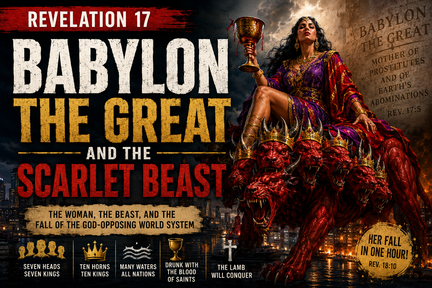
BIBLE STUDY: BABYLON THE GREAT AND THE SCARLET BEAST—Revelation 17
BIBLE STUDY: BABYLON THE GREAT AND THE SCARLET BEAST—Revelation 17
INTRODUCTION
INTRODUCTION
Revelation 17 pulls back the curtain on one of the most debated figures in all of prophecy: "Babylon the great, mother of prostitutes and of earth's abominations" (17:5, ESV). Before we get to the vision itself, we need to wrestle honestly with who this woman represents — because how we answer that question shapes how we read chapters 17-19 and the final judgment of the world system opposed to Christ.
I. THE VISION INTRODUCED (17:1-6)
I. THE VISION INTRODUCED (17:1-6)
A. The Invitation to See Judgment (17:1-2)
A. The Invitation to See Judgment (17:1-2)
"Then one of the seven angels who had the seven bowls came and said to me, 'Come, I will show you the judgment of the great prostitute who is seated on many waters, with whom the kings of the earth have committed sexual immorality, and with whose sexual immorality the earth-dwellers have become drunk.'" (17:1-2, ESV)
This vision is explicitly tied to the bowl judgments — one of the seven bowl angels shows John this scene, connecting chapter 17 directly to what we studied in chapters 15-16
Greek: (prostitute, harlot) — used throughout the Old Testament for covenant unfaithfulness and idolatry, not merely literal sexual sin
pornē
Compare Hosea 1-3 (Israel as an unfaithful wife), Ezekiel 16:15-34, Ezekiel 23:1-21 (Samaria and Jerusalem called harlots for idolatry and foreign alliances), Isaiah 1:21 ("How the faithful city has become a whore!")
Greek: (committed sexual immorality) — the kings of the earth are said to have "committed sexual immorality" with her — again, this is covenant language for compromising alliance and idolatry, not literal fornicationporneuō
"Seated on many waters" — explained later in the chapter itself (17:15) as "peoples and multitudes and nations and languages" — Scripture interprets Scripture here without us needing outside sources
B. The Woman on the Beast (17:3-6)
B. The Woman on the Beast (17:3-6)
"And he carried me away in the Spirit into a wilderness, and I saw a woman sitting on a scarlet beast that was full of blasphemous names, and it had seven heads and ten horns." (17:3, ESV)
The beast is scarlet, "full of blasphemous names" — this is the same beast introduced in Revelation 13:1, confirming this woman rides upon, and is intimately tied to, the end-times world power
Her appearance: "arrayed in purple and scarlet, and adorned with gold and jewels and pearls, holding in her hand a golden cup full of abominations and the impurities of her sexual immorality" (17:4)
Greek: (abomination) — the same word used in Daniel 9:27 and Daniel 11:31 for the "abomination of desolation," tying this figure to the broader pattern of end-times apostasy and defilementbdelygma
Outward splendor masking inward corruption — a consistent biblical pattern (compare Ezekiel 28:12-17, the king of Tyre; Matthew 23:27, "whitewashed tombs")
"And on her forehead was written a name of mystery: 'Babylon the great, mother of prostitutes and of earth's abominations.'" (17:5)
Greek: (mystery) — not something incomprehensible, but something previously hidden that is now being disclosed and explained (the same word Paul uses for the church in Ephesians 3:3-6). John himself will be given the interpretation in verses 7-18mystērion
"And I saw the woman, drunk with the blood of the saints, the blood of the martyrs of Jesus." (17:6)
This woman is a persecuting power, responsible for shedding the blood of believers — a critical identifying detail we'll return to
II. WHO IS BABYLON? — WHAT OTHERS SAY
II. WHO IS BABYLON? — WHAT OTHERS SAY
This is one of the most contested questions in eschatology. Let's lay out the major views honestly before weighing them against the text.
A. View 1: Babylon = Ancient Pagan Rome
A. View 1: Babylon = Ancient Pagan Rome
Many historic and preterist interpreters (going back to the early church) identify Babylon with the Roman Empire of John's own day.
Support offered: Revelation 17:9 says the seven heads are "seven mountains on which the woman is seated" — Rome was famously built on seven hills. Revelation 17:18 calls her "the great city that has dominion over the kings of the earth," which fit imperial Rome in the first century.
Weakness: This view struggles to explain how a city destroyed and judged in the text (17:16; 18:8-10, 21) could refer to Rome, since pagan Rome as an empire gradually declined rather than being suddenly and catastrophically destroyed in a single hour as Revelation 18:10, 17, 19 describes ("in one hour"). It also doesn't account for the beast's future dimension (17:8, "was, and is not, and is about to rise") if the beast is meant to be a contemporary Roman emperor only.
B. View 2: Babylon = Apostate/False Religious System (often identified with the Roman Catholic Church or a future one-world religion)
B. View 2: Babylon = Apostate/False Religious System (often identified with the Roman Catholic Church or a future one-world religion)
This has been a common Protestant reading historically, especially since the Reformation.
Support offered: The woman's wealth, purple and scarlet clothing, and golden cup have been compared to ecclesiastical vestments and ritual objects. Her being "drunk with the blood of the saints" (17:6) is applied to historic religious persecution.
Weakness: This reading is often driven by historical polemics between Protestants and Catholics rather than the text itself, and it requires reading centuries of church history into a first-century apocalyptic vision rather than letting the text's own explanatory verses (17:9-18) govern the interpretation.
C. View 3: Babylon = A Future Rebuilt Literal City of Babylon
C. View 3: Babylon = A Future Rebuilt Literal City of Babylon
Some futurists argue for a literal, rebuilt city of Babylon in Iraq as the end-times economic and religious capital.
Support offered: The name itself is Babylon, and Old Testament prophecies against literal Babylon (Isaiah 13, Jeremiah 50-51) describe a destruction so total it hasn't been literally fulfilled yet in history — some argue this points to a still-future, literal fulfillment.
Weakness: Isaiah 13:19-22 describes Babylon as never being inhabited again, "from generation to generation" — this reads more like a permanent desolation already substantially fulfilled over the centuries since ancient Babylon's fall, not a city requiring a future rebuilding, prominence, and re-destruction.
D. View 4: Babylon = A Global End-Times Economic-Religious-Political System
D. View 4: Babylon = A Global End-Times Economic-Religious-Political System
Many contemporary scholars, without locating "Babylon" in one city or church, see her as symbolic of the entire end-times world system — commercial, political, and religious — that opposes God and exalts itself in the beast's final kingdom.
Support offered: Revelation 18's extended lament (which we'll study in two weeks) describes merchants, shipmasters, and kings grieving Babylon's fall over massive trade losses (18:11-19), which reads more like a global economic-commercial system than a single religious institution or ancient city.
This view has the advantage of letting both the religious imagery of chapter 17 (harlotry, idolatry) and the economic imagery of chapter 18 (commerce, luxury goods) coexist as different facets of the same corrupt, God-opposing world system in the last days.
III. WHAT SCRIPTURE SAYS — LETTING THE TEXT INTERPRET ITSELF
III. WHAT SCRIPTURE SAYS — LETTING THE TEXT INTERPRET ITSELF
Rather than importing a theory, we have the advantage that Revelation 17 explains its own symbols. Let's walk through what the angel tells John directly.
A. The Seven Heads (17:9-11)
A. The Seven Heads (17:9-11)
"This calls for a mind with wisdom: the seven heads are seven mountains on which the woman is seated, and they are seven kings, five of whom have fallen, one is, the other has not yet come, and when he does come he must remain only a little while. As for the beast that was and is not, it is an eighth but it belongs to the seven, and it goes to destruction." (17:9-11, ESV)
The text itself gives a dual meaning: mountains kings — this is deliberately layered symbolism, not simple literalismand
Greek: (mountain) — while this can be literal, it's also frequently used symbolically in prophetic literature for kingdoms or centers of power (compare Daniel 2:35, where the stone that crushes the kingdoms "became a great mountain and filled the whole earth" — clearly symbolic of an all-encompassing kingdom, not a literal mountain)oros
The "kings" language points to successive world empires/rulers throughout history culminating in a final one — this fits the pattern already established in Daniel 2 and Daniel 7, where a succession of world empires precedes the final kingdom of Christ
B. The Ten Horns (17:12-14)
B. The Ten Horns (17:12-14)
"And the ten horns that you saw are ten kings who have not yet received royal power, but they are to receive authority as kings for one hour, together with the beast. These are of one mind, and they hand over their power and authority to the beast. They will make war on the Lamb, and the Lamb will conquer them, for he is Lord of lords and King of kings, and those with him are called and chosen and faithful." (17:12-14, ESV)
These are explicitly future ("have not yet received royal power") from John's vantage point — a final confederation of rulers who unite under the beast for a brief, decisive period ("one hour")
Their singular purpose is warfare against Christ Himself — this ties directly into the Armageddon narrative we previewed last week and will see fulfilled in Revelation 19:11-21
The outcome is never in doubt: "the Lamb will conquer them" — present in the text before the battle is even narrated, emphasizing certainty rather than suspense
C. The Waters (17:15)
C. The Waters (17:15)
"And the angel said to me, 'The waters that you saw, where the prostitute is seated, are peoples and multitudes and nations and languages.'" (17:15, ESV)
The text explicitly, directly interprets this symbol for us — no guesswork required. Babylon's influence and dominion extends over all peoples, not a single ethnic or geographic group, supporting a global rather than merely local scope.
D. The Beast Turns on the Harlot (17:16-17)
D. The Beast Turns on the Harlot (17:16-17)
"And the ten horns that you saw, they and the beast will hate the prostitute. They will make her desolate and naked, and devour her flesh and burn her up with fire, for God has put it into their hearts to carry out his purpose by being of one mind and handing over their royal power to the beast, until the words of God are fulfilled." (17:16-17, ESV)
This is a critical detail: the beast and the harlot are not identical — they are distinct, and the beast turns against and destroys her. This argues against identifying Babylon as simply the beast's kingdom itself; she is something the beast uses and then discards
Greek: (make desolate) — the same word family used of Jerusalem's desolation in Luke 21:20 and of the abomination of desolation in Matthew 24:15erēmoō
Notice the theology here: even the beast's betrayal of the harlot happens because "God has put it into their hearts" — total divine sovereignty over the unfolding of evil's self-destruction, echoing how God used Assyria and Babylon in the Old Testament as instruments of judgment while still being accountable for their own sin (compare Isaiah 10:5-7)
E. The Final Identification (17:18)
E. The Final Identification (17:18)
"And the woman that you saw is the great city that has dominion over the kings of the earth." (17:18, ESV)
The chapter closes with the plainest statement in the text: she is "the great city." This is the anchor point for chapter 18's lament, which we'll study next.
IV. WEIGHING THE VIEWS BIBLICALLY
IV. WEIGHING THE VIEWS BIBLICALLY
Given the text's own explanations, here's how I'd weigh what we've covered:
: The beast is explicitly future-oriented (17:8, "is about to rise from the bottomless pit"), and the final destruction described (17:16; 18:8-10) doesn't match how pagan Rome's empire actually declined historically over centuries — it describes sudden, total judgment in "one hour" (18:10, 17, 19)Against a purely past/preterist Rome-only view
: The text's own interpretive keys (17:9-10, 15, 18) point to something civilizational and global — "peoples and multitudes and nations and languages" — not a single denomination or historical religious institutionAgainst a merely "any one church" view
: While not impossible, the text's own symbolism (mountains representing kings, waters representing all peoples) suggests we're dealing with something bigger than geography — a system with a center, but a reach that is worldwideAgainst a strictly literal rebuilt-Babylon-only view
: Babylon represents the final, global, God-opposing world system — economic, political, and religious — that reaches its climax in the last days, working in tandem with (but ultimately used and discarded by) the beast's kingdom, before being utterly destroyed by God's judgment (17:17; 18:8) in preparation for Christ's return in chapter 19Most consistent with the text
The text doesn't require us to pick a single ancient or modern institution and force everything onto it. It gives us controlled, self-interpreting symbols (17:9, 15, 18) that describe something with the reach and character of "the great city" over "all nations" — language most consistent with a final, comprehensive world system rather than one city, empire, or church in history.
V. LOOKING AHEAD: REVELATION 18 — THE FALL OF BABYLON
V. LOOKING AHEAD: REVELATION 18 — THE FALL OF BABYLON
Next week we'll see this system's sudden and total collapse — the mourning of kings, merchants, and shipmasters who profited from her, and heaven's call to "Come out of her, my people" (18:4). We'll examine what it means for believers today to heed that call before her judgment falls.
