FROM BEHIND THE VEIL (22)
Notes
Transcript
THE FALL OF BABYLON
THE FALL OF BABYLON
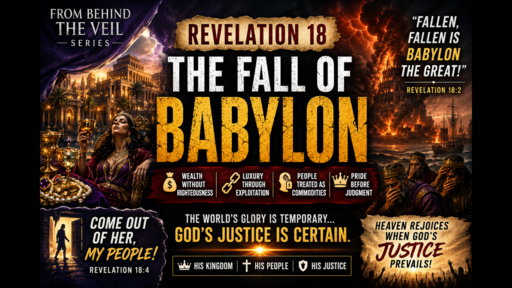
Revelation 18 describes the final judgment of Babylon, a symbol of the world’s corrupt religious, political, economic, and cultural systems opposed to God. Babylon appears powerful, wealthy, and secure, but her prosperity is temporary and her judgment is certain.
The chapter calls God’s people to separate themselves from Babylon’s sins, reject the worship of wealth and power, and trust in God’s final justice.
“Fallen, fallen is Babylon the great!” — Revelation 18:2
“Fallen, fallen is Babylon the great!” — Revelation 18:2
INTRODUCTION TO REVELATION 18
INTRODUCTION TO REVELATION 18
Revelation 17 and 18 describe Babylon from two related perspectives:
Revelation 17 presents Babylon as a corrupting religious and political power.
Revelation 18 emphasizes Babylon’s economic influence, luxury, exploitation, and opposition to God.
Babylon is connected to the ancient city of Babylon, which represented pride, idolatry, rebellion, and opposition to God. In Revelation, Babylon becomes a symbol of the organized systems of the world that exalt human power and prosperity above the Lord.
The chapter does not condemn every form of commerce, wealth, or government. Instead, it exposes a system in which wealth is pursued without righteousness, luxury is enjoyed through exploitation, and people are valued according to their usefulness or economic worth.
THE ANNOUNCEMENT OF BABYLON’S FALL
THE ANNOUNCEMENT OF BABYLON’S FALL
Revelation 18:1–3
John sees another angel descending from heaven. The angel has great authority, and the earth is illuminated by his glory. The angel announces Babylon’s downfall with the words:
“Fallen, fallen is Babylon the great!” — Revelation 18:2, ESV
The repetition emphasizes the certainty and completeness of Babylon’s judgment. Babylon’s fall is not a possibility or a warning that may be avoided. It is a divine sentence that will surely be carried out.
BABYLON BECOMES A DWELLING PLACE FOR EVIL
BABYLON BECOMES A DWELLING PLACE FOR EVIL
The angel declares that Babylon has become:
- A dwelling place for demons
- A haunt for every unclean spirit
- A haunt for every unclean bird
- A haunt for every unclean and detestable beast
This language communicates desolation and uncleanness. The city that once appeared attractive and desirable is revealed to be spiritually polluted.
Babylon’s external glory conceals internal corruption. What appears impressive to the world is exposed by God as spiritually ruined.
BABYLON’S INFLUENCE OVER THE NATIONS
BABYLON’S INFLUENCE OVER THE NATIONS
The nations have been influenced by Babylon’s immorality, and the kings of the earth have participated in her corruption. The merchants of the earth have become wealthy through her excessive luxury.
Babylon’s influence is therefore widespread. Her corruption affects:
- Nations
- Political leaders
- Business interests
- Cultural values
- Economic priorities
Babylon demonstrates that worldly influence is not the same as godly approval. A system may be powerful, prosperous, and admired while being deeply opposed to God.
The passage calls for spiritual discernment. God’s people must learn to distinguish between what the world celebrates and what God approves.
THE CALL FOR GOD’S PEOPLE TO COME OUTT
THE CALL FOR GOD’S PEOPLE TO COME OUTT
Revelation 18:4–8
Another voice from heaven gives a direct command:
“Come out of her, my people, lest you take part in her sins, lest you share in her plagues.” — Revelation 18:4, ESV
This command is central to the chapter. God’s people are called to separate themselves from Babylon’s sins before her judgment is revealed in full.
What Does It Mean to Come Out?
The command does not require physical isolation from society. Christians are called to live faithfully in the world while refusing to adopt its sinful values.
To come out of Babylon means:
- Rejecting idolatry
- Resisting materialism
- Refusing immoral compromise
- Rejecting pride and self-sufficiency
- Refusing to benefit from injustice
- Remaining loyal to God’s kingdom
Separation from Babylon is primarily spiritual and moral. God’s people must not allow Babylon’s priorities to shape their worship, desires, decisions, or identity.
BABYLON’S SIN HAVE REACHED HEAVEN
BABYLON’S SIN HAVE REACHED HEAVEN
The voice declares:
“For her sins are heaped high as heaven, and God has remembered her iniquities.” — Revelation 18:5, ESV
God has not overlooked Babylon’s sin. He sees the corruption, exploitation, violence, and persecution associated with her system.
The phrase “God has remembered” does not imply that God had forgotten. In Scripture, God’s remembering often indicates that He is about to act in judgment or deliverance.
BABYLON’S PRIDE
BABYLON’S PRIDE
Babylon has glorified herself and lived in luxury. She says in her heart:
“I sit as a queen, I am no widow, and mourning I shall never see.” — Revelation 18:7, ESV
Babylon’s confidence is rooted in pride. She believes that her position is permanent and that suffering will never reach her.
Her security is an illusion. God declares that her plagues will come in a single day.
Pride blinds people and institutions to their need for God. Babylon assumes that wealth and influence guarantee security, but Revelation 18 demonstrates that no human system can protect itself from divine judgment.
THE KINGS MOURN BABYLON’S DESTRUCTION
THE KINGS MOURN BABYLON’S DESTRUCTION
Revelation 18:9–10
The kings of the earth mourn Babylon’s fall because they have participated in her immorality and luxury. They see the smoke of her burning and stand at a distance because they fear her torment.
They cry:
“Alas! Alas! You great city, you mighty city, Babylon! For in a single hour your judgment has come.” — Revelation 18:10, ESV
MORNING FROM A DISTANCE
MORNING FROM A DISTANCE
The kings do not intervene to rescue Babylon. They stand at a distance, recognizing that her destruction is overwhelming and irreversible.
Their sorrow appears to focus primarily on the loss of Babylon’s power and influence rather than on the sin that brought about her judgment.
People may regret the consequences of sin without truly repenting of the sin itself. Babylon’s allies mourn the loss of what benefited them, but there is no indication that they mourn the evil that corrupted the city.
This raises an important spiritual question: Is sorrow directed toward sin, or merely toward the loss of comfort, profit, status, and security?
THE MERCHANTS MOURN THE LOSS OF WEALTH
THE MERCHANTS MOURN THE LOSS OF WEALTH
Revelation 18:11–17a
The merchants of the earth weep and mourn because no one buys their cargo anymore. Their grief is connected to the collapse of Babylon’s economic system.
The passage lists a wide range of goods, including:
- Gold and silver
- Precious stones and pearls
- Fine clothing
- Expensive wood and furniture
- Precious metals
- Spices and perfumes
- Wine and oil
- Fine food
- Animals and transportation
- Slaves and human souls
The list illustrates Babylon’s extraordinary wealth and luxury. It also reveals the breadth of the economic system connected to her.
THE COMMODIFICATION OF HUMAN BEINGS
THE COMMODIFICATION OF HUMAN BEINGS
The final items in the list are particularly sobering:
“slaves, that is, human souls.” — Revelation 18:13, ESV
Human beings are included among Babylon’s commercial goods. This reveals the moral bankruptcy of the system. People are treated as commodities rather than as persons created in the image of God.
Babylon’s problem is not simply that she possesses wealth. Her problem is that she pursues wealth through exploitation and places material gain above human dignity.
A society’s treatment of people reveals its spiritual condition. Whenever profit, power, or convenience becomes more important than human life and dignity, the values of Babylon are present.
The church must affirm that people are not products, tools, statistics, or resources. Every human being possesses value because every human being is created by God.
THE LOSS OF LUXURY AND DESIRE
THE LOSS OF LUXURY AND DESIRE
Revelation 18:14–17a
The merchants declare that Babylon’s luxury has disappeared:
“The fruit for which your soul longed has gone from you.” — Revelation 18:14, ESV
This statement reveals more than the loss of possessions. It exposes the desires of the human heart. Babylon has taught people to long for luxury as though it were the source of life and satisfaction.
The possessions of Babylon are temporary. They can disappear suddenly, leaving those who trusted in them empty and helpless.
THE DANGER OF DISORDERED DESIRE
THE DANGER OF DISORDERED DESIRE
The Bible does not teach that every material possession is evil. However, Revelation 18 exposes what happens when possessions become objects of worship.
Disordered desire occurs when people:
- Desire wealth more than wisdom
- Pursue comfort more than holiness
- Value possessions more than people
- Seek status more than faithfulness
- Trust in financial security more than God
The issue is not only what people possess but what possesses them. Material wealth becomes spiritually dangerous when it controls the heart and determines a person’s identity, purpose, and security.
THE SAILORS MOURN BABYLON’S FALL
THE SAILORS MOURN BABYLON’S FALL
Revelation 18:17b–19
The sailors, shipmasters, and all who work at sea join the mourning. They see the smoke of Babylon’s burning and cry out because the city that made them wealthy has been destroyed.
They repeat the same lament:
“What city was like the great city?” — Revelation 18:18, ESV
They recognize Babylon’s greatness, but they do not recognize her righteousness. Her uniqueness is measured by her wealth and economic power rather than by her faithfulness to God.
THE SADNESS OF JUDGEMENT
THE SADNESS OF JUDGEMENT
The phrase “in a single hour” appears repeatedly in this section. It emphasizes how quickly Babylon’s prosperity comes to an end.
The city’s wealth, influence, and commercial strength cannot prevent its collapse. What took generations to build can be destroyed in an instant.
Earthly security is fragile. Systems that seem immovable can collapse quickly. Therefore, believers must build their lives on God’s Word and God’s kingdom rather than on temporary earthly structures.
HEAVEN REJOICES OVER GOD’S JUDGEMENT
HEAVEN REJOICES OVER GOD’S JUDGEMENT
Revelation 18:20
While the kings, merchants, and sailors mourn, heaven is commanded to rejoice:
“Rejoice over her, O heaven, and you saints and apostles and prophets, for God has given judgment for you against her!” — Revelation 18:20, ESV
This command reveals that Babylon’s judgment is not merely the destruction of an economic power. It is God’s response to the suffering and persecution of His people.
THE JUSTICE OF GOD
THE JUSTICE OF GOD
God’s judgment demonstrates that:
- Evil does not escape His notice
- Persecution will not continue forever
- Oppression will be answered
- The blood of God’s people matters to Him
- Human injustice will ultimately be judged
Heaven rejoices because God’s justice has been revealed. The judgment of Babylon confirms that God is righteous and that He will defeat every power opposed to Him.
God’s justice may seem delayed, but it is never absent. Believers can remain faithful because the Lord sees the suffering of His people and will ultimately make all things right.
BABYLON’S COMPLETE AND FINAL DESTRUCTION
BABYLON’S COMPLETE AND FINAL DESTRUCTION
Revelation 18:21–24
A mighty angel takes a stone like a great millstone and throws it into the sea. The angel declares that Babylon will be thrown down with great violence and will never be found again.
The image communicates finality. Babylon will not gradually recover or return to its former glory.
“Never Again”
The passage repeats the idea that Babylon’s former activities will cease:
- The sound of harpists and musicians will not be heard
- The sound of craftsmen will not be heard
- The sound of a millstone will not be heard
- The light of a lamp will not shine
- The voice of the bridegroom and bride will not be heard
These descriptions portray the complete removal of ordinary life, productivity, celebration, and joy.
Babylon once appeared full of activity and prosperity. In the end, she is silent, empty, and forgotten.
THE BLOOD OF THE SAINTS
THE BLOOD OF THE SAINTS
The final verse identifies the reason for Babylon’s judgment:
“And in her was found the blood of prophets and of saints, and of all who have been slain on earth.” — Revelation 18:24, ESV
Babylon’s corruption produces violence. Her rebellion against God leads to the persecution and death of God’s people.
Her judgment is therefore not arbitrary. It is the righteous response of God to sin, oppression, bloodshed, and persistent rebellion.
God will not permit evil to continue forever. The fall of Babylon assures believers that persecution, injustice, and violence will ultimately be defeated.
MAJOR THEMES IN REVELATION 18
MAJOR THEMES IN REVELATION 18
1. The Temporary Nature of Worldly Power
1. The Temporary Nature of Worldly Power
Babylon appears permanent, but her fall occurs in a single hour. Worldly power is temporary, while God’s kingdom is eternal.
2. The Deception of Wealth
2. The Deception of Wealth
Babylon’s wealth creates the illusion of security. Her prosperity does not protect her from judgment.
3. The Danger of Compromise
3. The Danger of Compromise
Babylon’s influence is seductive. God’s people are commanded to come out of her so that they do not participate in her sins.
4. The Dehumanizing Power of Greed
4. The Dehumanizing Power of Greed
The inclusion of human souls among Babylon’s merchandise exposes the destructive nature of greed and exploitation.
5. The Certainty of Divine Judgment
5. The Certainty of Divine Judgment
God’s judgment may appear delayed, but it is certain. Babylon’s fall demonstrates that no rebellion against God will endure forever.
6. The Hope of God’s Justice
6. The Hope of God’s Justice
Heaven rejoices because God judges Babylon on behalf of His people. God sees injustice and will ultimately vindicate those who remain faithful to Him.
APPLICATION
APPLICATION
Examine the Values That Shape the Heart
Examine the Values That Shape the Heart
Revelation 18 calls for an honest examination of personal values. Important questions include:
- What defines success?
- What provides security?
- What receives the greatest attention and affection?
- Is comfort more important than obedience?
- Is profit more important than people?
- Is popularity more important than faithfulness?
- Are possessions being used as gifts from God or worshiped as substitutes for God?
Resist the Spirit of Babylon
Resist the Spirit of Babylon
Christians are called to resist the values represented by Babylon:
- Pride
- Greed
- Immorality
- Materialism
- Exploitation
- Self-sufficiency
- Persecution
- Indifference to suffering
This resistance requires more than avoiding certain behaviors. It requires a transformed mind and a heart devoted to God’s kingdom.
Live as Citizens of God’s Kingdom
Live as Citizens of God’s Kingdom
The command to come out of Babylon is a call to live differently. God’s people should reflect:
- Humility rather than pride
- Generosity rather than greed
- Holiness rather than immorality
- Justice rather than exploitation
- Compassion rather than indifference
- Faithfulness rather than compromise
- Worship rather than self-glorification
CONCLUSION
CONCLUSION
Revelation 18 presents the fall of Babylon as a warning to every person and system that exalts wealth, power, pleasure, and human glory above God.
Babylon’s influence is extensive, but her future is certain. Her luxury cannot save her. Her wealth cannot protect her. Her political relationships cannot rescue her. Her economic power cannot prevent her judgment.
God calls His people to come out of Babylon—to reject her sins, resist her values, and remain faithful to Him. The chapter also provides hope: God sees the suffering of His people, He will judge evil, and He will ultimately establish His righteous kingdom.
Babylon will fall, but God’s kingdom will endure forever.
Next Week’s Bible Study Preview
Next Week’s Bible Study Preview
Join us next week as we continue our study through Revelation with Revelation 19: The Triumph of Christ.
We will examine heaven’s celebration, the judgment of Babylon, and the glorious return of Jesus Christ as King of Kings and Lord of Lords. Revelation 19 reminds us that evil will not have the final word—Christ will reign victorious, and His kingdom will endure forever.
Next week: Revelation 19 — The Triumph of Christ
