For the House of the LORD Our God - Aug. 2nd, 2026

CJ Walker, DMin, ThD
Savoring the Psalter V: Songs of Degrees • Sermon • Submitted • Presented • 1:32:47
0 ratings
· 24 viewsPsalm 122 calls God’s gathered people to rejoice in worship, remember the LORD’s righteous order, and resolve to pray, speak, and seek peace for His house—fulfilled and empowered through Jesus Christ, who made peace by the blood of His cross.
Files
Notes
Transcript
Handout
[FORMAL ELEMENTS / DESCRIPTIVE DATA]
[Central Idea of the Text | The worshiper rejoiced to arrive at Jerusalem, recognized the city as the LORD-ordered center of tribal thanksgiving and Davidic judgment, and therefore joined the call to pray, speak, and seek comprehensive peace and good for the sake of God’s people and house.]
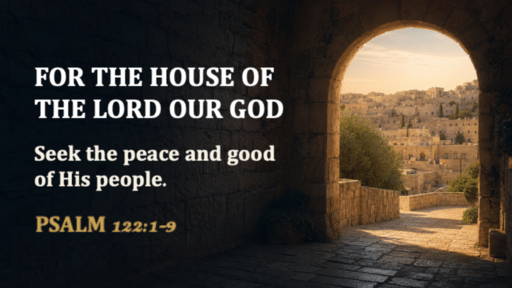
[Proposition | For the house of the LORD our God, seek the peace and good of His people.]
[Major Objective | Magnify the LORD as the One whose worship and righteous order make the peace of His people worth praying for and pursuing.]
[Specific Objective | Move hearers to take three deliberate actions this week: pray for the peace of God’s people, speak peace to brethren and companions, and seek one concrete good that strengthens worship, righteousness, or fellowship.]
[Structural Pattern | Three-stanza poetic-rhetorical form; three large movements with five internal strophes; verse 6 is the hinge; the house of the LORD is opening destination and closing motive.]
[Fallen Condition Focus | We want the comfort of peace while resisting the LORD-centered worship, righteous order, prayer, and personal responsibility by which His people seek one another’s good.]
[Text-order structure | I. Rejoice to stand before the LORD—Psalm 122:1–2. II. Remember what the LORD orders in Jerusalem—Psalm 122:3–5. III. Resolve to seek peace for the LORD’s house—Psalm 122:6–9.]
[INTRODUCTION | Scripture orientation, series number, and title.]
Please take your Bible this morning and turn with me to Psalm 122. This is the third of the Songs of degrees, and the title of the message is “For the House of the LORD Our God.”
[SCRIPTURE READING | Replace the following manual Psalm text with one native Logos KJV passage block only after import persistence is verified.]
Let us hear the whole psalm.
A Song of degrees of David. 1 I was glad when they said unto me, Let us go into the house of the LORD. 2 Our feet shall stand within thy gates, O Jerusalem. 3 Jerusalem is builded as a city that is compact together: 4 Whither the tribes go up, the tribes of the LORD, unto the testimony of Israel, to give thanks unto the name of the LORD. 5 For there are set thrones of judgment, the thrones of the house of David. 6 Pray for the peace of Jerusalem: they shall prosper that love thee. 7 Peace be within thy walls, and prosperity within thy palaces. 8 For my brethren and companions’ sakes, I will now say, Peace be within thee. 9 Because of the house of the LORD our God I will seek thy good.
[OPENING PRAYER | Use native Block Quote style.]
Let us pray.
Our Father, open this psalm to us and open our hearts to Thy Word. Make us glad to come before Thee. Teach us to love the worship Thou hast appointed, the righteousness Thou hast revealed, and the people Thou hast placed around us. Where there is pride in us, humble us. Where there is bitterness, bring us beneath the rule of Christ. Where there is careless speech, teach us to speak as those who will answer to Thee. Show us the peace purchased by the blood of Thy Son, and then make us instruments of peace under His lordship. We ask it in Jesus’ name. Amen.
[SERIES CONTEXT | Distress in Psalm 120, keeping in Psalm 121, arrival in Psalm 122.]
Psalm 120 opened this little collection with a worshiper in distress. He lived among lying lips and people who were for war, so he cried unto the LORD. Psalm 121 lifted his eyes beyond the hills to the Maker of heaven and earth, the Keeper who never sleeps. Now Psalm 122 brings us within the gates of Jerusalem. The cry of distress has become a confession of help, and the confession of help has brought the worshiper to the place where he longed to stand.
When the invitation first came, he did not receive it as one more demand upon an already crowded life. Someone said, “Let us go into the house of the LORD,” and something in him rose to meet the invitation: “I was glad.”
[NEED | Glad worship must mature into responsibility for the welfare of others.]
That gladness is beautiful, but the psalm does not leave him in a pleasant feeling. By the time the song is finished, the man who was invited to worship has taken responsibility for the welfare of others. He arrives, looks carefully at the city, understands what God has ordered there, and then binds himself to prayerful action. The psalm begins with what others said to him—“Let us go”—and it ends with what he now says before God: “I will seek thy good.”
[HANDOUT SELECT — BEGIN: Controlling Truth]
Here is the truth we must carry through the message: For the house of the LORD our God, seek the peace and good of His people.
[HANDOUT SELECT — END: Controlling Truth]
[MOVEMENT PREVIEW | Three text-order movements; give once without turning the sermon into an outline lecture.]
We will follow the worshiper through the psalm’s three movements. In verses 1 and 2, rejoice to stand before the LORD. In verses 3 through 5, remember what the LORD orders in Jerusalem. Then, in verses 6 through 9, resolve to seek peace for the LORD’s house.
[SPINE 1 | REJOICE TO STAND BEFORE THE LORD — PSALM 122:1–2.]
Look again at the opening testimony: “I was glad when they said unto me, Let us go into the house of the LORD.”
[SECTION | Joy awakened in company and directed to the LORD’s house.]
The joy is personal—“I was glad”—but it was awakened in company. He heard other voices say, “Let us go.” The invitation did not flatter him or promise to make him the center of attention. It called him to the LORD’s house, and he was glad to go with those who were going there.
[QUOTATION | Daniel J. Estes; apply native Block Quote style to the quotation-centered paragraph.]
[HANDOUT SELECT — BEGIN: Joy in the LORD]
Daniel Estes observes that “at the heart of worship was joy in the Lord.” That is the center of the verse. The worshiper was not merely excited about a journey or pleased to see a familiar city. His delight had a holy destination: “the house of the LORD.”
We know that the outward experience of gathering can be pleasant. We greet people we love. We hear voices singing beside us, watch children grow, and sometimes find that a conversation in the hallway came at precisely the right hour. Those are gracious gifts, but none of them can bear the weight of being the center. If every familiar face were absent and every preference went unanswered, the LORD would still be worthy of worship.
[HANDOUT SELECT — END: Joy in the LORD]
The invitation is “Let us go,” not “Let us see whether the service suits us.” We gather because God has spoken and Christ has opened the way. We come with sins to confess, burdens to bring, and praise to offer. We come to hear the Word of the living God, not merely to confirm thoughts we already had.
[APPLICATION | Let the shared invitation carry the weary believer.]
Notice also that the call is shared. There will be mornings when your faith helps another believer walk through the door. On another morning, you may be the weary one who needs to hear a brother say, “Come with me.” Scripture does not treat that need as a failure of maturity. God often uses the steady faith of His people to strengthen one who has become tired along the way.
Perhaps you remember the first person who invited you to church, opened a Bible with you, or simply made room beside him when everything was unfamiliar. You may not remember the sermon from that day, but you remember that you were not left alone. The faithful “they” in verse 1 became part of this worshiper’s glad testimony.
Now the LORD gives us the privilege of becoming part of that invitation for someone else. This need not be dramatic. It may mean noticing the person who has entered the room without knowing where to sit, or calling the believer whose absence has begun to concern you. Christian hospitality begins when we stop treating people as interruptions to the fellowship we had already planned.
[SECTION | Verse 2: invitation becomes achieved arrival.]
Verse 2 moves from invitation to arrival: “Our feet shall stand within thy gates, O Jerusalem.”
The Hebrew construction represents feet that have come to be standing there. The Authorized Version gives us the line exactly as we have received it, and the picture is plain: the travelers who set out for Jerusalem now find themselves within her gates. Intention has become presence.
There is a kind of admiration that never arrives. A person may admire the idea of worship while repeatedly arranging life so that worship receives whatever remains. He may speak warmly about Christian fellowship while keeping enough distance to avoid its obligations. Psalm 122 puts feet beneath the confession. “Our feet shall stand within thy gates.”
[GUARDRAIL | Never weaponize attendance against the providentially hindered.]
That statement must never become a weapon against someone who is providentially hindered. Sickness may keep a faithful believer at home. A caregiver may be serving another person while the congregation meets, and grief may make the walk into the room unusually hard. The psalm is not scolding the weak; it is restoring the goodness of the destination.
[CANONICAL BRIDGE | Hebrews 10: access through Christ and drawing near together.]
[HANDOUT SELECT — BEGIN: Draw Near Together]
Our greater access through Jesus Christ deepens that goodness. Hebrews tells believers that we have boldness to enter the holiest by the blood of Jesus, and then it says, “Let us draw near.” The same passage calls us to hold fast and to consider one another. Christ did not open a living way so that we might remain at a safe religious distance from God and His people. He brings us near to the Father and teaches us to draw near together.
So prepare for worship before you arrive. Ask the LORD to rule your attention, and come ready to give rather than merely to evaluate. If a burden is heavy, bring it into the assembly instead of waiting for a burdenless week that may never come. Let another believer help carry it, and look for the quiet opportunity to carry someone else.
[HANDOUT SELECT — END: Draw Near Together]
[RECOVERY LINE | Familiarity can make mercy seem ordinary.]
Familiarity can make mercy seem ordinary.
We possess the Scriptures in our own language. We may sing the name of Jesus openly and hear the Gospel announced without hiding. Week after week, the doors open and the people of God gather. When those mercies become familiar, we can begin to handle them carelessly; Psalm 122 teaches us to recover wonder.
[TRANSITION | Arrival becomes recognition; move from verses 1–2 into verses 3–5.]
[SPINE 2 | REMEMBER WHAT THE LORD ORDERS IN JERUSALEM — PSALM 122:3–5.]
The worshiper rejoices to stand before the LORD. Then, because he is standing within the gates, he looks at Jerusalem with understanding. Verses 3 through 5 say:
“Jerusalem is builded as a city that is compact together: Whither the tribes go up, the tribes of the LORD, unto the testimony of Israel, to give thanks unto the name of the LORD. For there are set thrones of judgment, the thrones of the house of David.”
[SECTION | Verse 3 is architectural first; communal coherence follows from the stanza.]
Verse 3 first describes a city. Jerusalem has been built, and its parts are joined together. We should not force the architecture to carry a meaning the words themselves do not bear. Yet we should also notice what happens in that joined city. The next verse brings the tribes there, and verse 5 brings the thrones of judgment there. The physical city becomes the setting for an ordered life before God.
The tribes were not identical. Each had its own history and place within Israel, but all of them were called “the tribes of the LORD.” Their unity did not require them to pretend that every distinction had disappeared. They belonged together because they belonged to Him.
That corrects a shallow idea of unity. Biblical unity is not achieved by finding people who share every taste or by allowing the strongest personality to set the terms. It is ordered belonging under the LORD. The people come from different places, but they gather around one name and under one Word.
[HANDOUT SELECT — BEGIN: Ordered Belonging]
Congregational life gives that truth somewhere to live. The older saint and the young believer may not understand every part of one another’s experience, yet both kneel before the same Lord. One member carries unusual strength in a season when another has almost none. If Christ is truly at the center, those differences do not have to become rival camps. They can become occasions for patience, honor, and mutual service. The aim is not a room in which everyone has learned to imitate everyone else. It is a people whose varied lives have been brought together beneath the authority of Jesus Christ.
[HANDOUT SELECT — END: Ordered Belonging]
[SECTION | Verse 4: prescribed ascent for thanksgiving to the LORD’s name.]
Verse 4 says that the tribes went up “unto the testimony of Israel.” The expression carries the idea of a prescription given to Israel. Their worship was not an exercise in personal invention. God had appointed it, and the purpose of their going was “to give thanks unto the name of the LORD.”
They did not gather to admire the tribes. They gathered to thank the LORD.
[CANONICAL GUARDRAIL | The church participates through Christ; the church does not replace Israel.]
That distinction reaches the church by way of Christ without turning the church into Israel or pretending that historical Jerusalem has disappeared. The New Testament commands believers to assemble, to receive the apostolic Word, and to worship through the Son. In the gathered church, we pray and sing as one body; we also observe the ordinances Christ gave. None of this is a human club built around compatible personalities. Christ gathers a people whom He purchased with His own blood.
[APPLICATION | Thanksgiving prevents correction from becoming contempt.]
If we lose thanksgiving, our attention soon curves inward. We begin to measure church life almost entirely by whether we were noticed or whether our preferences prevailed. Thanksgiving lifts our eyes from self without making us blind to genuine needs. It allows us to receive correction without concluding that everything is ruined, and it helps us correct what is wrong without despising the people for whom Christ died.
Before you rehearse the failure of another believer, pause long enough to thank God for one evidence of grace in that person. Before you describe the church only by its disappointments, remember the Word that has been preached, the prayers God has answered, and the servants whose work is known chiefly to Him. Gratitude will not settle every disagreement, but it will keep your own heart from entering the disagreement as though you had never needed mercy.
[SECTION | Verse 5 joins worship and righteous judgment.]
Then verse 5 places thrones of judgment in the same city where the tribes give thanks. Jerusalem was a center of worship, but it was also the place where judgment was rendered under the house of David. The psalm does not tell us how every seat was arranged. It tells us why the thrones were there.
[QUOTATION | W. Graham Scroggie; apply native Block Quote style.]
[HANDOUT SELECT — BEGIN: Worship and Righteousness]
W. Graham Scroggie expressed the connection with unusual clarity: “Religion and ethics must not be divorced. Worship can never be made a substitute for righteousness.”
That sentence belongs beside verse 5. Praise that refuses the rule of God is hollow. A congregation cannot honor the LORD’s name while treating truth as an inconvenience and righteousness as a threat to fellowship.
We often speak of peace as though peace simply means that no difficult word is spoken. Scripture will not let us settle for that definition. Silence can hide resentment, protect falsehood, or leave a wounded person without a hearing. The thrones of judgment remind us that the peace of Jerusalem was never meant to be peace at the expense of righteousness.
[HANDOUT SELECT — END: Worship and Righteousness]
This begins with our own willingness to live under the truth. It is easy to want justice when we have been injured and leniency when we are being corrected. It is easy to condemn a harsh spirit in someone else while excusing the contempt hidden in our own words. The worshiper who loves the LORD’s house must also welcome the LORD’s judgment of his own heart.
The same principle governs the life of a church. Grace and truth are not rival parties that must negotiate a compromise. Grace tells the truth in order to restore; truth serves the holy purposes of the God of grace. A church should be safe for confession because sin is taken seriously and Christ is believed to be sufficient.
[DAVIDIC CONTROL | Real Davidic relation; exact lamed subtype remains unresolved.]
The thrones belong to the house of David. The received title gives the psalm a real Davidic relation, although we should not pretend that the heading answers every question about the exact force of “of David.” What is certain in verse 5 is the Davidic institution of judgment. Later Scripture carries that line to Jesus Christ, David’s greater Son, who will judge in righteousness.
[GOSPEL PREVIEW | The cross joins righteousness and peace without making verse 5 directly predictive.]
Psalm 122:5 is not a direct prediction of the cross, but the cross shows us perfectly that peace and righteousness do not compete in God. At Calvary, God did not preserve peace by overlooking sin. The Son of God bore judgment in the place of sinners, and through His blood God reconciles the guilty to Himself.
Remember, then, what the LORD orders in Jerusalem. Worship rises to His name, and judgment stands in service of righteousness. The joined city is not an image of vague togetherness. It is the place where a diverse people come under the holy rule of one God.
[TRANSITION | Verse 6 is the hinge: description becomes summons.]
[SPINE 3 | RESOLVE TO SEEK PEACE FOR THE LORD’S HOUSE — PSALM 122:6–9.]
Now verse 6 turns description into summons: “Pray for the peace of Jerusalem.”
[SECTION | The plural command summons the whole worshiping company.]
The command is plural. Everyone who has heard the song is called to pray. Admiration is no longer enough; the worshiper must ask God for the welfare of the city he has just described.
The word “peace” carries more than the absence of open conflict. Verses 6 and 7 speak of secure welfare within the walls and settled well-being within the palaces. Verse 8 brings brethren and companions into view, while verse 9 speaks of seeking the city’s good. The prayer reaches the people who live there and the ordered life that allows worship and righteousness to flourish.
[QUOTATION | W. Graham Scroggie; apply native Block Quote style.]
[HANDOUT SELECT — BEGIN: Living Peace]
Scroggie wrote a line worth remembering: “The peace of the Psalm is not that of a cemetery.” Biblical peace is alive. It is not the stillness produced when every honest voice has been silenced; it is wholeness beneath the good rule of God.
The Authorized Version says, “They shall prosper that love thee.” We must not turn that into a promise of effortless wealth or uninterrupted comfort. The welfare envisioned by the psalm includes security and good order, but it remains welfare as God defines it. A suffering believer may possess peace with God even while circumstances remain painful.
[HANDOUT SELECT — END: Living Peace]
[HISTORICAL CONTROL | Pray first for historical Jerusalem without collapsing the sermon into policy or prophecy speculation.]
The first reference of the command is historical Jerusalem, and we should not rush past it. The city has not vanished from the biblical story, nor has the church replaced Israel. We may pray for Jerusalem without pretending that a single sentence will solve every question of policy or prophecy. We ask the God of truth to restrain evil, show mercy, and bring people to the saving knowledge of Jesus Christ.
[CHRISTIAN APPLICATION | Intercede for the peace of the church by explicit New Testament warrant.]
By warranted Christian application, we should also learn to pray for the peace of the church in which God has placed us. Daniel Estes notes that the psalmist calls his fellow worshipers to join him in interceding for Jerusalem “rather than presuming upon the welfare of the city.” That warning is needed. We cannot assume that sound worship, righteous relationships, and spiritual protection will maintain themselves without dependence upon God.
[HANDOUT SELECT — BEGIN: Pray for the Church]
Pray for this church with names and real burdens before you. Instead of stopping with “Lord, bless our church,” carry a particular person to the throne of grace. Ask the LORD to strengthen the teacher who is opening His Word to children, or to restore the member whose heart has begun to wander. When a marriage is under strain, do more than discuss the strain with someone else; intercede for the husband and wife before God.
Specific prayer changes the posture of the heart. It is difficult to keep treating a person as a problem once you have begun asking the LORD to show him mercy. Intercession does not make every necessary conversation disappear, but it helps us enter the conversation as servants rather than spectators.
Prayer is not a polite delay before we do what we had already decided to do. It places both the burden and the person before the wisdom of God. Sometimes the LORD will expose an assumption we had treated as fact. At other times He will confirm that a difficult step really must be taken, but He will change the spirit in which we take it. Either way, prayer loosens our grip upon the role of judge and reminds us that Christ, not our preferred outcome, is Lord of His church.
[HANDOUT SELECT — END: Pray for the Church]
Some burdens within a congregation are hidden. A person may smile in the hallway while carrying turmoil at home, and another may be fighting a temptation he has never found courage to name. We will not know everything, nor are we called to pry. We can ask the LORD to make His people faithful, to bring hidden sin into saving light, and to surround the suffering with wise love.
Do not pray only that trouble will stay away. Ask God to make us faithful when trouble comes. Pray that our doctrine will remain sound and our hearts tender, so that courage will not harden into cruelty and kindness will not become moral confusion.
[SECTION | Verse 8: plural prayer becomes personal speech.]
Verse 8 moves from the prayer of the congregation to the speech of one worshiper: “For my brethren and companions’ sakes, I will now say, Peace be within thee.”
He cannot govern every tongue in Jerusalem, but he can place his own words beneath the purpose of peace. “I will now say.” The man who joined a plural prayer accepts a personal responsibility.
[ILLUSTRATION | A story recruits an audience before anyone speaks directly; apply native Illustration style.]
Words can carry conflict through a church long after the first conversation has ended. A story passes from one person to another, and with each telling the speaker becomes a little more certain about motives he could not possibly know. By the time anyone speaks directly to the person involved, a whole audience has already been recruited.
[HANDOUT SELECT — BEGIN: Speak Peace]
Speaking peace takes a different path. It asks whether the account is true before repeating it, and it refuses to use truth as a weapon for self-exaltation. When correction is necessary, peace speaks to the person rather than performing for a crowd. Its aim is not to win a following but to serve repentance, understanding, and restored fellowship under Christ.
There may be a conversation you have delayed because you are rehearsing it everywhere except before the LORD. Begin with prayer, then go humbly. Perhaps the first words need to be, “I was wrong, and I have no excuse.” Perhaps you have been genuinely injured and must speak the truth about what happened. In either case, let your words answer to the God who placed worship and judgment in the same city.
Speaking peace does not require calling evil good. Verse 5 is still in the psalm. It does require us to surrender the pleasure of the cutting remark, the exaggerated retelling, and the final word that leaves no room for grace.
[HANDOUT SELECT — END: Speak Peace]
[SECTION | Verse 9: prayer and speech become deliberate pursuit.]
Then verse 9 carries responsibility beyond speech: “Because of the house of the LORD our God I will seek thy good.”
Prayer becomes personal speech, and speech gives rise to deliberate pursuit. The worshiper does not merely hope that someone else will create good conditions. He asks what good he can seek.
Often that good will appear ordinary. A believer notices that someone has been carrying a burden alone and makes time to listen. Another quietly handles a task that allows someone else to enter worship without distraction. A needed gift is given without advertisement, or a damaged reputation is protected when gossip reaches the room. None of those actions can purchase peace, but each can become an expression of the resolve in verse 9.
[HANDOUT SELECT — BEGIN: Seek Good]
Seeking good will inconvenience us because peace makes demands upon pride. It may require enough patience to hear the whole account instead of preparing an answer while the other person speaks. It may require the courage to address a wound before resentment hardens around it. Sometimes the cost is simply saying, “I was wrong,” and refusing to add a second speech explaining why the other person was worse.
There are situations in which seeking good does not produce immediate closeness. Trust may have been damaged, and rebuilding it can require time. Wise boundaries may be necessary while truth is established and help is sought. Peace does not compel a wounded person to pretend that nothing happened, nor does forgiveness erase every consequence in a moment. Even there, the Christian can refuse vengeance, tell the truth without embellishment, and leave room for the LORD to work in ways that cannot be forced.
The good we seek must still be defined by God. Giving a person everything he demands is not necessarily love, and preserving appearances is not necessarily peace. The LORD’s worship and the LORD’s righteousness govern the resolve. We seek a good in which people may flourish beneath His truth.
[HANDOUT SELECT — END: Seek Good]
[MOTIVE | Brethren and companions; the house of the LORD our God.]
Verse 8 gives one motive: “For my brethren and companions’ sakes.” These are not abstractions. Children learn from the way adults speak about the church. New believers discover what Christian love looks like by watching how mature believers handle disagreement. Our pursuit of peace creates consequences for people we may never have considered.
Verse 9 gives the greater motive: “Because of the house of the LORD our God.” Love for people and zeal for worship are joined. If we claim to love the house of God while treating His people with contempt, our zeal has become self-deceived. If we claim to love people while removing the truth that defines their good, our love has lost its direction.
The house of the LORD was the destination in verse 1, and it is the motive in verse 9. The worshiper first goes to the house; then, because he values what happens there, he seeks the welfare of the city around it. Worship does not draw him away from responsibility. True worship sends him toward faithful action.
[GOSPEL LANDING | David’s Son enters Jerusalem and makes peace through the blood of His cross.]
This movement brings us openly to Jesus Christ. He entered Jerusalem as David’s Son and wept over a city that did not know the things belonging to its peace. Luke is not presented as quoting Psalm 122 directly, but the canonical contrast is solemn: the city celebrated in this psalm did not recognize the Prince of peace when He came.
[HANDOUT SELECT — BEGIN: Peace through Christ]
Jesus cleansed the temple, told the truth about sin, and then went outside the gate to suffer. At the cross, He “made peace through the blood of his cross.” The peace He gives was not created by pretending that sin was harmless. He bore the judgment we deserved, died in the sinner’s place, and rose bodily from the grave.
If you are without Christ, your first need is not a calmer set of circumstances. You need peace with God. You cannot produce that peace through church attendance or moral improvement, and no amount of peacemaking can erase your guilt. Turn to God in repentance and believe on the Lord Jesus Christ. The crucified and risen Saviour will receive every sinner who comes to Him in faith.
Believer, remember the price by which you were reconciled. When Christ has shed His blood to make peace, we cannot treat bitterness, gossip, and selfish ambition as harmless habits. We forgive because we have been forgiven, and we pursue reconciliation without surrendering the truth of the Gospel.
[HANDOUT SELECT — END: Peace through Christ]
[ESCHATOLOGICAL CONTROL | Later canonical development, not the direct burden of Psalm 122.]
The New Testament carries believers through Christ to the heavenly Jerusalem, but that later development should not be forced backward into the direct burden of Psalm 122. We are not yet in the city where righteousness dwells without opposition. We serve Christ now in congregations where every member still needs grace, and we practice the peace of His kingdom while waiting for its fullness.
[INVITATION | Name one prayer, one conversation, and one concrete good.]
What faithful response lies before you?
[HANDOUT SELECT — BEGIN: Concrete Response]
Before this day is over, place one person by name before the LORD. If a conversation is needed, stop rehearsing it for an audience and prepare to speak with truth and humility. Then seek one real good that is within reach, even if no one besides God will see the cost.
You are not responsible to manufacture the peace of the whole church by tonight. You are responsible to bring your words and actions under the rule of Christ. The LORD can use a quiet act of obedience as part of His answer to prayers offered by people you may never hear.
[HANDOUT SELECT — END: Concrete Response]
[CONCLUSION | Return from “Let us go” to “I will seek.”]
The psalm began with a company saying, “Let us go.” It ends with one worshiper saying, “I will seek.” The invitation of God’s people awakened his gladness, and the worship of God awakened his responsibility.
[QUOTATION | John Greenleaf Whittier; apply native Block Quote style to the three quoted lines.]
John Greenleaf Whittier gave prayerful words to the kind of peace for which we long:
“Take from our souls the strain and stress,
And let our ordered lives confess
The beauty of Thy peace.”
That beauty is not found in avoidance. It appears when lives come beneath the gracious rule of God—when worship is directed to His name, righteousness is welcomed, and love becomes active for the sake of His people.
[FINAL SUMMONS | Recap once; emphasize the proposition and closing imperative.]
[HANDOUT SELECT — BEGIN: Final Summons]
So rejoice to stand before the LORD. Remember what the LORD orders in Jerusalem. Resolve to seek peace for the LORD’s house.
For the house of the LORD our God, seek the peace and good of His people.
Pray for peace, speak peace, and seek the good of His people—not for applause, not to control the outcome, but “because of the house of the LORD our God.”
[HANDOUT SELECT — END: Final Summons]
[CLOSING PRAYER | Use native Block Quote style.]
Let us bow our heads.
Our Father, we thank Thee for Jesus Christ, who made peace through the blood of His cross. Forgive us for wanting the comfort of peace without the holiness of Thy rule. Deliver us from careless speech and proud resistance to correction. Make us glad to worship, grateful for Thy people, and courageous enough to seek their good. Bring to mind the person for whom we should pray, the word we should speak, and the act of obedience we should undertake. Save the sinner who is still at war with Thee, and teach Thy church to display the peace of Christ until He comes. We ask it in Jesus’ name. Amen.
