FROM BEHIND THE VEIL (23)
Notes
Transcript
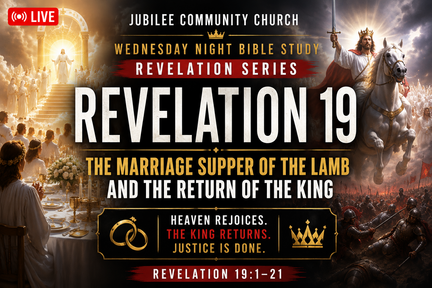
The Marriage Supper of the Lamb and the Return of the King
The Marriage Supper of the Lamb and the Return of the King
Text: Revelation 19:1–21 (ESV)
Series Context: Following our study of Babylon's judgment in Revelation 17–18, chapter 19 answers the fall of the harlot city with heaven's worship, unveils the wedding of the Lamb, and then pulls back the curtain on the Second Coming of Christ Himself — the moment every seal, trumpet, and bowl has been driving toward.
I. Setting the Scene
I. Setting the Scene
Revelation 18 ended with a dirge — kings, merchants, and sailors weeping over the smoking ruin of Babylon the Great, while heaven was told to "rejoice over her" (18:20). Chapter 19 is that rejoicing. The chapter falls into four clear movements:
19:1–5 — The Hallelujah Chorus: heaven celebrates the justice of God
19:6–10 — The Marriage Supper of the Lamb is announced
19:11–16 — The Rider on the White Horse: the Second Coming of Christ
19:17–21 — The Great Supper of God: the beast, the false prophet, and the armies of the earth are judged
Structurally, John pairs two suppers on purpose — the wedding supper of the redeemed (v. 9) and the carrion supper of the birds over the rebellious (v. 17). One table is set for the Bride; the other is set on the corpses of her enemies. That contrast is the theological spine of the chapter.
II. The Hallelujah Chorus (19:1–5)
II. The Hallelujah Chorus (19:1–5)
"After this I heard what seemed to be the loud voice of a great multitude in heaven, crying out, 'Hallelujah! Salvation and glory and power belong to our God, for his judgments are true and just; for he has judged the great prostitute who corrupted the earth with her immorality, and has avenged on her the blood of his servants.'" (Rev. 19:1–2, ESV)
Word Study: Ἁλληλουϊά (Hallēlouïa)A direct transliteration of the Hebrew הַלְלוּ־יָהּ (halelu-Yah), "praise the LORD." This is the only place in the entire New Testament the word appears — four times, all in this chapter (vv. 1, 3, 4, 6). John reaches back to the Hebrew Hallel psalms (Ps. 113–118, 146–150) to give heaven's final worship its oldest and most covenantal vocabulary.
The praise is anchored to a specific claim: God's judgments are ἀληθιναὶ καὶ δίκαιαι — "true and just" (v. 2). This echoes Deuteronomy 32:4 ("all his ways are justice... just and upright is he") and Psalm 19:9. It also directly answers the martyrs' cry under the altar in Revelation 6:10 — "how long before you will judge and avenge our blood?" Revelation 19 is the answer to Revelation 6. God's people are permitted to ask "how long," and God does answer, in His timing.
"Once more they cried out, 'Hallelujah! The smoke from her goes up forever and ever.'" (v. 3)
This phrase is drawn almost verbatim from Isaiah 34:10, describing the judgment of Edom. John deliberately borrows the language of a historical, completed judgment to describe the finality of Babylon's fall — her smoke does not go up for a season; it goes up εἰς τοὺς αἰῶνας τῶν αἰώνων, "unto the ages of the ages."
The twenty-four elders and four living creatures — the same worshiping company from Revelation 4–5 — fall down and worship God who sits on the throne (v. 4), and a voice from the throne calls all His servants, "small and great," to praise Him (v. 5). The worship in heaven is never elitist; it includes every tier of the redeemed.
III. The Marriage Supper of the Lamb (19:6–10)
III. The Marriage Supper of the Lamb (19:6–10)
"Then I heard what seemed to be the voice of a great multitude, like the roar of many waters and like the sound of mighty peals of thunder, crying out, 'Hallelujah! For the Lord our God the Almighty reigns. Let us rejoice and exult and give him the glory, for the marriage of the Lamb has come, and his Bride has made herself ready.'" (Rev. 19:6–7)
Word Study: γάμος τοῦ ἀρνίου (gamos tou arniou)
γάμος (gamos) — not merely the legal act of marrying but the wedding celebration itself, the feast, the festivities. John is describing a banquet, not a courtroom transaction.
ἡτοίμασεν ἑαυτήν (hētoimasen heautēn) — "has made herself ready," a reflexive construction. The Bride cooperates in her own readiness. This isn't a contradiction of Ephesians 5:25–27, where Christ sanctifies and cleanses the church; it's the other side of the same coin. Christ's grace sanctifies; the Bride's obedience responds.
"It was granted her to clothe herself with fine linen, bright and pure — for the fine linen is the righteous deeds of the saints." (v. 8)
The Greek is τὰ δικαιώματα τῶν ἁγίων — literally "the righteous acts/deeds of the saints" — δικαιώματα, plural, concrete acts, not δικαιοσύνη (righteousness as a status). Worth making plain to the men: our imputed righteousness before God (justification) is not what's pictured here. What clothes the Bride is the accumulated, Spirit-wrought obedience of the saints — the fruit, not the root, of salvation. This matches Ephesians 2:8–10: saved by grace through faith, not of works, and then created for good works.
Old Testament and Gospel BackgroundMarriage as covenant imagery runs through Scripture: Israel as YHWH's bride in Hosea 1–3, Isaiah 54:5–8, Isaiah 62:4–5, and Ezekiel 16; the church as Christ's bride in Ephesians 5:25–32 and 2 Corinthians 11:2. First-century Jewish weddings moved through three stages that illuminate this text: (1) betrothal, sealed by a legal contract and bride-price; (2) the bridegroom's departure to prepare a place, then his sudden return to collect the bride (cf. John 14:2–3); and (3) the wedding feast itself, often lasting seven days. Revelation 19 is stage three.
Two of Jesus' own parables sit directly behind this scene: the wedding feast in Matthew 22:1–14, where guests must be properly clothed, and the ten virgins in Matthew 25:1–13, waiting for the bridegroom. Revelation 19 shows the parables fulfilled — the Bride is, at last, ready.
The Fourth Beatitude"Blessed are those who are invited to the marriage supper of the Lamb." (v. 9)
This is the fourth of seven beatitudes scattered through Revelation (1:3; 14:13; 16:15; 19:9; 20:6; 22:7; 22:14). Notice the shift in imagery mid-verse: believers are both the Bride and the invited guests. Scripture is comfortable holding both pictures at once; the point is the certainty and joy of belonging to Christ at His table.
When John, overwhelmed, falls at the feet of the angel to worship him, he is rebuked: "You must not do that! ... Worship God." (v. 10). The angel then gives one of the most quoted interpretive keys in the book: "the testimony of Jesus is the spirit of prophecy." All genuine biblical prophecy — Old Testament and New — ultimately testifies to and centers on Jesus Christ. A good check whenever we handle prophetic texts: does this reading exalt Christ, or wander into speculation that has nothing to do with Him?
IV. The Rider on the White Horse (19:11–16)
IV. The Rider on the White Horse (19:11–16)
"Then I saw heaven opened, and behold, a white horse! The one sitting on it is called Faithful and True, and in righteousness he judges and makes war." (Rev. 19:11)
This is the moment the whole book has been building toward — the visible, personal, bodily return of Jesus Christ to the earth. Note the deliberate contrast with the first horseman of Revelation 6:2, who also rides a white horse: that rider is a counterfeit, a conquering imitation of Christ, likely tied to Antichrist's false peace. This Rider is the real thing — Faithful and True (πιστὸς καὶ ἀληθινός), the same title given to Christ in Revelation 3:14.
Reading the Description Piece by Piece
"His eyes are like a flame of fire" (v. 12) — perfect, penetrating discernment (cf. Rev. 1:14; 2:18).
"On his head are many diadems" — many crowns, not one. This directly answers the beast's ten diadems in Revelation 13:1. Whatever authority Satan and Antichrist claim, Christ's authority is greater, unbounded, unrivaled.
"He has a name written that no one knows but himself" — a note of reserved mystery even at His unveiling; the fullness of who Christ is remains beyond complete human comprehension.
"He is clothed in a robe dipped in blood, and the name by which he is called is The Word of God" (v. 13) — Ὁ Λόγος τοῦ Θεοῦ. The only occurrence of this exact title in Revelation, tying the book unmistakably to John's Gospel: "In the beginning was the Word... and the Word became flesh" (John 1:1, 14).
Whose Blood Is on the Robe?Genuinely debated among sound interpreters:
View 1 — His own blood: the robe recalls the atonement, the blood of the cross that secured this very victory.
View 2 — the blood of His enemies: the image is drawn from Isaiah 63:1–3, where the divine warrior comes from Edom with garments "stained crimson," having "trodden the winepress" alone in wrath (language v. 15 explicitly borrows).
The stronger reading, and the one that best fits the Isaiah background, is the second: this is the blood of judgment, not atonement. The Rider's robe is stained before the battle even begins, portraying the certainty of His victory. This doesn't diminish Calvary — this particular image points forward to judgment rather than backward to the cross.
The Armies of Heaven
"And the armies of heaven, arrayed in fine linen, white and pure, were following him on white horses." (v. 14)
Notice what these armies do not do: they do not fight. "From his mouth comes a sharp sword with which to strike down the nations, and he will rule them with a rod of iron" (v. 15; cf. Ps. 2:9; Rev. 1:16; 2 Thess. 2:8; Heb. 4:12). Christ conquers by the authority of His spoken word, not by the strength of an army. The armies in white linen are dressed exactly like the Bride in verse 8, which strongly suggests these are the redeemed saints returning with Christ, joined (in most readings) by the angelic hosts — present at the victory, but not the ones securing it.
"He will tread the winepress of the fury of the wrath of God the Almighty" (v. 15) directly parallels Revelation 14:19–20, and again roots itself in Isaiah 63.
Finally: "On his robe and on his thigh he has a name written, King of kings and Lord of lords" (v. 16) — Βασιλεὺς βασιλέων καὶ Κύριος κυρίων. In the late first century, Domitian was demanding the title dominus et deus, "lord and god," from his subjects. John's readers, facing real pressure to burn incense to Caesar, hear this title as a direct and comforting polemic: there is only one true King of kings.
V. The Great Supper of God (19:17–21)
V. The Great Supper of God (19:17–21)
"Then I saw an angel standing in the sun, and with a loud voice he called to all the birds that fly directly overhead, 'Come, gather for the great supper of God, to eat the flesh of kings, the flesh of captains, the flesh of mighty men, the flesh of horses and their riders, and the flesh of all men, both free and slave, both small and great.'" (Rev. 19:17–18)
This grim invitation deliberately mirrors the wedding invitation of verse 9. Two suppers, two guest lists: one gathers the redeemed to celebrate with the Lamb; the other gathers birds of prey to feast on those who opposed Him. John draws this directly from Ezekiel 39:17–20, the judgment of Gog and Magog, where birds and beasts are likewise summoned to a sacrificial feast on a defeated army.
The beast and the false prophet are seized and "thrown alive into the lake of fire that burns with sulfur" (v. 20) — the first two occupants of what becomes, in Revelation 20:10 and 20:14–15, the eternal destination of Satan, death, Hades, and all whose names are not in the Book of Life. "Thrown alive" is significant: this is conscious judgment, not annihilation. "And the rest were slain by the sword that came from the mouth of him who was sitting on the horse" (v. 21) — again, the word alone is the weapon. There is no described battle, no clash of armies. What we call "the Battle of Armageddon" (cf. Rev. 16:16) is, in the end, an execution carried out by a spoken word. God does not need a fight to win. He has already won.
VI. Interpretive Questions Worth Weighing
VI. Interpretive Questions Worth Weighing
1. Where does this fit relative to the millennium of chapter 20?Premillennial reading (the majority historic and dispensational view, the frame we've generally used through this series): Revelation 19 depicts the literal, visible Second Coming, immediately followed chronologically by the thousand-year reign in chapter 20. Amillennial/postmillennial readers treat chapters 19–20 as a recapitulation — a symbolic retelling of the same church-age realities, rather than a strict sequence. The amillennial view leans on Revelation's cyclical pattern elsewhere in the book; the premillennial view leans on "then I saw" (20:1) as a temporal marker, and on a future literal reign promised elsewhere (2 Sam. 7:12–16; Isa. 9:6–7; Zech. 14:9). We'll weigh chapter 20 fully next time.
2. Is the conflict a literal military battle at a real location?Some press for a literal, geographically located final battle (tied to Rev. 16:16's "Armageddon"). Others read the imagery as apocalyptic shorthand for God's total, final judgment on organized rebellion. Both camps agree on the outcome; they differ on how literally to press the staging.
3. Who exactly are the "armies of heaven"?The white-linen clothing (matching the Bride in v. 8) favors glorified saints; the consistent Old Testament pattern of "the LORD of hosts" returning with angelic armies favors angels; many sound interpreters hold both together as one company.
VII. Application
VII. Application
: Revelation 6 asks "how long?" and Revelation 19 answers it. Every wrong will be set right, on God's timetable, not ours.Assurance for the weary believer
: the Bride "made herself ready." Grace does not make obedience optional; it makes obedience possible.A call to readiness, not passivity
: the armies of heaven do not swing a sword. The victory belongs to Christ's word, not our effort — that should humble us as much as it emboldens us.Confidence, not swagger
: John's instinct at the height of revelation was to fall down and worship — and he was corrected to worship God alone, not the messenger. Every study of end-times events should end pointing us to worship the King of kings, not to speculation for its own sake.Worship as the right response to prophecy
Next Session: Revelation 20 — The Millennium and the Final Judgment
