Examining Ourselves - Aug. 2nd, 2026

The Lord's Supper • Sermon • Submitted • Presented • 1:00:22
0 ratings
· 7 viewsBecause the Lord disciplines His people rather than abandoning them to condemnation, we must let the Gospel search us, judge known sin, repair contempt toward His body, and then eat in grateful remembrance of Christ.
Files
Notes
Transcript
METADATA
Series: Lord’s Table • No. 08 • Passage: 1 Corinthians 11:28–32 • Topics: Lord’s Supper, self-examination, repentance, chastening, church unity • KJV
PREACHER NOTE — INTRODUCTION / TAKEOFF
Please take your Bible and turn with me to First Corinthians chapter eleven.
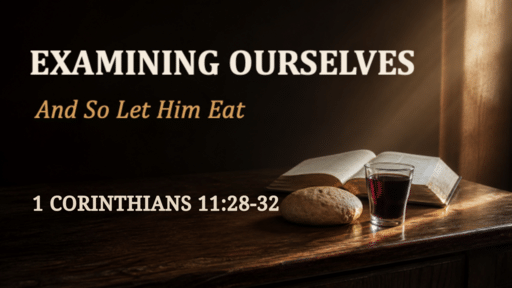
Tonight, before we come to the Lord’s Table, I want us to give careful attention to one sentence in verse twenty-eight: “But let a man examine himself, and so let him eat of that bread, and drink of that cup.”
There are two very different ways to hear that command wrongly.
One person hears it casually. He thinks, “I will pause for a moment, try to feel serious, and then go on as I was.” Examination becomes a brief religious mood. Nothing is named. Nothing is confessed. Nothing changes.
Another person hears it fearfully. He thinks, “If I examine myself honestly, I will find sin. If I find sin, I must be unworthy. If I am unworthy, I had better stay away.” Examination becomes a search for a personal worthiness that no sinner can find.
Paul allows neither response.
Listen to the whole anchor:
28 But let a man examine himself, and so let him eat of that bread, and drink of that cup. 29 For he that eateth and drinketh unworthily, eateth and drinketh damnation to himself, not discerning the Lord’s body. 30 For this cause many are weak and sickly among you, and many sleep. 31 For if we would judge ourselves, we should not be judged. 32 But when we are judged, we are chastened of the Lord, that we should not be condemned with the world.
This is a sober passage. Some at Corinth were weak. Some were sick. Some had died. We dare not soften what the Holy Ghost has said.
But this is also a hopeful passage. Paul does not say, “Examine yourself, discover that you are a sinner, and leave in despair.” He says, “Examine himself, and so let him eat.”
To understand why, we need to remember what was happening in Corinth.
The church was coming together, but Paul said their gathering was not for the better. It was for the worse. There were divisions among them. Some arrived with plenty. They went ahead with their own food. One was full while another remained hungry. Some had even become drunken. At the very gathering that should have displayed the grace of Christ, they displayed pride, appetite, and contempt.
Paul asked them, “Despise ye the church of God, and shame them that have not?”
Then he reminded them of the night the Supper was given.
“The Lord Jesus the same night in which he was betrayed took bread.”
On a night filled with human treachery, Jesus gave thanks. On a night when men were protecting themselves, Jesus gave Himself. He took the bread and said, “This is my body, which is broken for you: this do in remembrance of me.” He took the cup and said, “This cup is the new testament in my blood: this do ye, as oft as ye drink it, in remembrance of me.”
Corinth’s meal displayed self. Christ’s Supper displays His self-giving death.
That is why Paul says, “Wherefore.” Because this bread and this cup proclaim the death of the Lord, our manner at His Table must agree with the message we proclaim.
Because the Lord disciplines His people rather than abandoning them to condemnation, we must let the Gospel search us, judge known sin, repair contempt toward His body, and then eat in grateful remembrance of Christ.
So let us follow Paul’s own verbs.
MOVEMENT 1 —
I. EXAMINE YOURSELF UNDER THE GOSPEL—AND SO EAT
I. EXAMINE YOURSELF UNDER THE GOSPEL—AND SO EAT
First, examine yourself under the Gospel—and so eat.
“But let a man examine himself.”
This is personal. Paul does not say, “Let a man examine everyone else in the room.” It is always easier to see another person’s failure. We can remember what someone said to us, how someone disappointed us, how someone else needs to change.
But the Word says, “Let a man examine himself.”
Put your own manner under the light of the Lord’s death. Let Scripture test what you have excused. Ask the Lord to show you where your profession and your conduct have parted company.
The Table is like a mirror, but not a mirror that leaves us staring at ourselves.
When you stand before an ordinary mirror, the mirror shows what is present. It cannot wash your face. It cannot mend torn clothing. It cannot supply what is missing. It only tells the truth about what stands before it.
The Lord’s Table tells the truth in a greater way. It tells the truth about our sin: nothing less than the body and blood of Christ could answer it. It tells the truth about our Saviour: He gave Himself willingly and completely. It tells the truth about His church: we are not a collection of private customers; we are a people gathered around one Lord and one Gospel.
And then the Table points away from us. The bread says, “His body.” The cup says, “His blood.” The command says, “Remember Him.”
So examination does not mean circling endlessly inside your own heart. It means standing in the light of the cross long enough for the truth about Christ to expose the truth about you—and then following that truth into repentance, faith, and obedience.
The warning is about an unworthy manner, not a worthy person.
Paul says that a person may eat and drink “unworthily.” That word describes how the person participates. It does not say that any of us possesses personal merit sufficient for this Table.
Who among us could claim to be worthy of the body and blood of the Son of God?
The bread does not announce our worthiness. It announces His body given for us. The cup does not announce our goodness. It announces His blood shed for us. We do not come displaying a record that deserves Christ. We come remembering Christ, because without Him we have no righteousness and no hope.
Yet grace does not make carelessness safe.
The same Gospel that tells me Christ died for my sin will not permit me to protect that sin. The same cup that speaks of His blood will not bless my excuses. The same bread that reminds me His body was given for His church will not approve contempt for His people.
So examine yourself under the Gospel.
Am I trusting Jesus Christ alone? Or am I quietly trusting church attendance, baptism, family history, or the act of taking Communion?
Am I defending a sin that Scripture names? Have I renamed pride as personality? Have I renamed bitterness as discernment? Have I renamed gossip as concern? Have I renamed disobedience as a difficult season?
Have I treated a brother or sister in Christ with contempt? Is there someone I have shamed, ignored, used, or refused to hear?
What next obedient step is already clear?
Perhaps it is confession to God. Perhaps it is an apology without an excuse attached. Perhaps it is restitution. Perhaps it is ending a practice you have defended. Perhaps it is asking for help because you have not been able to overcome alone.
Examination is not the destination. Paul says, “and so let him eat.”
He does not say, “Let a man examine himself, and so let him preserve his sin but avoid the cup.” Abstention is not a substitute for repentance. The answer to exposed sin is not to hide from Christ’s command. The answer is to confess the sin, forsake its defense, take the next obedient step, and come resting in Christ.
Notice how different that is from trying to manufacture a feeling of worthiness.
Suppose examination brings a sharp conviction about words you spoke this week. You know they were cruel. The response is not to sit in the pew and say, “I need to feel worse before I can know I have repented.” The response is to call those words what God calls them, confess them to Him, determine that you will own them before the person you wounded, and ask the Lord for grace to speak differently.
Suppose examination exposes a private habit you have guarded. The response is not to promise God vaguely that you will do better. Bring the matter into the light. Remove the access you have protected. Seek the help and accountability that wisdom requires. Do the next thing obedience demands.
Suppose examination uncovers coldness rather than a dramatic outward act. You have treated the gathering as though it exists only for what you receive. You have remained comfortable while another member carried sorrow alone. You cannot repair every neglected opportunity tonight. But you can stop defending indifference. You can ask whose burden you should help bear and begin with the person the Lord has already brought to mind.
And suppose examination finds a conscience tenderly grieved by sins already confessed and forsaken. Do not keep presenting the same charge as though Christ’s promise were uncertain. Thank Him for forgiveness. Receive His cleansing by faith. Let the examination lead where Paul leads: “and so let him eat.”
The Table is not a reward for people who have cleansed themselves. The elements do not cleanse us at all. Christ cleanses. The Table is an ordinance for believers who remember that cleansing rests in His finished work and who refuse to make peace with known sin.
If examination is mercy, Paul now shows why refusing it is dangerous.
MOVEMENT 2 —
II. DISCERN THE BODY BEFORE JUDGMENT FALLS
II. DISCERN THE BODY BEFORE JUDGMENT FALLS
Second, discern the body before judgment falls.
Verse twenty-nine says, “For he that eateth and drinketh unworthily, eateth and drinketh damnation to himself, not discerning the Lord’s body.”
The word translated “damnation” here speaks of judgment. We know that because Paul explains it in the next verses. He speaks of weakness, sickness, death, and then of being chastened by the Lord. He is not saying that a child of God earns hell by one sinful participation. He is warning that the Lord judges the manner in which His church handles this holy ordinance.
The Corinthians had stopped making the proper distinction.
They treated the gathering as though it were an ordinary place to satisfy appetite. They treated the bread as though it were ordinary food. They treated poor members as though they did not matter. They said with the sign, “Christ gave Himself for us,” while they said with their conduct, “I will look after myself.”
They failed to honor the body signified by the bread, and it showed in how they treated the body gathered around it.
The bread remains bread. It does not become the physical body of Jesus. The cup remains the fruit of the vine. It does not become His blood. We do not repeat the sacrifice of Christ. We remember the sacrifice He finished once for all.
But a symbol commanded by Christ is not empty.
This bread directs our faith to the body He gave. This cup directs our faith to the blood He shed. To receive them as though nothing sacred is being confessed is to profane the death they proclaim.
God took that contempt seriously at Corinth.
“For this cause many are weak and sickly among you, and many sleep.”
Some were physically weak. Some were sick. Some had died. Paul does not leave the cause uncertain in their case. By inspiration, he says, “For this cause.”
The Lord’s holiness is not ceremonial atmosphere. He governs His church. He loves His Son. He will not treat contempt for the death of Christ as a small thing merely because it takes place during a religious service.
That should put holy fear in us.
It should not turn us into detectives of another person’s suffering.
Paul could identify Corinth’s cause by inspiration. You and I may not look at a sick brother and claim to know the secret reason. The Bible gives many examples of suffering that was not direct punishment for a particular sin. We are called to examine ourselves, not accuse the sufferer.
Take your own sin seriously. Do not claim secret knowledge about someone else’s suffering.
There is another distinction we must make. We must discern the body not only with our thoughts but with our conduct.
It is possible to sit quietly during Communion, look solemnly at the bread, and still harbor contempt for a person Christ purchased. It is possible to speak tenderly of the cross and speak cruelly about a church member. It is possible to remember the nails and refuse to release a grievance we keep polishing in private.
The Corinthians needed more than a quieter service. They needed to stop shaming one another. In verse thirty-three Paul says, “When ye come together to eat, tarry one for another.”
Their repentance needed to become visible. The people who hurried ahead needed to wait. The people who made the gathering about their appetite needed to eat at home. The people who treated the poor as less important needed to recognize the church of God.
Our circumstances differ, but the enduring truth does not. If I honor the Lord whose body was given, I cannot be content to despise people for whom He died.
This is where examination must become wonderfully practical.
Ask not only, “What do I think about the bread?” Ask, “What does my treatment of Christ’s people say that I think about His body?”
If I speak with warmth during the service but use contempt at home, the contradiction matters. If I welcome those who are useful to me but overlook those who cannot advance me, the contradiction matters. If I guard a grievance because it gives me a reason to remain distant, the contradiction matters. If I repeat another believer’s failure because the story makes me look discerning, the contradiction matters.
The next step may be as simple and as difficult as waiting. That was Paul’s word to Corinth: “tarry one for another.” Make room. Refuse to rush past the person who cannot keep your pace. Remember that the church is not arranged around your appetite, your preference, your schedule, or your importance.
Christ did not give His body for a people we are free to despise.
The warning is severe, but Paul does not leave the believer under a cloud of terror. He tells us how the Father uses judgment.
MOVEMENT 3 —
III. JUDGE YOURSELF UNDER THE FATHER’S HAND
III. JUDGE YOURSELF UNDER THE FATHER’S HAND
Third, judge yourself under the Father’s hand.
Verse thirty-one says, “For if we would judge ourselves, we should not be judged.”
Self-judgment is not a vague feeling that I am a bad person. It is agreeing with God about something specific.
God says it is pride. I stop calling it confidence.
God says it is bitterness. I stop calling it a good memory.
God says it is dishonesty. I stop calling it careful wording.
God says I have wronged someone. I stop explaining why that person made it easy.
Do not call sin a weakness when God calls it sin.
First John says, “If we say that we have no sin, we deceive ourselves, and the truth is not in us.” Honest examination will uncover sin because honest believers are not sinless.
Then John says, “If we confess our sins, he is faithful and just to forgive us our sins, and to cleanse us from all unrighteousness.”
Confession is not payment. It is agreement. We do not inform God of something He did not know. We stop arguing with His verdict.
There is a great difference between conviction and condemnation.
Condemnation says that the case is closed and the guilty one must bear the sentence. For the believer, Christ has borne that sentence. “There is therefore now no condemnation to them which are in Christ Jesus.”
Conviction brings a true charge into the light so that the child of God will agree with the Father and return to obedience. It is specific where vague shame is foggy. It says, “That word was false. That attitude was proud. That silence was cowardly. That action was impure.” Then it directs us toward confession, cleansing, and change.
The enemy would use exposed sin to drive you away from Christ. The Holy Spirit exposes sin to bring you into honest fellowship with Christ. The enemy says, “Hide, pretend, and despair.” The Gospel says, “Come into the light. Your Advocate is Jesus Christ the righteous.”
And where our sin has injured another person, repentance takes a direction. We cannot force another person to trust us immediately. We cannot guarantee that every relationship will be repaired in one conversation. But we can take the obedient step within our power. We can own what we did. We can ask forgiveness without demanding it. We can make restitution where that is needed. We can seek help from the proper spiritual authority.
Then Paul says, “But when we are judged, we are chastened of the Lord.”
The hand in this verse is a Father’s hand.
Hebrews says, “Whom the Lord loveth he chasteneth.” It says He chastens us “for our profit, that we might be partakers of his holiness.” It admits that chastening is not joyful while we endure it. It is grievous. But afterward it yields “the peaceable fruit of righteousness” in those who are exercised by it.
The Father’s chastening is severe mercy, not the world’s condemnation.
Look carefully at the end of verse thirty-two: “that we should not be condemned with the world.”
Paul does not comfort us by saying sin is harmless. He comforts us by showing the purpose of the Father. The Lord refuses to surrender His children to the sin that destroys. He corrects. He trains. He may deal painfully. But His chastening is distinguished from the condemnation that belongs to the world.
That distinction rests upon Jesus Christ.
If you are saved, your confidence tonight is not that your examination found only minor faults. Your confidence is that Jesus Christ bore condemnation in your place.
He lived the righteous life you have not lived. He went to the cross willingly. His body was given. His blood was shed. He died for the ungodly. He rose from the dead. His sacrifice is sufficient and complete.
The bread and cup do not add to that work. They do not repeat it. They do not become Christ. They do not save, forgive, sanctify, or heal simply because we receive them.
They call believers to remember Him.
So when examination exposes sin, do not run from the only Saviour you have. Run to Him. Confess the sin. Trust His finished work. Submit to His correction. Take the next step of obedience.
You do not come because your examination found you worthy. You come because the bread and cup point to the worthy Christ.
If you are not saved, receiving these elements cannot make you a Christian. Communion is not a doorway into salvation. It is a remembrance observed by those who already know Christ. Please refrain from the elements and receive the Saviour Himself by faith. Turn from sin and trust the Lord Jesus Christ, who died and rose again.
If you are a believer, come according to the requirements of Scripture and the established practice of this church. Come as one who has been born again, scripturally baptized, and is walking in obedience and fellowship. Do not come clinging to rebellion. Do not stay away merely to protect rebellion. Judge it. Confess it. Take the next obedient step.
In a moment, we will have a quiet opportunity before the Lord.
Do not try to search every year of your life in a few minutes. Ask the Lord to put His finger on what is clear now.
Is there a sin you have defended?
Is there a person you have treated with contempt?
Is there an apology you need to make?
Is there an act of obedience you have delayed?
Name it before God.
Rest your hope in Christ.
Commit yourself to the next obedient step.
Then hear the whole command: “Let a man examine himself, and so let him eat.”
Look to Christ. Name the sin. Take the next obedient step. And so let him eat.
PRAYER — PROTECTED
Let us pray.
Our Father, search us in the light of Thy Word. Show us where our conduct has contradicted the death we proclaim. Deliver us from careless presumption and from hopeless self-reliance. Give us grace to call sin what Thou dost call it, to confess it honestly, and to seek reconciliation humbly. Thank Thee for the body of Christ given for us and for His blood shed for us. Thank Thee that His sacrifice is finished, sufficient, and complete. Prepare Thy people to remember Him with reverence, gratitude, and hope. Draw the lost to saving faith in Christ. We ask it in Jesus’ name. Amen.
ORDINANCE TRANSITION — PROTECTED
With our eyes upon Christ and our hearts open before Him, we will now prepare to remember the body He gave for us.
