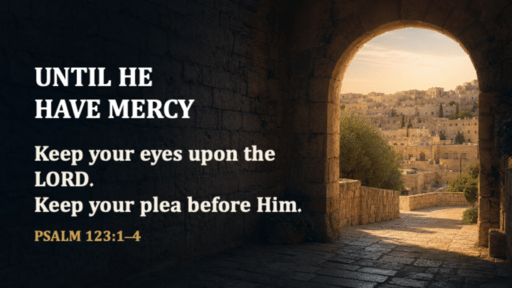
Until He Have Mercy - Aug. 9th, 2026

CJ Walker, DMin, ThD
Savoring the Psalter V: Songs of Degrees • Sermon • Submitted • Presented • 1:31:00
0 ratings
· 6 viewsWhen contempt fills the soul, Psalm 123 calls God’s people to keep their eyes upon the LORD, plead honestly for mercy, and approach the throne of grace through Jesus Christ even before the circumstance is visibly resolved.
Files
Notes
Transcript
Handout
[FORMAL ELEMENTS / DESCRIPTIVE DATA]
Central Idea of the Text:
An unnamed, socially humiliated community fixes its dependent attention upon the LORD in heaven and urgently asks Him for mercy because contempt has saturated its corporate life; the prayer ends with the burden still before Him.
Proposition:
When contempt has filled the soul, God’s people must keep their eyes upon the LORD and keep their plea before Him until He shows mercy.
Major Objective:
Faith response.
Specific Objective:
Lead hearers to direct common attention toward the LORD, ask honestly for mercy, approach through Jesus Christ, and refuse retaliatory or manufactured closure.
Structural Pattern:
Two textual movements joined by the mercy-root hinge at Psalm 123:2d–3a.
Fallen Condition Focus:
Souls filled by contempt become governed by human judgments, self-sufficient control, isolation, or retaliation.
Text-order structure:
I. Our eyes are upon the LORD (vv. 1–2).
II. Our plea is for mercy (vv. 3–4).
[OPENING CONTROL | Invisible wound → full soul → governing direction.]
What do you do when the wound is real, but there is no bruise to show anybody?
There are injuries that another person can see. There are hurts that can be measured, photographed, bandaged, or set in a cast. But contempt is often a wound without a visible mark. It can come through a look, a laugh, a tone of voice, a public dismissal, or the steady suggestion that you are beneath serious regard. Somebody may tell you not to take it so hard. Somebody else may wonder why you cannot simply forget it. Yet the person who has lived under contempt knows that words and attitudes can settle heavily upon the soul.
Psalm 123 gives words to people who have had their fill of that burden. The Psalm ends with this confession: “Our soul is exceedingly filled.”But it does not begin with the people who caused the hurt. It begins with the direction of the sufferer’s eyes.
[SCRIPTURE READING | Psalm 123 KJV.]
Let us hear the Word of God.
A Song of degrees. 1 Unto thee lift I up mine eyes, O thou that dwellest in the heavens. 2 Behold, as the eyes of servants look unto the hand of their masters, and as the eyes of a maiden unto the hand of her mistress; so our eyes wait upon the LORD our God, until that he have mercy upon us. 3 Have mercy upon us, O LORD, have mercy upon us: for we are exceedingly filled with contempt. 4 Our soul is exceedingly filled with the scorning of those that are at ease, and with the contempt of the proud.
Psalm 123 leaves its first occasion unnamed. We are not told the writer, the city, the year, or the faces behind the scorn. The title places it among the Songs of Degrees; the prayer itself brings us straight to what must be heard: a people have been made small in the eyes of others, and they turn their eyes toward the LORD.
An unnamed community has been socially humiliated. One voice opens the prayer, but before long it becomes the prayer of a people. They fix their attention upon the LORD, their God in heaven. They ask Him for mercy because contempt has saturated their common life. And the Psalm ends while that burden is still before Him.
[NEED | Contempt is a real social wound, but it must not control attention.]
Here is the burden: social contempt can fill the soul, but it must not govern the eyes.
And here is the call: when contempt has filled the soul, God’s people must keep their eyes upon the LORD and keep their plea before Him until He shows mercy.
The Psalm moves in two great parts. In verses 1 and 2, our eyes are upon the LORD. In verses 3 and 4, our plea is for mercy.
[SPINE 1 | OUR EYES ARE UPON THE LORD — Psalm 123:1–2.]
First, our eyes are upon the LORD.
First, our eyes are upon the LORD.
The body of the Psalm begins, “Unto thee lift I up mine eyes.”The first words establish the direction: “Unto thee.” Before the speaker explains what other people have done, he has already determined where he will look.
Note the order of importance. Contempt tries to govern the field of vision. You remember the face of the person who laughed. You hear the sentence again when the room is quiet. You read the expression, measure the tone, anticipate the next encounter, and imagine the reply you wish you had made. It is possible to leave the person’s presence while remaining under the government of that person’s judgment.
The Psalmist does not say that those things never happened. He does not tell himself that scorn is harmless. He changes the governing direction. “Unto thee lift I up mine eyes.”
The eyes are concrete. The verse does not say, “I lift my ideas,” or, “I lift my feelings.” He lifts his eyes. Faith, hope, attention, and prayer are all present in the act, but the bodily image should remain before us. The person who has been made to feel small looks upward.
Some people look down upon him, but he looks up to God.
Some voices have treated him as beneath regard, but he addresses the One who is above every human estimate.
Somebody else has attempted to assign his worth, but he brings his full attention to the LORD.
The direction is personal: “I” lift “mine eyes.” Yet the voice will soon become plural. The one person is not discarded when the congregation begins to speak. One worshiper’s Godward act becomes a doorway through which the whole people can pray.
The representative voice is deliberately unnamed. We may hear one faithful worshiper beginning the prayer, but the Psalm does not make him David, a priest, a cantor, or a pilgrim leader. His particular identity is not the point. His Godward direction becomes a doorway through which the whole people pray.
That is often the way corporate faith begins. One believer lifts his eyes. One mother prays. One father refuses despair. One church member names God before the whole room has found its words. Then “mine eyes” becomes “our eyes.”
Do not despise the first faithful look because you feel alone in it. The prayer of a people may begin with one person who says, “Unto thee.”
The speaker addresses “thou that dwellest in the heavens.” The LORD is not imprisoned inside the humiliating social order. The people who appear secure below do not sit above Him. Their opinion does not reach His height. Their contempt does not define His throne, His purpose, or His judgment.
The verse does not actually use the word throne, and it does not call God King in this line. We do not need to place more in the verse than it says. But throughout Scripture the heavens declare a transcendence that no human hierarchy can threaten. The LORD is above.
And yet He is not inaccessible. The speaker talks to Him. “Unto thee.” The One who dwells in the heavens is near enough to receive a bruised prayer. Verse 2 will call Him “the LORD our God.” Height and covenant relation stand together. The LORD is above the contemptuous order, and He is the God of the people who pray.
[SECTION | Household comparison: dependent attention toward superior agency.]
Verse 2 gives us the picture of their dependence.
“Behold, as the eyes of servants look unto the hand of their masters, and as the eyes of a maiden unto the hand of her mistress.”
The word “Behold” asks us to see the scene. There are servants. There are masters. There is a maiden. There is a mistress. In each case, the dependent person’s eyes are directed toward the hand of the person with superior authority.
But notice, that, while the comparison is clear, the exact action of the hand is not.
Verse 2 does not specify a single act of the hand. That is not a gap to be filled with a household custom. The hand is undefined; the dependence is not.
The servants watch the one whose agency bears upon what happens next. The maiden watches the mistress. The comparison carries dependent attention, not a promise that God must give one particular kind of provision.
Its direction is away from human superiority and toward the LORD. It may never be used to make an abused person quiet, to conceal injustice, or to tell someone to remain in danger. The praying people in Psalm 123 speak their grief plainly to God.
“So our eyes wait upon the LORD our God.”
The relation is transferred. As dependent people direct their eyes toward the one whose agency matters, so the community directs its eyes toward the LORD.
The picture calls for humility. We often want help while retaining control; the people of Psalm 123 take the lower place of need. They do not bargain with God or approach Him as customers collecting what they have earned. They watch for mercy from the LORD their God.
Mercy is requested, not managed.
And now the voice is plural. The person said, “mine eyes.” The people say, “our eyes.” The person said, “Unto thee.” The congregation says, “the LORD our God.”
There is a ministry in that change of number. A person under contempt is often isolated by it. Shame tells you that nobody else should know. Pride tells you to bear it without help. Fear tells you that if you speak, somebody will only add another layer of dismissal.
But the inspired prayer will not leave the burden in the singular. “Our eyes.” “Our God.” “Mercy upon us.” “We are exceedingly filled.” “Our soul.”
[APPLICATION | Make the singular burden corporate without erasing the person.]
The church should know how to say “our” around a wounded member.
There are burdens that begin in one person’s experience but must become the concern of the body. We do not erase the personal hurt. We refuse to let the person bear it in isolation. We learn to pray more than, “Lord, help him,” or, “Lord, help her.” We stand near enough to say, “Have mercy upon us.”
Whose “mine eyes” needs to become our prayer this morning? Who has been left to interpret contempt alone because the rest of us have been too comfortable to notice? One of the works of a congregation is to make a lonely cry corporate.
The King James Bible says, “So our eyes wait upon the LORD our God.”The word “wait” is printed in italics because it is supplied to make the English relation clear. The Hebrew line places “our eyes” toward the LORD, and the next line supplies the expectancy: “until that he have mercy upon us.”
The supplied word is faithful to the force. Their eyes are not glancing in God’s direction. They remain toward Him.
The waiting here is active. The community directs its eyes, confesses its God, persists in prayer, and tells Him why it hurts. Prayer does not prohibit truthful reporting, lawful protection, wise counsel, pastoral intervention, or escape from danger. It refuses silence, not responsibility.
“Until that he have mercy upon us.”
That word gives the Psalm a long breath. It does not give the congregation a schedule. The pressure of scorn may remain for a season, but the people will not let the scorner choose the direction of their attention.
[BLOCK QUOTE | Prioritized oral quotation; exact context and bibliography in Comprehensive Clippings entry 5.]
Charles Spurgeon wrote, “It is a great mercy to be enabled to wait for mercy.”
Waiting is not painless. But when a wounded person is still turned toward God, despair has not been given the final word. The LORD is the expected Agent; mercy governs the relation.
[FINAL SUMMONS | Eyes toward the LORD; plea for mercy; full soul brought through Christ.]
Our eyes are upon the LORD.
[TRANSITION | Internal Bridge — What verse 2 expects, verse 3 asks. Expectation becomes petition.]
Now listen to the hinge in the prayer.
Verse 2 ends, “Until that he have mercy upon us.” Verse 3 begins, “Have mercy upon us, O LORD, have mercy upon us.”
What verse 2 expects, verse 3 asks. The eyes that remain toward the LORD become the voices that cry to the LORD.
They have been looking toward Him for mercy. Now they speak directly to Him for mercy. Expectation becomes petition.
[SPINE 2 | OUR PLEA IS FOR MERCY — Psalm 123:3–4.]
Second, our plea is for mercy.
Second, our plea is for mercy.
“Have mercy upon us, O LORD, have mercy upon us.”
The people say the same thing twice, with the name of the LORD between the two pleas. This is the clearest cry in the Psalm.
The repetition is urgency. It is not manipulation.
There is a way of thinking about prayer that treats repeated words as a mechanism. If I say enough, feel enough, weep enough, promise enough, or gather enough people to repeat the request, then perhaps God will be obligated to act. That is not the posture here.
The people repeat the plea because it is the plea they have. When the soul is full, prayer does not have to become ornate. “Have mercy upon us, O LORD, have mercy upon us.”
There are mornings when a believer can pray through a whole range of truth and thanksgiving. There are nights when one sentence carries the entire burden. The LORD is not measuring literary variety. He receives the cry of need.
Mercy is the gracious action of God toward those who need Him. Psalm 123 names the true wound without trying to appoint the LORD’s method. The community is not managing an answer; it is asking for mercy from the One who sees rightly and acts righteously.
It also makes no argument from merit. Verse 3 says, “For we are exceedingly filled with contempt.” That is the reason they bring the plea. It is not the price by which they buy the answer.
Suffering does not place God in our debt. A person can be hurt and still need grace. A community can be despised without becoming righteous in everything merely because it has been despised. Mercy remains mercy.
The prayer rises from need to the character of the LORD. In Exodus 34, the LORD declares Himself merciful and gracious, longsuffering, and abundant in goodness and truth. The same passage refuses to separate mercy from justice. God is not gracious because sin and evil are imaginary. He is merciful in the fullness of His holy character.
That is important when contempt is the burden. The people do not need a God who pretends the wrong did not occur. They need the God whose mercy is gracious and whose judgment is righteous.
[SECTION | Adverse fullness: the community’s whole felt life has had its fill.]
The Psalm then tells Him why the plea is urgent: “For we are exceedingly filled with contempt.”
The language of fullness normally belongs to eating and satisfaction. A person receives enough and says, “I am full.” But here the fullness is bitter. Contempt has become an unwelcome portion. The community has received more than enough.
Verse 4 repeats it: “Our soul is exceedingly filled.”
The second statement is not wasted language. It presses the burden more deeply. “We are filled.” “Our soul is filled.”
The word “soul” here gathers the community in its whole felt life. The Psalm is not pausing to settle every question about the relation of body and soul. It is saying that contempt has not brushed the surface. It has entered the common life of the people.
There are wounds that other people minimize because they are not physical. Scripture does not minimize this one. The LORD inspired a prayer in which a community says that scorn has filled its soul.
Belief does not require us to sweep complaint beneath a theological carpet. Trust does not require us to call contempt harmless. The people who looked toward the LORD in verses 1 and 2 are the same people who speak candidly in verses 3 and 4.
Godward attention and honest complaint are not enemies.
In fact, the direction of the complaint is one mark of faith. The community does not merely rehearse the scorn among themselves until it becomes their identity. They do not answer the proud with a matching contempt. They speak to the LORD.
The Psalm teaches us to tell the truth in the right direction.
That truth will sometimes include the sentence, “I have had enough.” It will sometimes include, “Our soul is exceedingly filled.” Such words can be spoken in unbelief, but they can also be spoken as prayer. The difference is not that the pain has become small. The difference is that the pain has been brought before God.
The community specifies the burden: “the scorning of those that are at ease, and the contempt of the proud.”
Scorning is mocking derision. It may be carried by words, laughter, tone, or treatment. Contempt regards another person as beneath consideration.
The first group is described as “those that are at ease.” The expression describes people who are secure, undisturbed, or untroubled. In this hostile setting, there may be complacency in their ease. They are comfortable enough to treat the struggling community as an object of scorn.
The Psalm does not say that every person with comfort is wicked. It does not identify the group as the wealthy, a political party, an ethnicity, a nation, or an empire. We should not assign a modern name where God did not preserve an ancient one.
The moral warning is plain without our inventing a social label. Ease can become a platform from which another person’s distress is treated lightly.
When you are not carrying the burden, it can seem simple.
When your standing is secure, the person whose foot is slipping can look foolish.
When the wound is not yours, you may be tempted to decide how quickly somebody else ought to recover.
When the room generally receives you with respect, you may not notice how your humor lands upon the person who is already carrying scorn.
[APPLICATION | Comfort the scorned; warn the at-ease and proud.]
The Psalm does not only ask, “Who has treated me with contempt?” It also asks, “Whose soul have my words helped to fill?”
That question belongs in families. It belongs in churches. It belongs in conversation after the service. It belongs in what we say online and in what we repeat when the subject is not present.
Some humor depends upon another person being made small. Some certainty is expressed with no charity. Some family habits keep one member perpetually beneath the laughter of the others. Some Christians speak about struggling people from the comfortable vantage point of people who have never carried that particular weight.
The proud do more than think highly of themselves. Pride trains the heart to think lightly of others.
The Gospel does not train Christ’s church to climb by pushing humiliated people farther down.
If God has given you a season of ease, receive it with gratitude and humility. Do not turn it into the seat from which you judge every sufferer. Ask whether your security has made you attentive to the burdened or careless toward them.
And if the Spirit of God brings a face or a sentence to mind, do not defend contempt as honesty. Repent. Seek forgiveness. Stop giving another soul the portion of scorn it has already received in excess.
[TEXTUAL NOTE | Preserve the Kethib/Qere restraint; public KJV remains “the proud.”]
The final word in the Psalm describes “the proud.”
The Hebrew line has a received written form and a traditional reading note that have drawn careful attention from interpreters. We do not need to carry every technical question into the pulpit. The King James Bible gives the moral field faithfully: “the contempt of the proud.”
The people are morally characterized, but they remain historically unnamed. Pride and contempt belong together because pride establishes a false height from which other people can be despised.
Yet notice what the praying community does not do. It does not answer scorn with scorn. It does not spend the Psalm constructing an insult worthy of the insulters. It does not ask God to make them feel superior to the proud.
The people bring the full burden to the LORD.
That does not mean they are numb. It means their pain has been placed beneath a higher judgment than their own retaliation.
First Peter 2 tells us that Christ also suffered under reviling. He “did no sin, neither was guile found in his mouth.” And Peter says, “Who, when he was reviled, reviled not again; when he suffered, he threatened not; but committed himself to him that judgeth righteously.”
Peter is not quoting Psalm 123 there. He is showing us the sinless Saviour under contempt.
Jesus did not call evil good. He did not pretend the reviling was righteous. He refused to become what the revilers were. He entrusted Himself to the righteous Judge.
That is not weakness. Retaliation often feels strong because it gives an immediate sense of regained height. But returning contempt for contempt leaves both parties governed by the same proud order.
Christ shows another way. Tell the truth. Refuse the sin. Entrust judgment to God.
That example should never be used to trap a person in danger or conceal abuse. Jesus’ nonretaliation does not make lies truthful, crimes private, or protection unnecessary. Psalm 123 itself speaks the burden aloud. The Christian response is not silence before evil. It is refusal to let evil reproduce its character in us.
[CONCLUSION | Preserve the open ending. No immediate relief or Psalm 124 answer may be inserted.]
There is one more feature of the Psalm that we must not hurry past.
It ends here.
No one announces that the mockers have stopped. The poem does not supply a public vindication, an apology, or a changed social standing. The final human sound is still contempt.
Psalm 124 will speak of escape and help, and the Songs around Psalm 123 form a meaningful neighborhood. But Psalm 123 does not tell us that Psalm 124 is the explicit answer to this particular prayer. We will not make the next Psalm finish a story this Psalm deliberately leaves before God.
A prayer is not incomplete because the crowd has not changed its verdict. The praying community has done what faith does here: it has faced the LORD, asked for mercy, and spoken the truth about a full soul.
The last direction in the Psalm is not toward the proud. It is toward the LORD.
[RECOVERY LINE | Open ending does not equal despair.]
A prayer can be faithful before it is visibly answered.
The Throne of Grace
Now the New Testament brings Christian hearers to the throne of grace.
Psalm 123 lifts its eyes to the God who dwells in the heavens. Hebrews 4 names Jesus the Son of God, the great High Priest who has passed into the heavens.
The people of Psalm 123 ask for mercy. Hebrews tells us that through this High Priest we may come boldly unto the throne of grace, that we may obtain mercy, and find grace to help in time of need.
Jesus Christ is not remote from human weakness. He knows rejection and reviling, yet He is without sin. He does not look upon a bruised soul with the contempt of the proud.
The object of our attention is not a cold sky. Through Christ, it is a throne of grace.
[BLOCK QUOTE | Prioritized oral quotation; exact context and bibliography in Comprehensive Clippings entry 1.]
Daniel Estes has written, “the Lord’s compassion is the confidence of his people.”
First Peter 2 shows us Christ under reviling. When He was reviled, He did not revile again; when He suffered, He did not threaten, but committed Himself to Him that judgeth righteously.
Christ did not call evil good. He did not hide the truth. He refused to let the evil done against Him reproduce its character in Him. That is the path Psalm 123 places before a wounded people: tell the truth, seek needed protection, and entrust judgment to God without taking up contempt as your own weapon.
If scorn has entered your soul, do not let it tell you that God regards you as the proud do. Bring Him the real prayer. “Have mercy upon us, O LORD.”
If you have been left alone with that hurt, let the plural language of the Psalm gather around you. The church is not called merely to notice the wounded; it is called to pray with them.
If your ease has made another person’s pain look small, repent. If your humor, your tone, or your certainty has helped fill another soul with scorn, seek forgiveness and learn the gentleness of Christ.
If you have been answering contempt with contempt, stop. The Lord Jesus Christ did not teach His people to recover dignity by making another person smaller.
And if you do not know Christ, you need more than relief from human opinion. You need mercy before a holy God. Jesus Christ died for our sins, was buried, and rose again. Come to God through the great High Priest.
Church, Psalm 123 gives us no retaliatory speech and no imagined human triumph. It gives us a prayer we may bring together.
[FINAL SUMMONS | Eyes toward the LORD; plea for mercy; full soul brought through Christ.]
Our eyes are upon the LORD.
Our plea is for mercy.
The soul may be full, but contempt must not govern the eyes.
The scorned are not forgotten in the heavens.
The comfortable are not excused by their ease.
The proud do not sit in final judgment.
Through Jesus Christ, the great High Priest, the church comes to the throne of grace and says, “Have mercy upon us, O LORD.”
[CLOSING PRAYER | Ask for Godward eyes, honest corporate prayer, repentance from contempt, and mercy through Christ.]
Let us pray.
Father, Thou hast heard the cry of people whose souls are full of contempt. Keep us from making light of another person’s wound. Forgive us where pride, careless speech, or easy laughter has made another person smaller.
Teach the wounded among us to bring Thee the truth, and teach this church to say “our” where a brother or sister has been left alone. Give mercy through Jesus Christ, our great High Priest. Keep our eyes upon Thee, our God in heaven. We ask it in His name. Amen
