Ordinary Men, Extraordinary Calling (2)
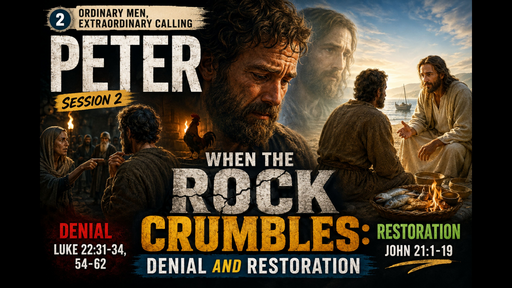
Ordinary Men, Extraordinary Calling • Sermon • Submitted • Presented • 32:49
0 ratings
· 13 viewsFiles
Notes
Transcript
"When the Rock Crumbles: Denial and Restoration"
"When the Rock Crumbles: Denial and Restoration"
SCRIPTURE: Luke 22:31-34, 54-62 (denial); John 21:1-19 (restoration)
SCRIPTURE: Luke 22:31-34, 54-62 (denial); John 21:1-19 (restoration)
INTRODUCTION
INTRODUCTION
If Session 1 showed us Peter's call, this session shows us his crisis — and it's the crisis every serious study of Peter has to reckon with honestly. This is not a minor stumble. Peter, the man who confessed "You are the Christ, the Son of the living God" (Matthew 16:16), the man who walked on water, the man in Jesus' inner circle at the Transfiguration and in Gethsemane — this man will look a servant girl in the eye and swear he never knew Jesus at all.
We're not going to soften that. The Bible doesn't.
The Warning (Luke 22:31-34)
The Warning (Luke 22:31-34)
Before the denial happens, Jesus tells Peter it's coming — and tells him something else at the same time that's easy to miss:
"Simon, Simon, behold, Satan demanded to have you, that he might sift you like wheat, but I have prayed for you that your faith may not fail. And when you have turned again, strengthen your brothers." (Luke 22:31-32, ESV)
Notice the structure. Exēitēsato (ἐξῃτήσατο) — "demanded" — is a strong legal term, like a formal request granted by a court. Satan has asked for permission to test Peter, the way he asked for permission to test Job. But Jesus' response isn't to prevent the sifting — it's to pray that Peter's faith won't ultimately fail through it. And then Jesus says something remarkable: "when you have turned again" — not "if." Jesus predicts both the fall and the recovery in the same breath.
This matters for how we read everything that follows. Peter's denial isn't a surprise to Jesus, and it isn't the end of the story from Jesus' perspective — it's a passage Peter has to go through, not a wall he crashes into and stays behind.
Peter's response shows us exactly the overconfidence that will set up his fall:
"Lord, I am ready to go with you both to prison and to death." (Luke 22:33, ESV)
Jesus' reply is blunt: "the rooster will not crow this day, until you deny three times that you know me" (v.34). Peter trusts his own resolve more than he trusts Jesus' warning — a pattern that shows up more than once in his story (recall Matthew 16:22, where Peter rebukes Jesus for predicting His own death).
The Denial (Luke 22:54-62)
The Denial (Luke 22:54-62)
Jesus is arrested and taken to the high priest's house. Peter follows — Luke tells us he followed "at a distance" (v.54), which is itself a small, telling detail. He hasn't abandoned Jesus entirely, but he's no longer close.
Three denials follow in rapid succession, each one escalating:
First denial (v.56-57) — A servant girl, staring at him in the firelight, says "This man also was with him." Peter's response: "Woman, I do not know him."
Second denial (v.58) — Someone else identifies him: "You also are one of them." Peter: "Man, I am not."
Third denial (v.59-60) — About an hour later, someone insists with real confidence: "Certainly this man also was with him, for he too is a Galilean." Matthew's account adds that Peter began "to invoke a curse on himself and to swear, 'I do not know the man'" (Matthew 26:74) — the language intensifies from simple denial to oath-taking, the kind of thing a man does when he's cornered and desperate.
Then Luke includes a detail none of the other Gospels record, and it's the most devastating verse in the whole account:
"And immediately, while he was still speaking, the rooster crowed. And the Lord turned and looked at Peter. And Peter remembered the saying of the Lord... And he went out and wept bitterly." (Luke 22:60-62, ESV)
Enebletsen (ἐνέβλεψεν) — Jesus "looked at" Peter, a direct, sustained gaze. Picture the scene: Jesus has just been beaten and mocked, standing bound in the courtyard, and in the middle of His own suffering He turns and looks at the man who just denied Him three times. No words. Just a look. And that look breaks Peter completely — eklausen pikrōs, "wept bitterly," the same intensity of grief used elsewhere for mourning the dead.
What the Denial Reveals
What the Denial Reveals
It's worth pausing here rather than rushing to the restoration, because the denial itself teaches something the church needs regularly. Peter's failure wasn't a failure of belief — he still believed Jesus was who He said He was. It was a failure of courage under pressure, from a man who, hours earlier, had drawn a sword to defend Jesus physically (John 18:10) but couldn't withstand the social pressure of a servant girl's question. Bravery in one moment doesn't guarantee bravery in the next. Physical courage and social courage are not the same thing, and most of us are stronger in one than the other.
The Restoration (John 21:1-19)
The Restoration (John 21:1-19)
John's Gospel gives us the resolution, and it's constructed with obvious intentionality. Peter, uncertain what to do after the resurrection, goes back to fishing (John 21:3) — echoing exactly where his story with Jesus began. Jesus appears on the shore, and once again there's a miraculous catch of fish (v.6), echoing Luke 5 unmistakably. John recognizes Jesus first and says so; Peter, characteristically, doesn't wait — he throws himself into the water to get to Jesus faster than the boat can carry him (v.7).
After breakfast on the beach, Jesus asks Peter the same question three times:
"Simon, son of John, do you love me more than these?" (John 21:15, ESV)
Three questions to match three denials — the symmetry is deliberate. There's a well-known observation about the Greek verbs used here: the first two times Jesus asks using agapaō (ἀγαπάω, sacrificial, committed love) and Peter answers with phileō (φιλέω, warm affection, friendship-love), as though Peter — humbled now — won't overclaim the way he once did. By the third question, Jesus shifts to phileō Himself, meeting Peter where he actually is rather than demanding language Peter isn't yet ready to use. (This distinction is debated among scholars as possible synonym variation in Koine usage, but even if the verbs overlap more than older commentators assumed, the threefold structure mirroring the threefold denial is undisputed and is clearly the main point of the passage.)
Each time Peter answers, Jesus responds with a commission: "Feed my lambs... Tend my sheep... Feed my sheep" (v.15-17). This is the fulfillment of Luke 22:32 — "when you have turned again, strengthen your brothers." Restoration isn't just forgiveness given privately; it's responsibility restored publicly. Jesus doesn't sideline Peter after the failure. He puts him back in charge of the flock.
The chapter ends with Jesus predicting the manner of Peter's eventual death (v.18-19) — reliable early church tradition (Tertullian, Eusebius) holds that Peter was crucified in Rome under Nero, and asked to be crucified upside down, not considering himself worthy to die in the same manner as his Lord. The man who once denied Jesus to save his own life would ultimately give his life rather than deny Him again.
Character Notes for Discussion
Character Notes for Discussion
Peter's failure was foreknown and even factored into Jesus' plan for him — the sifting was permitted, not prevented, because it would produce someone able to "strengthen the brothers."
Restoration in Scripture is rarely just an internal, private feeling — it typically comes with renewed responsibility. Jesus doesn't just forgive Peter; He re-commissions him.
The specificity of "three" — three denials, three questions, three commissions — shows how deliberately God addresses specific sin, not just sin in general terms.
Discussion Questions
Discussion Questions
Jesus prayed for Peter's faith before the fall, not to prevent the fall. How does that change the way you think about your own seasons of failure?
Peter denied Jesus most strongly under social pressure, not persecution or violence. Where are you most likely to deny Christ — not verbally necessarily, but through silence or distance?
Jesus restored Peter with a job, not just a private word of comfort. Has God ever called you back into service in the exact area where you'd failed?
Closing
Closing
The rock cracked. But the story doesn't end at the crack — it ends with Jesus looking a broken man in the eye, not to condemn him, but to call him back to the water one more time. Next session, we'll watch that restored man stand up in front of thousands at Pentecost and never look back.
