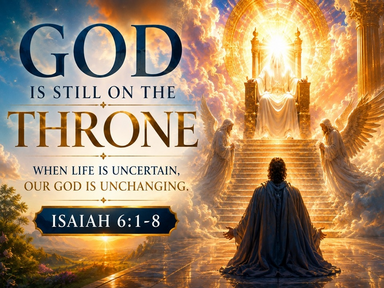
God is Still on the Throne

Notes
Transcript
The Throne is Still Occupied
Rev. Derek Geldart
Reverence / Isaiah 6:1-8
Though it may not feel like it when living in this fallen word, God is still on the throne you just have to see Him
Chaos is what we experience when the things we thought were stable begin to shake, the future becomes uncertain, and circumstances seem beyond anyone's control.
Imagine what it would be like to step inside an Avatar movie-not simply watching it on a screen, but experiencing it through virtual reality. You find yourself dressed in a T-shirt and shorts, sitting in a small wooden boat that appears to be held together by little more than pitch from a pine tree. That might be disturbing if you weren't surrounded by breathtaking beauty. Along the shoreline rises a magnificent rainforest alive with brilliant colors. Multicolored birds sweep through the trees, butterflies drift above the water, and a deer stands quietly at the river's edge, staring at its reflection as it drinks from the crystal-clear stream.
The little boat gently carries you downstream. You lie back, rest your head against the wooden boards, and stare into a brilliant blue sky decorated with clouds like painted portraits of unimaginable beauty. You trail your hand through the cool water, making gentle ripples beside the boat, and think to yourself, I can't imagine a more beautiful place. And then-everything changes. The current begins to quicken. The little boat starts to rock. The peaceful river suddenly becomes violent, and the hand that moments ago was making gentle ripples is now being dashed against sharp, jagged rocks. You sit up. Ahead of you are rapids-and beyond them, the river seems to disappear.
You grab the oars and desperately pull toward shore, but the current is too strong. You paddle harder. The boat spins. The water roars. And then you hear something terrifying-the deafening thunder of thousands of gallons of water crashing somewhere ahead. A waterfall! There is nowhere to go. Within moments, the current seizes the little boat and hurls you over the edge. You plunge into darkness. The boat splinters beneath you, and the tremendous force of the water drives you deeper and deeper beneath the surface. Your lungs begin to burn. You struggle desperately for air, but you don't even know which way is up. Then suddenly the current catches you again. This time it pulls you upward. The darkness begins to disappear. You see bubbles rushing past your face. Then light. Sunlight glistens through the water above you. Your head finally breaks through the surface, and you gasp. Air fills your burning lungs, and with every breath hope floods back into your terrified heart. Slowly, exhausted, you swim toward shore. Your hands finally touch smooth stones, and you pull yourself from the water and collapse onto the riverbank.
For a few moments you simply lie there, thankful to be alive. Then you raise your head, and once again you are surrounded by breathtaking beauty. The raging waters that nearly destroyed you now cascade over the cliff as one of the most magnificent waterfalls you have ever seen. Around it stand towering trees, brilliant flowers, and colourful birds-a landscape clothed in splendour greater than the robes of the richest king. Only moments ago you were resting peacefully in paradise. Then you were fighting for your life. And now, once again, you are surrounded by indescribable beauty.
While Avatar is only the product of human imagination, the world it portrays-with breathtaking beauty one moment and terrifying danger the next-bears a striking resemblance to the world in which we live. Creation itself bears the scars of the Fall. Paul tells us that "the whole creation has been groaning as in the pains of childbirth right up to the present time" (Romans 8:22, NIV). And we hear that groaning all around us. Wars rage in Ukraine, Gaza, Sudan and other parts of the world, while tensions between powerful nations continue to rise. Economic and trade uncertainty has become almost normal, and families feel the pressure of rising prices. Earthquakes and floods destroy communities and displace thousands from their homes. Wildfires consume forests and towns, while droughts leave other regions desperate for rain. We live in a beautiful world-but it is also a broken world.
And much like that little boat on the river, life can sometimes feel like a journey through circumstances we cannot control. One moment the waters are calm, the sun is shining, and life seems wonderfully good. Then, without warning, the current changes. A diagnosis comes. A job disappears. A relationship breaks. A war begins. An economy falters. Someone we love is suddenly gone. We enjoy the journey when it carries us through the mountains of blessing, but we become frightened when the same unpredictable journey suddenly plunges us into the valleys of tribulation. We cannot see around the next bend, and sometimes we have no idea where the current is taking us.
But there is something profoundly hopeful about Paul's description of creation's groaning. He does not compare it to the groaning of death, but to the pains of childbirth (Romans 8:22). The pain is real, but it is not meaningless. Something is coming. This fallen creation will not remain this way forever. Christ will return, creation will be liberated from its bondage to decay, our bodies will be redeemed, and ultimately God will declare, "I am making everything new!" (Romans 8:21-23; Revelation 21:5, NIV). The world may be groaning, but God has not abandoned it. The world may appear chaotic, but God has not lost control. And that brings us to the prophet Isaiah. Isaiah also lived in a world of change, uncertainty and national anxiety. In Isaiah 6, a king who had occupied Judah's throne for more than half a century had died, an era had ended, and the future seemed uncertain. Yet in that very year, Isaiah was given a vision that changed everything: "In the year that king Uzziah died I saw also the Lord sitting upon a throne, high and lifted up" (Isaiah 6:1, KJV).
Today, as we look at Isaiah's vision and commission, I want us to discover a truth that God's people desperately need in every uncertain generation: when life becomes uncertain, our peace is not found in unchanging circumstances, but in the unchanging King who reigns forever.
Earthly Thrones are Temporary
Isaiah 6:1 NIV
In the year that King Uzziah died, I saw the Lord, high and exalted, seated on a throne; and the train of his robe filled the temple.
To understand the significance of Isaiah's words, "In the year that King Uzziah died" (Isaiah 6:1), we need to understand something about the world in which Isaiah lived. Uzziah did not inherit a peaceful and secure kingdom. His father Amaziah became king at twenty-five years of age, and Scripture tells us that "he did what was right in the eyes of the LORD, but not wholeheartedly" (2 Chronicles 25:1-2). Amaziah assembled an army of 300,000 fighting men and then hired another 100,000 soldiers from Israel. When a man of God warned him not to depend upon the Israelite troops, Amaziah eventually listened and sent them home (2 Chronicles 25:5-10). God subsequently gave Judah a great victory over Edom (2 Chronicles 25:11-12).
But success changed Amaziah. After defeating the Edomites, he brought home their gods, bowed down before them, and offered sacrifices to them (2 Chronicles 25:14). Think about the foolishness of that! Amaziah defeated a nation and then began worshipping the very gods that had been unable to save the people he had just defeated. When God sent a prophet to confront him, Amaziah refused to listen (2 Chronicles 25:15-16). Eventually, he went to war against Israel. Judah was routed, Amaziah was captured, part of Jerusalem's wall was torn down, and the treasures of the temple and palace were carried away (2 Chronicles 25:20-24). Years later, Amaziah's own people conspired against him, and he was killed (2 Chronicles 25:27-28). His reign, which had begun with such promise, ended in defeat, humiliation, and death.
Then came Uzziah. He was only sixteen years old when he became king, but he would reign for an extraordinary fifty-two years (2 Chronicles 26:1-3). Scripture tells us that "he did what was right in the eyes of the LORD" and that "as long as he sought the LORD, God gave him success" (2 Chronicles 26:4-5). Under Uzziah, Judah became strong again. He defeated the Philistines and other enemies. The Ammonites brought him tribute, and his fame spread as far as the border of Egypt (2 Chronicles 26:6-8). He built and fortified towers in Jerusalem and throughout the countryside. He developed agriculture, strengthened the nation's defenses, and commanded an army of more than 300,000 trained fighting men (2 Chronicles 26:9-13). He even equipped Jerusalem's defenses with specially designed machines capable of shooting arrows and hurling large stones from its towers (2 Chronicles 26:14-15). Scripture says, "His fame spread far and wide, for he was greatly helped until he became powerful" (2 Chronicles 26:15, NIV).
For fifty-two years, Uzziah had been a symbol of strength, prosperity, and stability. Think about how long that is. Entire generations had been born, raised families, and grown old knowing no other king. Uzziah was simply part of life in Judah. But then we read one of the saddest sentences in his story: "But after Uzziah became powerful, his pride led to his downfall" (2 Chronicles 26:16, NIV). Uzziah entered the temple and attempted to burn incense before the Lord, something God had reserved for the priests. Azariah the priest, along with eighty other courageous priests, confronted the king and warned him that he had been unfaithful to God (2 Chronicles 26:17-18). Instead of humbling himself, Uzziah became enraged, and while he was raging against the priests, leprosy suddenly appeared on his forehead (2 Chronicles 26:19-20). The mighty king who had commanded armies could not command the disease in his own body. The king who had built towers to protect Jerusalem could not protect himself from the judgment of God. The man whose fame had spread far and wide was now forced to live in isolation. Uzziah remained a leper until the day he died, separated from others and excluded from the temple of the Lord, while his son Jotham took charge of the palace and governed the people (2 Chronicles 26:21).
And then, after fifty-two years, Uzziah died. Imagine what his death must have represented to the people of Judah. For more than half a century, Uzziah's reign had been associated with relative stability, military strength, prosperity, and national security. Now the king who had symbolized all of that was gone. To the northeast, the mighty Assyrian Empire was becoming an increasingly ominous presence. Yes, Jotham had already been governing the people during his father's illness, so Judah was not without leadership. But something much larger had happened: an era had ended. The familiar was disappearing, the future was uncertain, and one of the great symbols of Judah's earthly security had been taken away. And perhaps that is why the opening words of Isaiah 6 are so powerful: "In the year that King Uzziah died, I saw the Lord, high and exalted, seated on a throne..." (Isaiah 6:1, NIV). Uzziah's throne had changed hands-but God's throne had not. The king who had ruled Judah for fifty-two years was dead, but the King of kings was still alive. Uzziah's power had failed; God's power had not. Uzziah's reign had ended; God's reign never would.
And therein lies the first great lesson Isaiah's vision teaches us: earthly thrones are temporary. Every human source of security eventually changes. Kings die. Governments change. Economies rise and fall. Nations become powerful and then decline. Careers end. Health fails. Possessions disappear. Even the people we love eventually leave us. Scripture warns us, "Do not put your trust in princes, in human beings, who cannot save" (Psalm 146:3, NIV). There is nothing wrong with being thankful for seasons of stability and blessing. Uzziah's prosperity itself had been a gift from God (2 Chronicles 26:5, 15). The danger comes when we begin trusting the blessing instead of the One who gave it. Sometimes God allows an earthly throne to become empty so that we remember which throne was holding us all along.
Heaven's Thone is Never Empty
And that is exactly where Isaiah's eyes are drawn. While everything on earth was subject to change, Isaiah looked beyond the turbulence of his circumstances and saw the One who never changes. There, "high and exalted, seated on a throne" (Isaiah 6:1), was the sovereign Lord of all creation-the One who made and rules over "all things... visible and invisible" (Colossians 1:16, NIV). Isaiah's vision is not unique. Again and again, when Scripture pulls back the curtain and allows us to glimpse the throne room of heaven, the throne is occupied. Micaiah saw "the LORD sitting on his throne with all the multitudes of heaven standing around him" (1 Kings 22:19, NIV). Centuries later, John was taken through an open door into heaven and immediately declared, "there before me was a throne in heaven with someone sitting on it" (Revelation 4:2, NIV). Around that throne, the four living creatures never cease declaring, "Holy, holy, holy is the Lord God Almighty," while the twenty-four elders fall before the One who lives forever and ever and worship Him (Revelation 4:8-11). Heaven is not portrayed as confused, frightened, or desperately trying to respond to events on earth. At the center of everything stands a throne, and upon that throne sits God. Earth may be filled with uncertainty, but heaven's throne is never empty.
What a beacon of hope that vision becomes when we find ourselves being tossed about by the turbulent waters of life! We love the seasons when the water is calm-when our families are well, our health is good, our employment is secure, and tomorrow appears predictable. But calm waters rarely last forever. Wars erupt. Economies falter. Disease comes. Marriages break. Jobs disappear. Prices rise. People we love die. Solomon observed life "under the sun" and concluded that "time and chance happen to them all" (Ecclesiastes 9:11, NIV). From where we stand, we simply cannot see what is waiting around the next bend. That uncertainty can frighten us so deeply that we spend our lives trying to construct enough wealth, power, possessions, insurance, and earthly security to protect ourselves from every possible tomorrow. There is wisdom in preparing responsibly for the future (Proverbs 21:5), but there is no amount of preparation that can place tomorrow completely within our control.
And perhaps that is part of what God wants us to learn: we were never meant to control tomorrow; we were meant to trust the One who already rules over it. Paul describes us as fragile "jars of clay," hard pressed, perplexed, persecuted, and struck down, yet sustained by an "all-surpassing power" that comes from God and not from ourselves (2 Corinthians 4:7-9). Our security was never supposed to be found in the strength of the jar, but in the power of the God who holds it. Jesus therefore tells us, "do not worry about tomorrow" (Matthew 6:34, NIV). Not because tomorrow contains no trouble, but because tomorrow is already under the sovereign care of our Father. And what makes this sovereign King so precious to us is that the God who rules the universe is not distant from the people who belong to Him. The One seated upon heaven's throne invites us to find refuge beneath His wings (Psalm 91:4). When one sheep wanders, the Shepherd goes after the one that is lost until He finds it (Luke 15:4-6). He knows His sheep personally and "calls his own sheep by name" (John 10:3, NIV). And when the burdens of life become too heavy for us to carry, Jesus says, "Come to me, all you who are weary and burdened, and I will give you rest" (Matthew 11:28-30, NIV).
So when the current suddenly changes and we find ourselves once again being swept through the rapids of life, our hope is not that the rapids are imaginary. The pain is real. The loss is real. The uncertainty is real. But the appearance that no one is in control is an illusion. Above the storm, above the nations, above our circumstances, and above every unknown tomorrow, the King is still in the room. The throne is still occupied. And the God who sits upon it knows His children by name.
Heaven is Filled with Worship, Not Panic
Isaiah 6:2-4 NIV
Above him were seraphim, each with six wings: With two wings they covered their faces, with two they covered their feet, and with two they were flying. And they were calling to one another:
"Holy, holy, holy is the LORD Almighty;
the whole earth is full of his glory."
At the sound of their voices the doorposts and thresholds shook and the temple was filled with smoke.
And as Isaiah's eyes move from the One seated upon the throne to those gathered around it, he discovers something remarkable: heaven is not filled with panic over what is happening on earth; it is filled with worship of the God who reigns over it! Notice the posture of the seraphim. Each had six wings: "With two wings they covered their faces, with two they covered their feet, and with two they were flying" (Isaiah 6:2, NIV). These magnificent heavenly beings who minister in the very presence of God do not approach Him casually. They cover their faces before His overwhelming holiness, cover their feet in humility, and with the remaining two wings stand ready to serve Him. Their posture says what their voices proclaim: God is holy, God is worthy, and God alone is King.
Shouldn't that be our posture as well? What a privilege it is to come into the presence of this holy and sovereign God and, like Mary, sit at the feet of His Son, listening to His words and submitting ourselves to His authority (Luke 10:39). When we truly understand who sits upon the throne, our fear of those who possess only temporary earthly power begins to lose its grip upon us. Jesus said, "Do not be afraid of those who kill the body but cannot kill the soul" (Matthew 10:28, NIV). Why should the child of God be paralyzed by earthly powers when our lives are held securely in the hands of the eternal King? Christ promises that His sheep will never perish and that no one can snatch them from His hand or from His Father's hand (John 10:27-29). When the rulers of nations threaten, boast, wage war, and appear to determine the destiny of the world, we can remember that there is a throne infinitely higher than theirs. Scripture declares, "It is God who judges: He brings one down, he exalts another" (Psalm 75:7, NIV), and Daniel reminds us that God "deposes kings and raises up others" (Daniel 2:21, NIV). Earthly rulers may exercise authority for a season, but they never exercise authority outside the sovereignty of God. Every crown is temporary, every throne is borrowed, and every ruler will ultimately answer to the King who gave them breath. And one day, every knee will bow and every tongue confess that Jesus Christ is Lord (Philippians 2:10-11).
When We See God Correctly, We See Ourselves Correctly
Isaiah 6:5 NIV
"Woe to me!" I cried. "I am ruined! For I am a man of unclean lips, and I live among a people of unclean lips, and my eyes have seen the King, the LORD Almighty."
While coming before the sovereign King gives us peace, standing in the presence of His perfect holiness is also profoundly humbling. Isaiah has seen the Lord high and exalted, heard the seraphim cry, "Holy, holy, holy," and watched as the temple filled with smoke and its foundations shook (Isaiah 6:1-4). Overwhelmed, Isaiah cries, "Woe to me!... I am ruined!" (Isaiah 6:5). The word "ruined" carries the idea of coming undone-as though Isaiah is unraveling before the absolute holiness of God [2]. What makes his response remarkable is that Isaiah was already a prophet devoted to God's service. Yet the clearer Isaiah saw God, the clearer Isaiah saw himself. His "unclean lips" represented more than improper words; they revealed the moral uncleanness that characterized both himself and the people among whom he lived [3][4]. Isaiah stopped measuring himself against other sinners and found himself measured against the holiness of God. He had seen "the King, the LORD Almighty" (Isaiah 6:5), and every illusion of his own goodness disappeared.
When we see God correctly, we begin to see ourselves correctly. That pattern appears throughout Scripture. Job encountered God and repented "in dust and ashes" (Job 42:6), while Peter fell before Jesus and cried, "Go away from me, Lord; I am a sinful man!" (Luke 5:8). Divine holiness can be deeply uncomfortable because it exposes what comparison with others allows us to overlook [5]. Before a holy God, we recognize our failure, confess our sin, and acknowledge our desperate need for mercy [6]. But Isaiah's cry of "I am ruined" was not the end of his story. His conviction was preparing him for what came next: the God who revealed his sin was about to provide the cleansing Isaiah could never provide for himself.
God Cleanses Before He Commissions
Isaiah 6:6-8 NIV
Then one of the seraphim flew to me with a live coal in his hand, which he had taken with tongs from the altar. With it he touched my mouth and said, "See, this has touched your lips; your guilt is taken away and your sin atoned for."
Then I heard the voice of the Lord saying, "Whom shall I send? And who will go for us?"
And I said, "Here am I. Send me!"
Isaiah stood before the throne convinced that he was ruined, but the God who exposed his sin had no intention of leaving him there-God was about to do for Isaiah what Isaiah could never do for himself. A vision of God's holiness produces conviction of sin; Isaiah felt deeply the corruption of his lips-the very instrument of his prophetic ministry-and the corruption of the people among whom he lived [7]. In the light of God's holiness, the darkness of our sin is exposed, and even our righteous acts are revealed as "filthy rags" (Isaiah 64:6). Yet the God who exposes our sin also provides the means of cleansing it. Though "the wages of sin is death" (Romans 6:23), the seraph touched Isaiah's lips with the burning coal from the altar and declared, "your guilt is taken away and your sin atoned for" (Isaiah 6:6-7). This is grace: Isaiah could confess his uncleanness, but only God could take it away. And what Isaiah experienced symbolically at the altar, we receive fully through Jesus Christ, the spotless Lamb chosen before the creation of the world to redeem us by His precious blood (1 Peter 1:18-20). Therefore, for those who belong to Christ, "there is now no condemnation" (Romans 8:1).
And that same grace continues in the life of the believer. When we sin, we are invited not to hide from God but to come to Him in confession, knowing that "he is faithful and just and will forgive us our sins and purify us from all unrighteousness" (1 John 1:9, NIV). Then notice what immediately follows Isaiah's cleansing: "Whom shall I send? And who will go for us?" Isaiah responds, "Here am I. Send me!" (Isaiah 6:8). The man who moments earlier cried, "I am ruined!" now cries, "Send me!" The grace that cleansed Isaiah became the grace that commissioned Isaiah. Likewise, those of us who have been cleansed through Christ are sent into a turbulent world, ready to "give the reason for the hope" that we have (1 Peter 3:15).
Conclusion
As we leave Isaiah's vision, remember that the river of life will not always be calm. There will be bends we cannot see around, rapids we cannot avoid, and valleys we would never have chosen to enter. But when the waters begin to roar, we need not live in fear as though everything is out of control. The throne is still occupied. The God who ruled in the year King Uzziah died is the same God who rules today. Earthly kingdoms will rise and fall, circumstances will change, and tomorrow will sometimes bring things we never expected-but our God remains "high and exalted, seated on a throne" (Isaiah 6:1). Heaven is not panicking. God has not abandoned His people. And nothing that awaits us around the next bend will ever take Him by surprise.
So when the world seems chaotic, do what Isaiah did: look up. Worship Him with the reverence of the seraphim (Isaiah 6:2-3). Come honestly before His holiness (Isaiah 6:5). Receive with gratitude the cleansing and grace He has provided through Jesus Christ (Isaiah 6:6-7; 1 Peter 1:18-20). And then rise with Isaiah and say, "Here am I. Send me!" (Isaiah 6:8). We do not know what waits around the next bend. We do not know when the peaceful waters will become rapids again. But we know the One who rules over every current, every storm, every nation, and every tomorrow. The throne is not empty. The King is not absent. Our God is alive, our God is active, and our God is still on the throne.
Footnotes
[1] John and Chou MacArthur Abner, ed., Think Biblically: Recovering a Christian Worldview (Wheaton, IL: Crossway, 2025), 235-236.
[2] Tony Evans, The Tony Evans Bible Commentary (Nashville, TN: Holman Bible Publishers, 2019), 640
[3] John A. Martin, "Isaiah," in The Bible Knowledge Commentary: An Exposition of the Scriptures, ed. J. F. Walvoord and R. B. Zuck (Wheaton, IL: Victor Books, 1985), 1:1045.
[4]Larry L. Walker, Elmer A. Martens, Cornerstone Biblical Commentary: Isaiah, Jeremiah, & Lamentations (Carol Stream, IL: Tyndale House Publishers, 2005), 13.
[5] R.C. Sproul, Before the Face of God: Book 3: A Daily Guide for Living from the Old Testament (Grand Rapids: Baker Book House; Ligonier Ministries, 1994).
[6] Paul L. Redditt, 1 & 2 Chronicles, ed. Leslie Andres and Samuel E. Balentine, Smyth & Helwys Bible Commentary (Macon, GA: Smyth & Helwys, 2020), 126-127.
[7] Andrew M. Davis, Exalting Jesus in Isaiah (Nashville, TN: Holman Reference, 2017), 40.
Page . Exported from Logos Bible Study, 11:40 AM August 29, 2026.
