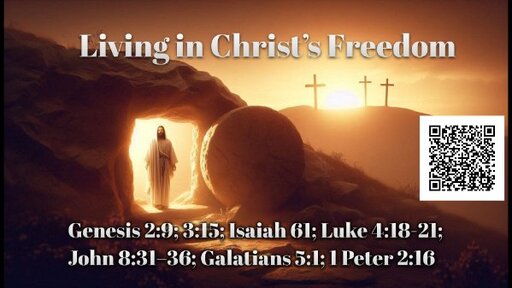
Living in Christ's Freedom

Notes
Transcript
Handout
Freedom! It stirs in each of us passion, longing, sacrifice, and responsibility, for it can be defined as being at the center of the American ethos and human longing.
Freedom as the American ethos begins with the Puritans' fleeing England to practice their faith free from the persecution of the Church of England, and continues with the American Revolution fighting for freedom from taxation without representation. This is embodied in Patrick Henry’s famous quote, “Give me liberty or give me death.”
Freedom, as the American ethos, continues in the Declaration of Independence. It is best represented by the quote: “We hold these truths to be self-evident, that all men are created equal, that they are endowed by their Creator with certain unalienable rights, that among these are life, liberty, and the pursuit of happiness.” In many ways, this has become the American dream, yet it has been disconnected from Jesus, who is the source of life, liberty, and happiness.
Freedom, as the American ethos, was tested in the Civil War, which demonstrated the American belief in freedom as a core value for every human, not contingent upon their status.
Freedom, as the American ethos, was tested once again in the Civil Rights movement of the 1960’s. This is embodied in the I Have a Dream speech of Martin Luther King Jr. with his closing statement: “When we allow freedom to ring—when we let it ring from every city and every hamlet, from every state and every city, we will be able to speed up that day when all of God’s children, black men and white men, Jews and Gentiles, Protestants and Catholics, will be able to join hands and sing in the words of the old Negro spiritual, ‘Free at last, Free at last, Great God a-mighty, We are free at last.’”
Why is there a longing in every human heart to have freedom ring, to be free at last?
It is because we were created free to choose good or evil. This is evident in Genesis 2:9, where God made the Tree of Life and the Tree of (experiencing) Knowledge of Good and Evil, giving Adam and Eve the freedom of choice.
Sadly, we see in Genesis 3 that they used their freedom to satisfy their selfish desires and thus lost their freedom, becoming enslaved to their fallen nature, slaves of the serpent, who is Satan, the god of this world, all because Adam and Eve, our ancestors, gave up their freedom for momentary gain.
Thank God that he did not choose to leave humanity in bondage to their fallen nature nor to the devil. In the midst of his punishment, he gives hope in Genesis 3:15, saying to the serpent, “I will put enmity between you and the woman, and between your offspring and her offspring; he shall bruise your head, and you shall bruise his heel.”
This is the first prophecy of the coming freedom found only in Jesus’ death and resurrection, where Satan and all his host are defeated; his head is crushed, bringing spiritual freedom at his First Coming to all who believe and, at his Second Coming, physical freedom to the whole world. Come, Lord Jesus, come!
The work of God setting humanity free to love and serve him continues with the Israelites in Exodus, where he, through Moses, commands Pharaoh, “Let My people go, so that they may worship Me in the wilderness...”
We all know that this was not the ultimate freedom God had for Israel or for the world, for they would continue to suffer under the bondage of the fallen nature and the god of this world. Those who lived in faithful loyalty to Yahweh would gain glimpses of the freedom which he had in store.
The prophet Isaiah, by inspiration of the Holy Spirit, reveals their hopes of freedom in Isaiah 61 with the prophecy of Jesus bringing spiritual freedom in his First Coming and physical freedom in his Second Coming. Look at Isaiah 61:1-3 with me.
The Spirit of the Lord God is upon me,
because the Lord has anointed me
to bring good news to the poor;
he has sent me to bind up the brokenhearted,
to proclaim liberty to the captives,
and the opening of the prison to those who are bound;
to proclaim the year of the Lord’s favor,
and the day of vengeance of our God;
to comfort all who mourn;
to grant to those who mourn in Zion—
to give them a beautiful headdress instead of ashes,
the oil of gladness instead of mourning,
the garment of praise instead of a faint spirit;
that they may be called oaks of righteousness,
the planting of the Lord, that he may be glorified.
Jesus confirms, roughly 500 years later, that this prophecy is about him in Luke 4:18-21
“The Spirit of the Lord is upon me,
because he has anointed me
to proclaim good news to the poor.
He has sent me to proclaim liberty to the captives
and recovering of sight to the blind,
to set at liberty those who are oppressed,
to proclaim the year of the Lord’s favor.”
And he rolled up the scroll and gave it back to the attendant and sat down. And the eyes of all in the synagogue were fixed on him. And he began to say to them, “Today this Scripture has been fulfilled in your hearing.”
He chose to end in the middle of the thought to distinguish between his First and Second Coming. At his First Coming, he brought spiritual freedom (freedom from sin and death) for all who believe in his death and resurrection. At his Second Coming, he will bring physical freedom for all who believe, ultimately with the New Heaven and Earth.
How do we answer our longing for freedom now?
Jesus gives us the answer in John 8:31-36. Let’s look at it together.
So Jesus said to the Jews who had believed him, “If you abide in my word, you are truly my disciples, and you will know the truth, and the truth will set you free.” They answered him, “We are offspring of Abraham and have never been enslaved to anyone. How is it that you say, ‘You will become free’?”
Jesus answered them, “Truly, truly, I say to you, everyone who practices sin is a slave to sin. The slave does not remain in the house forever; the son remains forever. So if the Son sets you free, you will be free indeed.
Jesus gives us the key to having freedom now in five parts.
First, we must believe in him.
To believe in Jesus is not just to give intellectual assent; the devil and his minions do that. It is to believe in his work (his death and resurrection) and to obey his word.
Second, we must abide in him.
To abide in him is to stay in relationship with him in all aspects of our lives.
Third, we must know the truth.
To know the truth, we must accept that he is the source of all truth and not believe the cultural lie that truth is relative to each person. Truth is objective and discovered through our relationship with Jesus.
Fourth, we must not practice sin.
To not practice sin is to walk in humility, repenting of our sins, knowing that he has forgiven us and set us free from sin and death. If we will not walk in humility, repenting of our sins, then we are using our freedom to be enslaved once again.
Fifth, we must live in the reality of his freedom, for he has set us free.
Paul said it well in Galatians 5:1: “For freedom Christ has set us free; stand firm therefore, and do not submit again to a yoke of slavery.” Peter puts it another way in 1 Peter 2:16: “Live as people who are free, not using your freedom as a cover-up for evil, but living as servants of God.”
My challenge for all of us is to first believe in Jesus' death and resurrection and receive the freedom he has purchased with his own blood.
Second, it is to not use our freedom for selfish desires, i.e., sin, but to use our freedom to serve God and love our fellow man.
Go, live in Christ’s freedom, looking forward to his second coming bringing ultimate freedom.
