Why the New Covenant
Notes
Transcript
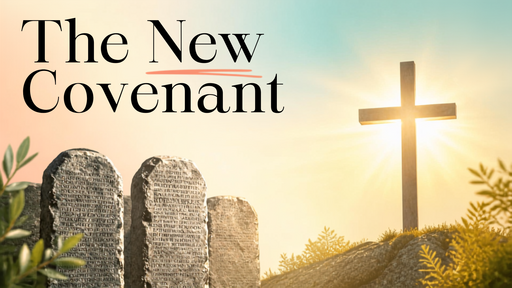
The New Covenant
Why the New Covenant? - Jeremiah 31:31-34
September 6, 2026
When I first arrived at a local resort back in 2018 to take over their HR Department, I had two very difficult tasks to handle - literally in the first week. First, I had to write up both of my managers (losing one of them just months later) and lay off a Sales Manager. This, of course, was after the previous HR leader effectively walked out on them. Sometimes we're tasked with a difficult situation under difficult circumstances. Jeremiah's story, without a doubt, placed him in a difficult situation under difficult circumstances as well, but obviously stumps my story by ... a whole lot.
Jeremiah's ministry spanned about 50 years, if we were to use the timeline found in this book. He prophesied during the reign of five different kings (some good, some not), and his ministry was primarily for the "HOUSE OF JUDAH" (which was the Southern Kingdom of Israel).
Jeremiah's message was not a "fun" message to deliver. For much of the book, he is warning them about destuction and calling them to repentance. Yet, as expected, they do not turn from their ways, and ended up being destroyed anyway. This was difficult for Jeremiah. In fact, he was called the "weeping prophet" due to the message, the lack of response, and his own sacrifices as he had the burden to carry this message, and the results of their lack of response. As a priest and prophet, Jeremiah 13 tells us that he wept over the people. Personally, we see in chapter 16 that he could not marry or have children. He had a heavy burden to carry.
Unfortunately, despite Jeremiah's warnings, much of the book shows that the warnings were largely ignored. As we have seen time and time again - even in our last series in Genesis, the Lord always provides hope. That's largely found in chapter 31 in the verses we'll be covering today and for the next several weeks. What was that hope? The promise of a "NEW COVENANT."
Over the next several weeks, we will do a short series on the new covenant. Naturally, we will want to begin this series in the passage that we were given this new covenant. So, we'll be in Jeremiah 31:31-34 this morning. Jeremiah can be found in the Old Testament between Isaiah and Lamentations.
Let's see what the Lord says to Jeremiah, beginning in verse 31:
31 "BEHOLD, THE DAYS ARE COMING, DECLARES THE LORD, WHEN I WILL MAKE A NEW COVENANT WITH THE HOUSE OF ISRAEL AND THE HOUSE OF JUDAH, 32 NOT LIKE THE COVENANT THAT I MADE WITH THEIR FATHERS ON THE DAY WHEN I TOOK THEM BY THE HAND TO BRING THEM OUT OF THE LAND OF EGYPT, MY COVENANT THAT THEY BROKE, THOUGH I WAS THEIR HUSBAND, DECLARES THE LORD.
33 FOR THIS IS THE COVENANT THAT I WILL MAKE WITH THE HOUSE OF ISRAEL AFTER THOSE DAYS, DECLARES THE LORD: I WILL PUT MY LAW WITHIN THEM, AND I WILL WRITE IT ON THEIR HEARTS. AND I WILL BE THEIR GOD, AND THEY SHALL BE MY PEOPLE.
34 AND NO LONGER SHALL EACH ONE TEACH HIS NEIGHBOR AND EACH HIS BROTHER, SAYING, 'KNOW THE LORD,' FOR THEY SHALL ALL KNOW ME, FROM THE LEAST OF THEM TO THE GREATEST, DECLARES THE LORD. FOR I WILL FORGIVE THEIR INIQUITY, AND I WILL REMEMBER THEIR SIN NO MORE."
Before we continue, I think there are at least two words the need to be defined.
First, the term "NEW." I know ... seems silly to define this well understood term ... however, we're talking about the Hebrew word, not the English word.
The Hebrew term used here resembles the ideal of "renewal" or "repair" or something "fresh" or "rebuild" or "rejuvenate." So, in this context, the Lord - with the purpose of restoring His people to Himself - offers a "NEW" or better way to be reconciled.
In this case, the language used for this "better way" is a "NEW COVENANT," which means we need to define next - COVENANT.
In its simplest form, a covenant is an agreement between two parties. In the context of a biblical covenant, it's a binding promise between God and His people. One author put it this way: Covenants are one of the most important themes in the Bible-they are the key to God's redemptive plan to restore humanity to its divine calling.
So, putting this together, why is this "new covenant" necessary?
Let me attempt to answer this with our main idea:
God invites us into a new relationship with
Him through the new covenant.
So, with this in mind, let's explore ...
HOW THE NEW COVENANT WORKS
First,
* God gives us a new heart (v.33)
o The first part of this new covenant relates to the idea of a new heart.
o What makes this heart renewed?
o In part, the answer is found in verse 32 with the mention of the covenant made with "THEIR FATHERS"
o This refers to the covenant made with Moses, and the distribution of the Law.
o So, what happens to this "Law?"
o The "new" law is written on the heart.
o This phrase means that the Lord is shifting the relationship from external to internal.
o Why the change of heart?
o Jeremiah said back in 17:9 that THE HEART IS DECEITFUL ABOVE ALL THINGS, AND DESPERATELY SICK
o Jesus, in John 3:3, told Nicodemus that UNLESS ON IS BORN AGAIN HE CANNOT SEE THE KINGDOM OF GOD.
o The new covenant is superior to the old covenant.
o How do we receive this new heart?
o Well, we must be born again. How?
o Jesus Christ - the promised Messiah.
o In Luke 22:20, Jesus, when instituting the Lord's Supper, says THIS CUP THAT IS POURED OUT FOR YOU IS THE NEW COVENANT IN MY BLOOD, pointing us to His death.
o You see, through Jesus, this new covenant was inaugurated.
o The new covenant allows us to have a new relationship with God.
o One that only His Son could offer.
o John the Baptist knew this, he said this in John 3:36: WHOEVER BELIEVES IN THE SON HAS ETERNAL LIFE; WHOEVER DOES NOT OBEY THE SON SHALL NOT SEE LIFE, BUT THE WRATH OF GOD REMAINS ON HIM.
o Do you believe in the Son?
o Through the new covenant, God gives us a new heart.
o Through the new covenant, we see next that ...
* God gives us Himself (vv.33-34)
o The next promise that the new covenant provides is that He will be ours, and we will be His.
o Part of the implication here is that we will personally know God.
o When we have His Word in our hearts, we will be more aligned with Him.
o When verse 34 says that we will know Him, it implies a deep and personal relationship. Once again, one that is only possible through Jesus.
o Jesus Himself said that no one comes to the Father unless they are called to Him.
o You see, He is calling us to Himself.
o Notice the audience of this new covenant - it begins with both the Northern and the Southern Kingdom, and later, we see with Jesus, and later through the Apostles, that it is extended to those who follow Jesus.
* We'll explore this more in Hebrews in the next couple of weeks.
o It's no wonder the bible says in Exodus 20:5 that God is a jealous God.
o This is to say that because He is God, He is deserving of our whole devotion.
o In this context, and the context of Exodus 20 (the old law, if you will), God is showing His desire and devotion to His most treasured creation.
o In fact, the basis of the Law is found (again) in Exodus 20, where the Lord prefaces the giving of the Law this way: I AM THE LORD YOUR GOD, WHO BROUGHT YOU OUT OF THE LAND OF EGYPT, OUT OF THE HOUSE OF SLAVERY. (Exodus 20:2)
o In other words, God reminded Moses - and through him, His people - that He was the one who gave them new life, therefore, they were to respond by following Him in obedience.
o This new covenant perfects this union that God once had with His people.
o We have already established in verse 32 that the forefathers broke the old covenant, therefore requiring the new.
o This means that God Himself brings forth the solution to man's failure.
o Man's failure to follow God's law.
o Here's the implication: Christianity is not simply about following [a set of rules, or] better rules -it is about entering a new relationship with God.
o Once again, that can only be done through Christ.
o Finally, we see, in part, how this is accomplished in Christ, namely that ...
* God gives us forgiveness (v.34)
o I mentioned earlier that Jesus inaugurated the new covenant with His blood, so let's head over to Matthew 26:28 to see what this means: FOR THIS IS MY BLOOD OF THE COVENANT, WHICH IS POURED OUT FOR MANY FOR THE FORGIVENESS OF SINS.
o The writer of Hebrews also tells us that WITHOUT THE SHEDDING OF BLOOD THERE IS NO FORGIVENESS OF SINS. (9:22)
o Once again, we see the unity of the Old and the New Testaments.
o Without spoiling anything, the next two weeks, we'll look again at this new covenant through the lens of the writer of Hebrews, who will show us that everything in the Old Testament was a shadow of things to come.
o In other words, it all pointed us to Jesus.
o It all shows us the redemptive plan throughout history, all pointing us to the Messiah.
o The word "FORGIVE" ... means to free from or release from something and so to pardon, to forgive, to spare. God's offer of pardon and forgiveness to sinners. [In fact, this word] is never used of people forgiving each other but used of God forgiving.
o Guzik further says: The sacrificial system under the old covenant could only cover sin and its guilt; the new covenant brings forgiveness so complete that it could be said that God no longer remembers the sin of those connected to Him through the new covenant.
o When we are forgiven, we can enter a restored relationship with our God.
o That is what the new covenant promised.
o A summary of the new covenant reads this way: The New Covenant is God's promise to forgive our sins, transform our hearts, and bring us into a restored relationship with Him through Jesus Christ.
Why would the Creator of the universe give us a way to a restored relationship with us? Because He is motivated by His love for the creation He once called "very good." We all know the verse - FOR GOD SO LOVED THE WORLD, THAT HE GAVE HIS ONLY SON, THAT WHOEVER BELIEVES IN HIM SHOULD NOT PERISH BUT HAVE ETERNAL LIFE.
To say it another way, as we noted in our main idea earlier: God invites us into a new relationship with Him through the New Covenant.
This invitation to be in relationship with God is available, even in this moment.
We are His creation, His people, and He is calling each of us to return. Maybe for first time. Maybe you need to rekindle that relationship. Or maybe, you just need to deepen that relationship. He is calling you now. How will you answer?
Let's pray.
2
