What are You Waiting For

Notes
Transcript
What are You Waiting For?
Rev. Derek Geldart
Faithfulness / 2 Kings 7:3-9
Don't wait until all things are known act now and serve God
In 2 Kings 6-7, we are told that Ben-Hadad king of Aram mobilized his entire army, surrounded Samaria, and laid siege to the city (2 Kings 6:24). A siege was one of the most devastating forms of ancient warfare. The enemy did not necessarily have to break through the city walls; they could simply surround them and wait [1]. Nothing came in and no one could safely go out. Food and other necessities that normally arrived from the surrounding countryside were suddenly cut off, and as supplies disappeared, prices began to soar. The situation became even worse as people from the surrounding countryside fled inside the walls for protection, adding more mouths to feed from an already shrinking supply. And day after day, the people of Samaria could look down from those walls and see the enemy surrounding them-well supplied and able to eat while they slowly starved. The physical suffering was terrible, but so was the psychological toll. With every passing day, the people became weaker, hungrier, and increasingly hopeless [3].
When the army of Aram surrounded Samaria, Scripture gives us a disturbing picture of just how desperate conditions eventually became. We are told that there was such a severe famine that "a donkey's head sold for eighty shekels of silver, and a quarter of a cab of seed pods for five shekels" (2 Kings 6:25). To put those prices into perspective, eighty shekels represented roughly ten months of wages for an ordinary worker [9]. Imagine spending nearly a year's wages simply to purchase the head of a donkey! A donkey was valuable as a working animal and, under the Law of Moses, was also considered ceremonially unclean and therefore forbidden as food (Leviticus 11:2-8 - [4][5]). Yet the people had become so desperate that even a donkey's head-the least desirable part of an animal they ordinarily would not eat-had become enormously expensive. The Hebrew expression translated by the NIV as "seed pods" is more literally rendered "dove's dung," which is how a number of older translations understood the phrase [6]. Some interpreters believe the expression may instead have referred to a type of seed pod or other undesirable food [7], but the traditional understanding is that it refers literally to dove's dung. If so, the picture is almost unimaginable: people were so hungry that even something as repulsive as bird droppings had become valuable enough to buy and sell [8]. But tragically, even that was not the worst of it. As the king of Israel was passing along the city wall, a woman cried out to him for justice. She and another woman had agreed that they would cook and eat her son one day and the other woman's son the next. They ate the first child, but when the following day came, the second woman hid her son (2 Kings 6:27-29). It is difficult even to imagine the desperation that could drive a mother to such a horrifying act. Samaria had reached the point where there seemed to be no food, no escape, and from a human perspective, no hope.
After hearing of the people's desperation, the king tore his robes, revealing that he was wearing sackcloth underneath them (2 Kings 6:30). His sackcloth revealed his grief and distress over what was happening in Samaria, but his next words revealed what was taking place within his heart:
2 Kings 6:31 NIV
He said, "May God deal with me, be it ever so severely, if the head of Elisha son of Shaphat remains on his shoulders today!"
Rather than turning to God in humble repentance, the king directed his anger toward Elisha and swore that the prophet would die. What makes this moment so pivotal is the collision between human despair and divine promise. The king looked at everything happening around him and could see no possible way out. In fact, as his messenger approached Elisha, the king declared, "This disaster is from the LORD. Why should I wait for the LORD any longer?" (2 Kings 6:33). He recognized that this disaster had come under God's sovereign hand, yet at the same time he had lost confidence that God would do anything about it. But at the very moment when the situation appeared completely hopeless, Elisha announced an extraordinary promise from God:
2 Kings 7:1 NIV
Elisha replied, "Hear the word of the LORD. This is what the LORD says: About this time tomorrow, a seah of the finest flour will sell for a shekel and two seahs of barley for a shekel at the gate of Samaria."
Think about how impossible those words must have sounded. People were starving. A donkey's head was selling for an outrageous price. Mothers had become so desperate that they had resorted to eating their own children. An enemy army still surrounded the city. Yet God said that within twenty-four hours there would be such an abundance of food that flour and barley would once again be sold at ordinary prices. One of the king's officers immediately responded with skepticism, saying, "Look, even if the LORD should open the floodgates of the heavens, could this happen?" (2 Kings 7:2). Elisha answered that the officer would see the promise fulfilled with his own eyes, but he would not eat any of it (2 Kings 6:30-7:2). And so the stage is set. Everything the people could see told them that their situation was hopeless, while the Word of God declared that everything was about to change. The question was not whether they could understand how God would do it-they could not. The question was whether they could trust the God who had spoken. They wanted certainty before they believed; God was asking them to trust Him before they could see the outcome.
Sometimes Doing Nothing is Still a Decision
2 Kings 7:3-4 NIV
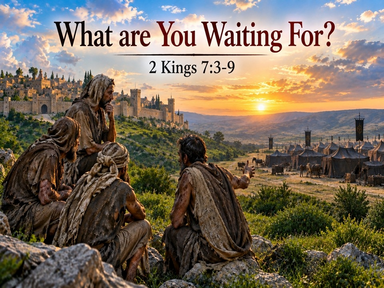
Now there were four men with leprosy at the entrance of the city gate. They said to each other, "Why stay here until we die? If we say, 'We'll go into the city'-the famine is there, and we will die. And if we stay here, we will die. So let's go over to the camp of the Arameans and surrender. If they spare us, we live; if they kill us, then we die."
We are introduced to four men with leprosy sitting outside the city gate, facing what seemed to be an impossible decision. Under the Law of Moses, those with defiling skin diseases were required to live outside the community (Numbers 5:1-4) [10]. Even if they entered Samaria, the people inside were starving too. Their second option was to surrender to the Arameans and hope for mercy. After all, only two chapters earlier, Naaman, commander of the Aramean army, suffered from leprosy yet continued to occupy a position of great authority (2 Kings 5:1). But these men were still Israelites approaching an enemy army, so there was no guarantee they would be spared. Their final option was the easiest: do nothing. Stay where they were and take no risk. But they understood that staying was still a decision: "Why stay here until we die?" Remaining outside the gate offered no safety; it only guaranteed that eventually they would starve, possibly because they had previously depended upon the generosity of those entering and leaving the city [11].
What was true for these four men is still worth remembering today: doing nothing is still a decision. We sometimes imagine that by refusing to act we have avoided making a choice, when in reality our inaction has made the choice for us. The Holy Spirit has given gifts to every believer "just as he determines" (1 Corinthians 12:4-11). If God has equipped us to serve but we continually choose not to use what He has given us, our inaction becomes a decision. God calls us to offer our lives to Him and to discern and follow His will (Romans 12:1-2). We are not saved by what we do-we are saved by grace through faith in Jesus Christ (Ephesians 2:8-9). Yet genuine faith was never intended to remain inactive. James tells us that faith which "is not accompanied by action, is dead" (James 2:17), while our obedience gives evidence that we truly know Christ (1 John 2:3-6). Jesus similarly warned about the servant who, out of fear, buried what his master had entrusted to him and was called a "wicked, lazy servant" (Matthew 25:14-30). He may have thought doing nothing was the safest choice-but doing nothing was still a decision.
So let me ask you: Is there something God has been calling you to do that you keep postponing because doing nothing feels safer? Sometimes waiting is wisdom, and Scripture certainly teaches us to wait upon the Lord. But sometimes what we call waiting is really fear disguised as caution. Am I waiting because God is telling me to wait-or because I am afraid to move without certainty?
Faith Often Means Moving Without Knowing the Outcome
2 Kings 7:5 NIV
At dusk they got up and went to the camp of the Arameans. When they reached the edge of the camp, no one was there,
The four lepers decided to approach the Aramean camp without knowing what awaited them. Would they be welcomed, imprisoned, or immediately killed? They had no idea. Yet verse 5 contains four simple words that changed everything: "At dusk they got up." As far as they knew, nothing about their circumstances had changed. The city was still starving, the Aramean army was still outside the walls, and surrendering to the enemy was still dangerous. They did not have certainty about the outcome-they simply recognized that they could not remain where they were. While Scripture does not tell us that these four men were consciously acting in faith in God, their decision illustrates something the Bible repeatedly teaches about the life of faith: we are often called to move forward without knowing the outcome. Scripture defines faith as "confidence in what we hope for and assurance about what we do not see" (Hebrews 11:1), and believers are called to "live by faith, not by sight" (2 Corinthians 5:7). Biblical faith does not mean waiting until we can calculate a high probability of success. It means trusting the God who has spoken even when we cannot see where obedience will ultimately lead.
Neither is faith a careless leap into the unknown. God has not promised to illuminate the entire road before us, but He has given us His Word as "a lamp for my feet, a light on my path" (Psalms 119:105). And when the road ahead seems uncertain, faith remembers the road behind. The psalmist declared, "I will remember the deeds of the LORD; yes, I will remember your miracles of long ago" (Psalms 77:11-12). Remembering how God has faithfully carried us in the past gives us courage to trust Him with a future we cannot yet see. That does not mean faith guarantees that every decision will turn out as we hoped, or that obedience will remove every trial. Rather, we trust that "all things work together for good to them that love God, to them who are the called according to his purpose" (Romans 8:28, KJV). Like the lepers, we are often called to move forward into circumstances where the outcome remains unknown. That can be frightening, but the valleys and shadows of the unknown are never so dark that God cannot light our path, secure our steps, and lead us according to His will. Faith rests in the assurance that the God who promises, "Never will I leave you; never will I forsake you" (Hebrews 13:5) is already present wherever obedience may lead us. We may not understand what He is doing or why He is leading us down a particular path, but His thoughts are higher than our thoughts and His ways higher than our ways (Isaiah 55:8-9). Faith does not require knowing where the path will end; it requires trusting the God who leads us along it.
God May Already be Working Where You Cannot See
2 Kings 7:5-7 NIV
At dusk they got up and went to the camp of the Arameans. When they reached the edge of the camp, no one was there, for the Lord had caused the Arameans to hear the sound of chariots and horses and a great army, so that they said to one another, "Look, the king of Israel has hired the Hittite and Egyptian kings to attack us!" So they got up and fled in the dusk and abandoned their tents and their horses and donkeys. They left the camp as it was and ran for their lives.
What the four lepers did not know was that while they were deciding whether to approach the Aramean camp, God was already at work. They had wondered, "If they spare us, we live; if they kill us, then we die" (2 Kings 7:4). But when they arrived, there was no enemy there to make that decision. The Lord had caused the Arameans to hear what sounded like a great approaching army, and they had fled for their lives (2 Kings 7:6-7). The lepers were worrying about what might happen when they arrived, while God was already working in a place they could not see.
We find that same truth throughout Scripture. Abraham climbed Mount Moriah prepared to obey God, not knowing that God had already provided a ram that would take Isaac's place (Genesis 22:1-19). At the Red Sea, Israel could see Pharaoh's army behind them and the sea before them, but they could not yet see the path God was about to open through the water (Exodus 14:13-31). And when Ananias was told to go to Saul of Tarsus, he knew Saul's reputation but could not possibly have known all that God would accomplish through the man who would become the apostle Paul (Acts 9:10-19).
The same is true for us. When God calls us to obey, we rarely know everything that lies ahead. We may encounter difficulties, disappointments, or circumstances we never expected. That is why Scripture tells us not to "become weary in doing good" (Galatians 6:9). Our confidence is not that obedience will always produce the outcome we desire, but that Christ is sovereign over "things visible and invisible" (Colossians 1:16). Some of God's people have even died in faith without seeing everything God had promised fulfilled in their lifetime (Hebrews 11:13). Yet Jesus said, "Blessed are those who have not seen and yet have believed" (John 20:29). Sometimes we hesitate to take the next step because we cannot see what lies ahead, forgetting that God may already be at work where we cannot yet see.
The Step They Feared Led to Something They Never Imagined
2 Kings 7:8 NIV
The men who had leprosy reached the edge of the camp, entered one of the tents and ate and drank. Then they took silver, gold and clothes, and went off and hid them. They returned and entered another tent and took some things from it and hid them also.
What makes this moment so remarkable is the complete reversal these four men experienced. Only hours earlier they had been sitting outside the city gate expecting to die. When they finally decided to approach the Aramean camp, they did not know whether they would be shown mercy or killed. Yet when they arrived, there was no battle to fight and no enemy waiting for them. The camp was empty. The men who had expected death instead found food and drink, silver and gold, and clothing in abundance (2 Kings 7:8). The step they feared taking led them into circumstances they could never have imagined. Had fear kept them sitting at the city gate, they would never have discovered what God had already done. But we need to be careful here. Scripture does not teach us to be reckless and call it faith. When Satan tempted Jesus to throw Himself from the temple and expect God to rescue Him, Jesus answered, "Do not put the Lord your God to the test" (Matthew 4:5-7). Biblical faith does not manufacture danger in order to prove that God is faithful. Biblical faith obeys God even when obedience requires us to face what we cannot see.
And sometimes that is where fear becomes a powerful obstacle. We prefer what is familiar because at least we know what to expect. We imagine everything that could go wrong and convince ourselves that remaining where we are must be safer. But the Christian life was never intended to be lived sitting still because we are afraid of what might happen. Paul compared it to running a race and urged believers to "run in such a way as to get the prize" (1 Corinthians 9:24-27). When fear of the unknown begins to control us, listen to what God told His people through Isaiah:
Isaiah 41:10 NIV
So do not fear, for I am with you;
do not be dismayed, for I am your God.
I will strengthen you and help you;
I will uphold you with my righteous right hand.
Notice that God's answer to their fear was not, "I will tell you everything that is going to happen." His answer was, "I am with you." That is still the foundation of Christian courage. When God's Word clearly calls us to obedience, we can bring our anxieties to Him (Philippians 4:6-7) and be "strong and courageous" because He will never leave nor forsake His people (Deuteronomy 31:6). Faith does not mean that the path ahead will always be easy, nor does obedience guarantee that every outcome will be what we hoped for. Some of God's people suffered greatly precisely because they obeyed Him (Hebrews 11:35-38). But faith as small as a mustard seed rests in a God whose power is greater than the obstacles before us (Matthew 17:20). So don't let fear make the decision for you. When God has made the path of obedience clear, trust Him enough to take the next step-even when you cannot see where that step may lead.
What God Does in us May be Intended for Others
2 Kings 7:9 NIV
Then they said to each other, "What we're doing is not right. This is a day of good news and we are keeping it to ourselves. If we wait until daylight, punishment will overtake us. Let's go at once and report this to the royal palace."
As the four lepers enjoyed their unexpected abundance, something changed within them. Their thoughts turned from themselves to the starving people inside Samaria. "What we're doing is not right," they said. "This is a day of good news and we are keeping it to ourselves." Scripture does not tell us precisely what punishment they feared. Perhaps they feared punishment from the king when it was discovered that they had withheld news that could have saved the city, or perhaps they feared divine judgment for remaining silent. Either way, they recognized that keeping this discovery to themselves while others were dying was wrong. And notice whom God used to carry this life-saving news. These were not soldiers, prophets, or officials. They were four men with leprosy who had been excluded from the community and left outside the city gate. Yet these men whom society had pushed aside became the bearers of the very news that could save the people inside the city from starvation [12]. Their thinking had changed from, "How can we survive?" to "How can we remain silent when others need to know?" They realized that discovering good news brought with it a responsibility to share that news [13]. What they had discovered was no longer merely about their own survival; others needed to hear it so that they too could live.
There is a powerful principle here for us. Sometimes what God does in us and through us is not intended to end with us. Perhaps God has brought you through a difficult season and strengthened your faith through it. Paul tells us that God "comforts us in all our troubles, so that we can comfort those in any trouble" (2 Corinthians 1:3-4). God may use what He has taught you through your struggles to encourage someone who is now walking through a similar valley. Perhaps God has placed you in your workplace, your church, your family, your community, or among particular friends where your faithfulness can influence someone else. Mordecai challenged Esther with the question, "Who knows but that you have come to your royal position for such a time as this?" (Esther 4:14). Esther could not know everything that would happen when she approached the king. She simply had to trust that God had placed her where she was for a purpose.
But as Christians, we possess something far greater than the news those four men carried back to Samaria. They had discovered food that could save people from physical starvation; we have been entrusted with the gospel of Jesus Christ, the good news through which sinners can receive eternal life. Paul asks, "How can they believe in the one of whom they have not heard? And how can they hear without someone preaching to them?" (Romans 10:14). Jesus has therefore commanded His people to "go and make disciples of all nations" (Matthew 28:19-20).
Four ordinary, rejected men discovered something that could save a starving city, and eventually they realized, "We cannot keep this to ourselves." God still uses ordinary people like you and me. We may sometimes feel inadequate, fearful, or insignificant, but the question is not whether we consider ourselves extraordinary. The question is whether we will faithfully use what God has entrusted to us. Perhaps God has brought you through what He has, placed you where He has, and taught you what He has-not merely for your own sake, but so that through your faithful obedience, someone else might be helped, strengthened, or pointed to Christ. So where are you still sitting at the gate? If God has made the next step of obedience clear, what are you waiting for?
Footnotes
[1] Menashe Har-El, What God Created: Landscape, Nature and Man in the Bible (Jerusalem: Carta, Jerusalem, 2022), 174.
[2] John H Walton, Zondervan Illustrated Bible Backgrounds Commentary (Old Testament): 1 & 2 Kings, 1 & 2 Chronicles, Ezra, Nehemiah, Esther (Grand Rapids, MI: Zondervan, 2009), 140.
[3] Victor H. Matthews, The Cultural World of the Bible: An Illustrated Guide to Manners and Customs (Grand Rapids, MI: Baker Academic, 2015), 162-163.
[4] John H Walton, Zondervan Illustrated Bible Backgrounds Commentary (Old Testament): 1 & 2 Kings, 1 & 2 Chronicles, Ezra, Nehemiah, Esther (Grand Rapids, MI: Zondervan, 2009), 137-138.
[5] Donkeys they did not have a divided hoof, nor chew the cud, placing them in the category of forbidden animals.
[6] John M'Clintock and James Strong, "Doves' Dung," in Cyclopædia of Biblical, Theological, and Ecclesiastical Literature (New York: Harper & Brothers, Publishers, 1891), 2:879.
[7] Moisés Silva and Merrill Chapin Tenney, in The Zondervan Encyclopedia of the Bible, D-G (Grand Rapids, MI: The Zondervan Corporation, 2009), 180.
[8] Catherine L. McDowell, "1-2 Kings," in The Baker Illustrated Bible Background Commentary, ed. J. Scott Duvall and J. Daniel Hays (Grand Rapids, MI: Baker Books, 2020), 313.
[9] John MacArthur Jr., ed., The MacArthur Study Bible (Nashville, TN: Word Pub., 1997), 2199.
[10] John M'Clintock and James Strong, "Leprosy," in Cyclopædia of Biblical, Theological, and Ecclesiastical Literature (New York: Harper & Brothers, Publishers, 1882), 5:373.
[11] Victor H. Matthews and Don C. Benjamin, Social World of Ancient Israel, 1250-587 BCE (Grand Rapids, MI: Baker Academic, 1993), 153-154.
[12] Patrick Gabriel Lumbroso, Under the Vine: Messianic Thought through the Hebrew Calendar (Clarksville, MD: Lederer Books A division of Messianic Jewish Publishers, 2013), 226.
[13] Tremper Longman III, ed., 1 Samuel Thru 2 Kings, Layman's Bible Commentary (Barbour Publishing, 2009), 3:186.
Page . Exported from Logos Bible Study, 10:14 AM September 12, 2026.
