When Nations Rage, The KING Still Reigns
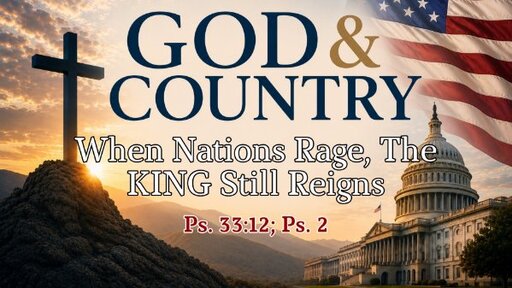

God and Country: A Biblical Balance • Sermon • Submitted • Presented • 52:05
0 ratings
· 8 viewsFiles
Notes
Transcript
Introduction — Blessed Is the Nation
Open your Bibles to two places Psalm 2; and hold your place there and turn to Psalm 33 .
On and off since July we have been looking at the series I titled God and Country: A Biblical Balance.
And as we bring this series to a close today, I am reminded of a verse that really summarizes the biblical relationship between God and Country: Look with me at verse 12 of Psalm 33
Every one of us wants God's blessing upon our country.
We want our children and grandchildren to enjoy the freedoms in this country
We want peace, righteousness, stability, and prosperity.
But notice where the Psalmist places the emphasis:
“whose God is the LORD.”
The strength of a nation is not found in:
Its military.
Its economy.
Its government.
Its political leaders.
A nation's greatest need is God.
and its greatest strength is God
But there must be A Necessary Distinction
Because too many have handled this verse out of context.
The latter part of the verse refers specifically to God's chosen people, Israel
America is not Israel.
America does not possess Israel's covenant promises.
But, the truth of this verse is universal:
no nation is harmed by righteousness, and no nation is helped by rebellion against God.
With that in mind we can make application to our own country and say…
“Blessed is the nation whose God is the LORD...”
But when we turn to Psalm 2, we find the exact opposite.
Read Psalm 2:1-3
But while men rebel against God, vs. 4-6 remind us that God is still God and Christ is still King.
I want us to understand a Key Thought this morning
Our hope is not in the nation beneath us, but in the King above us.
So as we examine Psalm 2 and I pray we can relay the truth, “When Nations Rage, The KING still Reigns”.
Lets Pray
the first thing I want us to see…
I. The Rebellion of the Nations
I. The Rebellion of the Nations
— vv. 1–3
Psalm 33:12 says: “Blessed is the nation whose God is the LORD...”
But Psalm 2 opens with nations that do not want God to be Lord.
At the heart of Psalm 2 is a simple issue:
Who has the right to rule over me?
A. The Rage of the Rebellious — v. 1
“Why do the heathen rage, and the people imagine a vain thing?”
The nations are restless and stirred up against God.
They “imagine a vain thing”
(—they believe they can reject God's authority and still determine their own destiny.)
But their rebellion is vain because, man might be able to reject God, but he cannot remove God
A. The Rage of the Rebellious — v. 1
B. The Rise of the Rebellious — v. 2
“The kings of the earth set themselves, and the rulers take counsel together, against the LORD, and against his anointed...”
The rebellion reaches from the people to those in authority.
They “set themselves”—they deliberately take their stand.
And notice who their opposition is ultimately against:
“against the LORD, and against his anointed.”
The fundamental problem is not political or societal —it is spiritual.
Behind man's rejection of God's authority is an ancient rebellion:
Satan rebelled against God's authority.
In Genesis 3, Satan challenged God's Word: “Yea, hath God said...?”
Adam and Eve chose their own judgment over God's command.
Ever since Eden, fallen man has essentially said:
“I know better than God.”
A. The Rage of the Rebellious — v. 1
B. The Rise of the Rebellious — v. 2
C. The Refusal of the Rebellious — v. 3
“Let us break their bands asunder, and cast away their cords from us.”
Their rage in verse 1 and their rising in verse 2 finally reveal their real desire in verse 3.
They do not merely dislike God's ways—they .
reject God's rule
Satan tempted Eve… “Hath God said..”
from the very begining man has said, I know better than God
The “bands” and “cords” picture the authority and rule of the LORD and His Anointed.
They look at God's authority as something that binds them
They view His rule as something that restricts them.
They want to throw off every restraint so they can rule themselves.
This is the heart of rebellion:
“I will not have God rule over me.”
They want :
freedom without submission
Power without accountability.
Authority without a King.
Notice their language: “Let us break… let us cast away…”
They do not want to bend the restraints.
They want to break them.
They do not want to loosen God's authority.
They want to cast it away altogether
Preaching thought:
The rebellious heart calls God's authority bondage, because it believes that freedom means being able to live without God.
Man wants :
God's blessings without God's boundaries,
God's provision without God's precepts,
and God's goodness without God's government.
And that brings us right back to Psalm 33:12: “Blessed is the nation whose God is the LORD...”
A nation cannot reject the rule of God and expect to retain the blessing of God.
II. The Response of God
II. The Response of God
— vv. 4–6
The nations are raging, rulers are rising, and restraints are being rejected.
But notice the contrast: while earth is raging, Heaven is not rattled.
A. His Sovereignty — v. 4
“He that sitteth in the heavens shall laugh...”
God is not pacing the halls of Heaven wondering what the nations will do.
He is sitting—the posture of One who is completely in control.
Their rebellion does not threaten His throne.
His laughter is not amusement at their sin; it reveals the futility of their rebellion.
The nations may shake their fists toward Heaven, but they cannot shake the throne of Heaven.
A. His Sovereignty — v. 4
B. His Authority — v. 5
“Then shall he speak unto them in his wrath, and vex them in his sore displeasure.”
In verse 3, man speaks: “Let us break their bands...”
In verse 5, God speaks.
And when God speaks, man's rebellion does not get the final word.
God's wrath reminds us that He is not indifferent toward sin.
He is patient, but He is still holy.
He is merciful, but He is still Judge.
Nations, rulers, and individuals are all accountable to Him.
God does not need the approval of man for His Word to remain authoritative.
A. His Sovereignty — v. 4
B. His Authority — v. 5
C. His Supremacy — v. 6
“Yet have I set my king upon my holy hill of Zion.”
I love that word “Yet.”
The nations rage—yet.
The rebellious rise up—yet.
They rebellious reject His restraints—yet.
They take counsel against His Anointed—yet.
After everything man says he will do, God simply declares:
“Yet have I set my king...”
Man may reject the King, but man cannot remove the King.
Jesus Christ was not elected by men, and He cannot be removed by men.
Governments change.
Leaders change.
Nations change.
But God's King remains.
And that is where our confidence must rest.
That brings us to:
III. The Reign of the Son
III. The Reign of the Son
— vv. 7–9
In verse 6, God says: “Yet have I set my king...”
Now in verse 7, the King begins to speak.
And there can be no question who this King is.
The New Testament repeatedly takes us back to Psalm 2 and identifies Jesus Christ as the Son and King of this Psalm.
A. His Position — v. 7
“Thou art my Son; this day have I begotten thee.”
The King is not merely another earthly ruler.
God declares: “Thou art my Son.”
Acts 13:33 - connects this verse with the risen Christ.
Hebrews 1:5 - applies it directly to the superiority of the Son.
Hebrews 5:5 - uses it concerning Christ's appointment as High Priest.
We need to understand that “begotten” does not mean that Jesus began to exist.
Christ is the eternal Son of God.
Rather, the New Testament connects this declaration with Christ being openly vindicated and presented in His Messianic position.
The rulers of verse 2 may have their positions.
But there is only one Son.
There is only one Anointed.
There is only one King
And the One rejected by men has been exalted by God.
A. His Position — v. 7
B. His Possession — v. 8
“Ask of me, and I shall give thee the heathen for thine inheritance, and the uttermost parts of the earth for thy possession.”
Now the Psalm looks beyond Israel.
Look at the scope:
“the heathen...”
“the uttermost parts of the earth...”
Christ's kingdom will not be confined to one people, one border, or one nation.
The whole earth is His rightful possession.
Revelation 11:15 says: “The kingdoms of this world are become the kingdoms of our Lord, and of his Christ; and he shall reign for ever and ever.”
There is coming a day when the One whom the nations rejected will rule over the nations.
That is important as we close a God and Country series:
America is not the kingdom we are ultimately waiting for.
I am thankful for my country.
I pray for my country.
I want God to bless my country.
But America is not promised an everlasting kingdom.
Our hope is in the coming Kingdom of Jesus Christ.
A. His Position — v. 7
B. His Possession — v. 8
C. His Power — v. 9
“Thou shalt break them with a rod of iron; thou shalt dash them in pieces like a potter's vessel.”
Now notice that phrase:
“a rod of iron.”
That language appears again in Revelation.
Revelation 19:15 describes Christ at His return:
“and he shall rule them with a rod of iron...”
Psalm 2 is looking forward to the day when the rejected King returns as the reigning King.
At His first coming, He stood before earthly rulers.
At His second coming, earthly rulers will fall before Him.
At His first coming, men placed a sign above Him that declared Him to be the King of the Jews
When He returns, He will wear on His person the title : “KING OF KINGS, AND LORD OF LORDS.” — Revelation 19:16
And Revelation 20 then tells us of the thousand-year reign of Christ.
So the “rod of iron” reminds us that His Millennial Kingdom will not be established by election, negotiation, or the permission of the nations.
The King will come with absolute authority.
And notice the contrast in Psalm 2:
Verse 1 — The nations rage.
Verse 2 — The rulers rise.
Verse 3 — They reject His restraints.
Verse 9 — The Son rules.
Man's rebellion does not change God's destination for history.
that gives us tremendous confidence.
We don't know what America will look like fifty years from now.
We don't know what nations will rise.
We don't know what nations will fall.
But we know where history is going.
History is not moving toward the triumph of a political party.
History is moving toward the reign of Jesus Christ.
And because the Son will reign, God now turns to the nations and says:
“Be wise now therefore...”
IV. The Responsibility of the Nations
IV. The Responsibility of the Nations
— vv. 10–12
After showing us the rebellion of the nations, God does not immediately close the door in judgment.
He gives them an opportunity to respond.
And notice the word “therefore.”
Because God is sovereign and because His Son will reign, the nations must decide how they will respond to Him.
A. Be Wise — v. 10
“Be wise now therefore, O ye kings: be instructed, ye judges of the earth.”
The same rulers who were rising against God in verse 2 are now being warned by God in verse 10.
God calls them to stop, consider, and be instructed.
True wisdom recognizes that no earthly authority is independent of God's authority.
The wise nation understands: We may govern men, but God governs us.
Every ruler is accountable to a higher throne.
Every law is measured against a higher law.
Every nation will ultimately answer to God.
A. Be Wise — v. 10
B. Bow Down in Worship — v. 11
“Serve the LORD with fear, and rejoice with trembling.”
The answer to rebellion is submission.
Verse 3 says, “Let us break their bands.”
Verse 11 says, “Serve the LORD.”
What a contrast.
They wanted to throw off His authority; God calls them to bow before His authority.
And notice the balance:
“fear” — yet “rejoice.”
“rejoice” — yet “with trembling.”
We serve a God worthy of our joy.
But we also serve a God worthy of our reverence.
The proper response to the sovereignty of God is not merely to acknowledge Him—it is to serve Him.
A. Be Wise — v. 10
B. Bow Down in Worship — v. 11
C. Believe on the Son — v. 12
“Kiss the Son, lest he be angry, and ye perish from the way...”
To “kiss the Son” is an expression of homage, allegiance, and submission to the King.
You cannot claim to honor God while rejecting His Son.
The issue ultimately comes down to Jesus Christ.
And then look at how the Psalm ends: “Blessed are all they that put their trust in him.”
That brings us all the way back to where we began:
Psalm 33:12: “Blessed is the nation whose God is the LORD...”
Psalm 2:12: “Blessed are all they that put their trust in him.”
There is the message:
The blessing is not found in resisting God, but in resting in God.
Nations must answer to Christ.
Rulers must answer to Christ.
But so must you and I.
I cannot make an entire nation trust Christ.
I cannot make Washington bow before Christ.
But I can decide who will rule my heart, my home, and my life.
So after this entire God and Country series, perhaps the greatest question is not:
“What is America going to do?”
The greater question for each of us is:
“What am I going to do with the King?”
The nations may rage.
The rulers may rise.
The restraints may be rejected.
But the King still reigns.
And: “Blessed are all they that put their trust in him.”
Conclusion — What Will You Do With the King?
Conclusion — What Will You Do With the King?
Psalm 33:12 — “Blessed is the nation whose God is the LORD...”
Psalm 2:12 — “Blessed are all they that put their trust in him.”
We began talking about a nation, but God ends Psalm 2 talking about you
The ultimate question is not, “What will America do with God?”
It is, “What will you do with the King?”
To the Lost — Trust the King
The rebellion of Psalm 2 is not only the rebellion of nations.
It is the rebellion of the human heart.
Romans 3:23 — “For all have sinned...”
We have all broken God's law and rejected His authority.
Romans 6:23 — “For the wages of sin is death...”
But here is the the Good News:
The King we rebelled against is the King who came to save us.
Jesus Christ came as the sinless Son of God.
He died on the cross for our sins.
He was buried.
He rose again the third day.
And He offers eternal life to every sinner who will trust Him.
“For whosoever shall call upon the name of the Lord shall be saved.” — Romans 10:13
You cannot save yourself.
Religion cannot save you.
Baptism cannot save you.
Church membership cannot save you.
Being a good citizen cannot save you.
You must trust Christ.
Psalm 2:12 says: “Blessed are all they that put their trust in him.”
Before you worry about America's relationship with God — make sure of your relationship with God.
To the Christian — Submit to the King
We can easily look at our country and ask:
Why won't they listen to God?
Why won't our leaders submit to God?
Why won't our nation follow God's Word?
But before we point toward Washington, we need to look within.
Is Christ ruling my life?
My highest allegiance is not to a political party.
My highest allegiance is not to a politician.
My highest allegiance is not even to my country.
My highest allegiance belongs to Jesus Christ.
So:
Love your country.
Pray for your country.
Serve your country.
Stand for righteousness in your country.
Seek God's blessing upon your country.
But above all put your trust in Christ.
Because nations rise and nations fall.
Governments come and governments go.
But the King still reigns.
And the final word of this God and Country series is the final word of Psalm 2:
“Blessed are all they that put their trust in him.”
The question is not “What will America do with God?”
The question is: “What will you do with the King?”
Because, Our hope is not in the nation beneath us, but in the King above us
