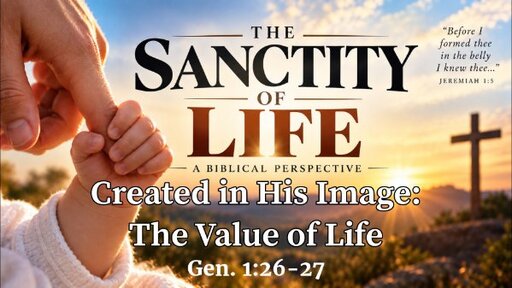
Created in His Image

Sermon • Submitted • Presented • 41:30
0 ratings
· 1 viewFiles
Notes
Transcript
Created in His Image — The Value of Human Life
Text: Genesis 1:26–27 KJV
Theme: The value of human life is established by the God who created it.
Key Thought: Human life is valuable not because of what a person can do, but because of whose image that person bears.
Introduction — What Makes a Life Valuable?
We live in a world that places value on almost everything.
A house is valued by its location.
A vehicle is valued by its condition.
An object may be valued by its usefulness, rarity, or what someone is willing to pay for it.
But how do you determine the value of a human life?
The world values life by:
What we can do?
What we can contribute?
Our intelligence?
Our health?
Our independence?
Our age?
Our abilities?
If those things determine the value of human life, then inevitably some lives will be considered more valuable than others.
But when we come to Genesis 1, God establishes the value of human life before man ever has the opportunity to place a value upon it.
Notice the progression of Genesis 1:
God speaks — light appears.
God speaks — the waters are divided.
God speaks — dry land appears.
God speaks — vegetation grows.
God speaks — the sun, moon, and stars take their place.
God speaks — the waters and skies are filled.
God speaks — the earth brings forth living creatures.
But then we come to verse 26:
“And God said, Let us make man in our image, after our likeness...”
Something is different.
Something is different when God creates man.
And those two verses answer some of the most important questions our culture is wrestling with today.
Where does human life come from?
What makes human life valuable?
And what responsibility do we have toward human life?
Genesis answers all three.
First, consider The Source of Life.
Human life is valuable not because of what a person can do, but because of whose image that person bears.
I. The Source of Life
I. The Source of Life
“Let us make man...” — v.26
Before we can understand the value of human life, we must understand the source of human life.
Human life begins with God.
Why?
Life Is Designed by God
“Let us make man...”
Man is not presented as an accident of creation.
There is purpose and intentionality in the language.
Cross References:
Psalm 100:3
“Know ye that the LORD he is God: it is he that hath made us, and not we ourselves...”
Isaiah 44:24
“...I am the LORD that maketh all things...”
Preaching Thought:
Human life is not an accident to be explained; it is a creation to be valued.
Illustration to Consider:
Artist and Artwork
When you stand before a great painting, you can admire the brushstrokes, the colors, the detail, and the design. All of it tells you that somebody put the paint on the canvas.
But when determining the significance and value of a piece of art, there is another question that matters:
Who painted it?
A painting becomes more significant when you discover the hand behind the brush. The identity of the artist changes the way you look at the artwork.
And when we come to human life, Genesis 1 tells us whose hand was behind the brush.
“And God said, Let us make man…”
Man is not an accident on the canvas of creation. God is the Artist. God is the Designer. God is the Creator.
And before we ever discuss what man can do, what man can contribute, or what value society places upon him, we must begin with Who made him.
You cannot properly determine the value of the artwork while ignoring the Artist.
But Genesis takes us even further.
Because God did not merely create man.
God gave man a distinction that He gave to nothing else in His creation.
Genesis 1:26:
“Let us make man in our image, after our likeness...”
And that brings us from the Source of Life to the Significance of Life.
II. The Significance of Life
II. The Significance of Life
“in our image, after our likeness...” — v.26
Here is the theological heart of the message.
What makes humanity unique?
Not simply that man is alive.
Animals are alive.
Not simply that man was created.
Everything in Genesis 1 was created.
The distinction is:
“in our image, after our likeness.”
A. Man Bears a Unique Image
God never says this about:
The sun.
The stars.
The oceans.
The birds.
The animals.
Only humanity receives this distinction.
“in our image...”
Cross References:
Genesis 5:1
“...In the likeness of God made he him.”
Genesis 9:6
“Whoso sheddeth man's blood, by man shall his blood be shed: for in the image of God made he man.”
James 3:9
“...men, which are made after the similitude of God.”
Important Truth:
The Fall in Genesis 3 marred the image of God in man, but it did not erase it.
Genesis 9 and James 3 both speak of mankind after the Fall as still possessing a unique relationship to God's image.
Preaching Thought:
Sin has damaged man, but sin has not made human life disposable.
A. Man Bears a Unique Image
B. Man Possesses an Inherent Value
If the image of God is the foundation for human dignity, then human value cannot be based upon ability.
That means value does not increase when someone becomes:
Stronger.
Smarter.
Wealthier.
More independent.
More productive.
And value does not decrease when someone becomes:
Weak.
Sick.
Disabled.
Elderly.
Dependent upon others.
This Is Where Sanctity of Life Becomes Personal
The unborn child has value.
The newborn child has value.
The child born with disabilities has value.
The healthy adult has value.
The elderly person has value.
The person who requires constant care has value.
Why?
Not because of what they can contribute.
Because of whose image they bear.
Cross Reference — Psalm 139:13–16
David describes God's involvement with him in the womb:
“My substance was not hid from thee...”
and:
“Thine eyes did see my substance, yet being unperfect...”
Preaching Thought:
Human dignity is not awarded by society; therefore, human dignity cannot legitimately depend upon society's estimation of usefulness.
Illustration to Consider:
Damaged Currency
Take a dollar bill and crumple it.
Step on it.
Stain it.
Tear its edge.
Ask:
“Has its value disappeared because it has been damaged?”
No.
Its condition has changed, but its value remains.
Sin has terribly marred humanity, but humanity still bears the Creator's mark.
Gospel Connection
Man was created in the image of God, but sin has terribly marred what God created.
We are still image-bearers—but we are fallen image-bearers.
Romans 3:23 says:
“For all have sinned, and come short of the glory of God.”
Sin has affected every part of us.
It has separated us from God.
It has left us unable to repair ourselves.
But God did not discard what sin had damaged.
Jesus Christ came into this world to redeem fallen men.
He died for our sins.
He was buried.
He rose again.
And when a sinner places his faith in Jesus Christ, God begins a work of restoration in that life.
Romans 8:29 says that God's purpose for His children is that we might be:
“...conformed to the image of his Son...”
Sin marred the image—but Christ came to redeem the sinner.
And that tells us something about the value God places upon human life:
God did not merely create us—He loved fallen humanity enough to give His Son for us.
John 3:16:
“For God so loved the world, that he gave his only begotten Son...”
So when we ask, “What is a human life worth?”
Creation tells us: We bear His image.
Calvary tells us: He gave His Son.
That does not mean our worth purchased salvation—salvation is entirely by grace.
But it does reveal the incredible love of God toward fallen humanity.
And if God sees people as souls worth reaching, redeeming, and restoring, then we had better be careful that we never look at another human being as worthless.
A. Man Bears a Unique Image
B. Man Possesses an Inherent Value
C. Man Reflects a Divine Purpose
The image of God is not merely something man possesses; it affects what man was created to be.
Humanity was created to represent God's rule upon the earth.
“...and let them have dominion...”
There is dignity, but there is also purpose.
Cross References:
Psalm 8:4–6
“What is man, that thou art mindful of him?... Thou madest him to have dominion over the works of thy hands...”
Ephesians 4:24
“And that ye put on the new man, which after God is created in righteousness and true holiness.”
Colossians 3:10
“...the new man, which is renewed in knowledge after the image of him that created him.”
Preaching Thought:
We were not created merely to exist; we were created to know God, reflect God, and live for God.
III. The Stewardship of Life
III. The Stewardship of Life
“and let them have dominion...” — v.26
Being made in God's image gives humanity dignity, but being placed under God's authority gives humanity responsibility.
God gave man dominion over His creation.
But there is an important distinction we cannot miss:
Man was given dominion, but man was never given sovereignty.
God remains the Creator.
We remain the creature.
God is the One who gives life, and therefore God retains ultimate authority over life.
That means there are boundaries to man's dominion.
Dominion does not mean ownership.
Dominion means stewardship under the authority of God.
And if life belongs ultimately to God, then we have a responsibility concerning how we regard it.
A. We Are Responsible to God for Life
Life is something God has entrusted to us.
And when something has been entrusted to you, possession does not give you unlimited authority over it.
Illustration
Think about guardianship.
A child may be placed into someone's care.
That guardian has real authority.
They have real responsibility.
They make decisions concerning the care and protection of that child.
But their authority is not absolute.
Why?
Because the child has been entrusted to their care.
Their authority carries with it accountability.
And the same principle applies to human life.
God has given us life, but the gift of life does not make us sovereign over life.
We are accountable to the Giver for how we regard what He has given.
Deuteronomy 32:39: “...I kill, and I make alive...”
1 Samuel 2:6: “The LORD killeth, and maketh alive...”
Acts 17:28: “For in him we live, and move, and have our being...”
Those verses remind us that life ultimately rests in the hands of God.
So when it comes to human life, man does not have the authority to simply determine:
This life matters.
That life does not.
This life is useful.
That life is expendable.
This life is worth protecting.
That life is inconvenient.
Because the value and authority over human life do not originate with us.
Preaching Thought:
Dominion is not ownership. It is stewardship under the authority of God.
And if I am accountable to God for how I regard life, then naturally that responsibility must affect how I treat the lives of others.
A. We Are Responsible to God for Life
B. We Are Responsible for How We Treat Others
The image of God has implications beyond abortion.
James 3:9
James condemns using our tongue to curse:
“...men, which are made after the similitude of God.”
Why does how I treat another person matter?
Because that person bears God's image.
Therefore, a biblical doctrine of life affects how we treat:
The unborn.
The disabled.
The elderly.
The poor.
The sick.
The vulnerable.
The unwanted.
The person who cannot repay us.
Even the person with whom we strongly disagree.
Cross References:
Proverbs 31:8–9
“Open thy mouth for the dumb in the cause of all such as are appointed to destruction.”
Proverbs 24:11
“If thou forbear to deliver them that are drawn unto death...”
Preaching Thought:
It is inconsistent to defend the image of God in the womb while disregarding the image of God standing in front of us.
The sanctity of life should shape more than our position on abortion.
It should shape the way we see people.
A. We Are Responsible to God for Life
B. We Are Responsible for How We Treat Others
C. We Are Responsible to Protect Life
Throughout Scripture, God's people are repeatedly commanded to care about those who are weak and vulnerable.
Cross References:
Psalm 82:3–4
“Defend the poor and fatherless: do justice to the afflicted and needy. Deliver the poor and needy...”
Proverbs 31:8
“Open thy mouth for the dumb...”
Important Balance:
A biblical view of the sanctity of life should not just say: “Do not take innocent life.”
It should also say:
“Love, serve, protect, and care for human life.”
Illustration to Consider:
The Good Samaritan — Luke 10:30–37
The wounded man could offer the Samaritan nothing.
He was helpless.
He was dependent.
He was costly.
Yet his inability to contribute did not make his life unworthy of compassion.
That gives a practical picture of what valuing human life looks like:
We do not merely declare that life has value—we treat people as though their lives have value.
Conclusion
Conclusion
Genesis 1 settles the question of human value.
God is the Source of life — therefore life is not accidental.
God has established the Significance of life — therefore life is not disposable.
God has made us Stewards of life — therefore we are accountable for how we regard it.
So the question is not simply, “Do I believe in the sanctity of life?”
The question is:
“Do I see human life the way God sees human life?”
The unborn.
The disabled.
The elderly.
The weak.
The unwanted.
The person who can give us absolutely nothing in return.
Every human life has value—not because of what that person can do, but because of whose image that person bears.
And there is one final truth:
We were created in His image, but sin has marred us and separated us from our Creator.
Yet God did not abandon fallen man.
Jesus Christ came. He died for our sins. He was buried. He rose again. And through Him, fallen sinners can be reconciled to the God who gave them life.
So let us value the life God created, protect the life God entrusted, and point every life we can to the Christ who saves.
