Zephaniah 2.9a-God Makes Three Assertions About Himself (Doctrinal Bible Church in Huntsville, Alabama)

Doctrinal Bible Church
Pastor-Teacher Bill Wenstrom
Sunday October 4, 2026
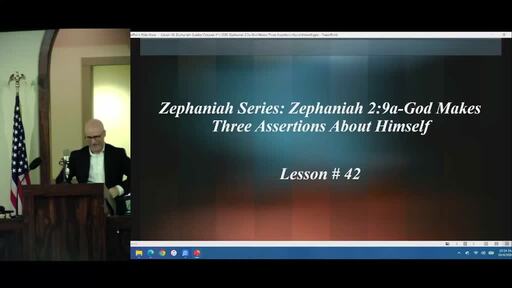
Zephaniah Series: Zephaniah 2:9a-God Makes Three Assertions About Himself
Lesson # 42
Zephaniah 2:9 Consequently, I existing eternally, the Lord ruling over the armies, the God ruling over and in a relationship with Israel declares: Moab’s people will be like Sodom’s people likewise Ammon’s citizens like Gomorrah’s people. A place overrun by weeds as well as salt pits, indeed, a desolation forever and ever! The remnant from My people will plunder them. Specifically, the survivors from the nation will inherit their territory. (Pastor’s translation)
Zephaniah 2:9 is a result clause since God’s declaration in this verse regarding Moab and Ammon presents the result of the previous statements in Zephaniah 2:8 regarding the people of Moab and Ammon.
In verse 8, the Lord asserts that He heard the public insults of His people Judah from the people of Moab and Ammon.
They showed public contempt for the people of Judah.
In fact, these two groups triumphed over Judah’s territory in that they conquered these lands with the help of the Babylonians.
The Lord in verse 9 promises or guarantees that the people of Moab will become like the people of Sodom and the people of Ammon like the people of Gomorrah.
Therefore, verse 9 indicates that the people of Moab will become like the people of Sodom and the people of Ammon like the people of Gomorrah as the direct result of their contemptuous and bad treatment of the people of Judah.
The prophet Zephaniah quotes God speaking here in verse 9.
God makes three assertions or declarations about Himself before issuing the prophecy against the people of Moab and Ammon.
The first description is that He exists eternally or in other words, the Lord is describing Himself as eternal meaning that as to His nature, He has no beginning or end.
It not only speaks of the reality of His existence but also that He is immanent meaning that He involves Himself in and concerns Himself with and intervenes in the lives of members of the human race, both saved and unsaved.
Since, each member of the Trinity is co-equal, co-infinite and co-eternal, each also is eternal life: (1) God the Father is eternal life (Jo. 5:26; 6:57; 1 Th. 1:9). (2) The Word of God is eternal life (Jn. 5:26, 6:35 Phlp. 2:16; 1 Jo. 1:1) (3) The Holy Spirit is eternal life (Jn. 6:63; Rm. 8:2).
In Zephaniah 2:9, after asserting that He exists eternally, God makes a second assertion about Himself, namely that He is the Lord over the armies.
The term “sovereignty” connotes a situation in which a person, from his innate dignity, exercises supreme power, with no areas of his province outside his jurisdiction.
As applied to God, the term “sovereignty” indicates His complete power over all of creation, so that He exercises His will absolutely, without any necessary conditioning by a finite will or wills (cf. Isaiah 40:15, 17; Daniel 2:19-23).
The third assertion that God makes about Himself in Zephaniah 2:9 is that He is the God over and in relationship with the nation of Israel.
This assertion teaches that God is sovereign over Israel and that Israel possesses a relationship with Him based upon His choice of them to be His people.
It clearly implies that Moab and Ammon’s poor treatment of Israel has offended Him because He possesses a covenant relationship with Israel.
The implication is that God would deal with Moab and Ammon for their contemptuous treatment of Israel.
