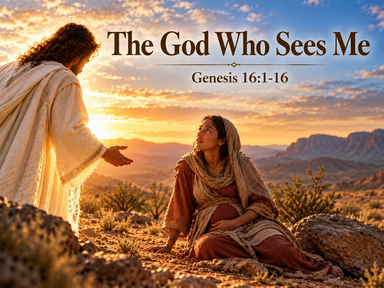
The God who Sees Me

Notes
Transcript
The God Who Sees Me
Rev. Derek Geldart
Deliverance / Genesis 16:1-16
With all the bodily aches and pains, the sagging body parts, walking into a room with a sense of urgency only to forget why we went there, and watching people we love suffer-and eventually attending their funerals-we are reminded of the words of James: our lives are like "a mist that appears for a little while and then vanishes" (James 4:14). There is an expiry date stamped upon the dust of our existence, and perhaps that is why, as the years pass, we begin to think more seriously about what really matters. We want our families to know that we loved them. We want our lives to have mattered. And above all, as followers of Jesus Christ, we want to "conduct [ourselves] in a manner worthy of the gospel of Christ" (Philippians 1:27). But knowing how we want to live does not mean life will unfold the way we planned. We have God's Word in our hands and the Holy Spirit dwelling within us and guiding us into truth (John 16:13), but we still live in a creation that is "groaning as in the pains of childbirth" (Romans 8:22). How we sometimes wish life were linear-that the road ahead were clearly marked, every decision obvious, and every turn anticipated. But life rarely works that way. A phone call can change everything. A diagnosis can redraw the future. Someone else's decision can suddenly become our burden. A carefully constructed plan can unravel almost overnight. And suddenly we find ourselves somewhere we never intended to be-perhaps even in a wilderness.
That is where we meet Hagar in Genesis 16. Hagar did not choose many of the circumstances that shaped her life. Caught in the consequences of other people's decisions and badly mistreated, she eventually reached the point where fleeing into the wilderness seemed like her only option (Genesis 16:1-6). She was displaced, hurting, and uncertain about what her future held. Yet it was there, in the wilderness, that Hagar encountered God in a way she would never forget. The woman who must have wondered whether anyone saw what was happening to her discovered that heaven had not overlooked her. She would eventually say of the Lord, "You are the God who sees me" (Genesis 16:13).
So if you have ever found yourself somewhere you never expected to be, if circumstances beyond your control have changed the direction of your life, or if you have ever felt forgotten or overlooked, then Hagar's story has something important to say to you. Even when life appears chaotic, God has not surrendered His throne. Even in the wilderness, He knows where you are. You may feel unseen by everyone around you, but you are never unseen by God.
God Sees the Overlooked
But before we can understand why Hagar found herself alone in the wilderness, we need to go back and look at the promise God had given Abram and Sarai-and what happened when they decided they could no longer wait for God to fulfill it in His way and in His time. In Genesis 12 we are told of Abram's calling. The Lord told him to leave his country and travel to a land that God would later show him (12:1-3), along with this remarkable promise:
Genesis 12:2-3 NIV
"I will make you into a great nation,
and I will bless you;
I will make your name great,
and you will be a blessing.
I will bless those who bless you,
and whoever curses you I will curse;
and all peoples on earth
will be blessed through you."
Abram eventually settled in the land of Canaan, where the Lord promised that He would give the land to his descendants (12:7). But there was an obvious problem: Abram and Sarai had no children. After a decade of waiting for a child to be born (16:3), reason began to overcome faith [1], and Sarai proposed a solution grounded in the cultural practices of her day. She told Abram to take Hagar, her Egyptian slave, as his wife and conceive a child who could become the legal heir of her husband [2], so that, as Sarai put it, "perhaps I can build a family through her" (16:2). The plan worked-at least initially. Hagar became pregnant. But her pregnancy also elevated her status. She now carried something Sarai desperately wanted but could not have, and no law could completely suppress the hope and dignity this new role brought her [3]. Hagar herself was not without fault-Genesis tells us that after becoming pregnant she began to despise Sarai (Genesis 16:4)-but she was nevertheless a servant caught in circumstances largely created by the decisions of Abram and Sarai. Tension quickly developed between the two women. Sarai blamed Abram for the situation she herself had initiated and expected him to defend her against Hagar. Instead, Abram abdicated responsibility and gave Sarai authority to deal with Hagar as she saw fit. Scripture simply tells us that Sarai "mistreated Hagar" (16:6) [4]. The treatment became so severe that Hagar fled.
Maybe you can relate, at least in some small way, to how Hagar must have felt. If life was not difficult enough already, she now faced the anger of the very woman who had arranged for her pregnancy in the first place. How helpless she must have felt. Sarai's authority over her maidservant was not superseded by Hagar's new marital status [5]. Hagar was an Egyptian servant living away from her homeland, caught in the conflict of Abram's household, while other people made decisions that radically affected her life. And that is where Hagar's ancient story suddenly becomes remarkably contemporary. Most of us know something about the helplessness that comes when circumstances beyond our control change the direction of our lives. A spouse walks away. A company restructures. A diagnosis arrives. Someone we trusted breaks our confidence. Someone else makes a decision, and suddenly we are left carrying the consequences. And sometimes the deepest pain is not merely the circumstance itself, but the question that begins to form inside us: "Does anyone actually see what this is doing to me?"
Hagar may have been overlooked by Abram and Sarai, but she had not been overlooked by God. When Hagar fled from Sarai and entered the wilderness, we are told that "the angel of the LORD found Hagar near a spring in the desert" (16:7). And then notice what happens next. God calls her by name: "Hagar, slave of Sarai, where have you come from, and where are you going?" (16:8). The woman who may have felt like little more than someone else's servant discovered that she was personally known by God. She had run into the wilderness believing she was alone, but heaven knew exactly where she was.
And perhaps that is one of the great truths we need to remember when we find ourselves in our own wilderness. Affliction can make God seem distant. Silence can make us wonder whether He has forgotten us. Yet Scripture repeatedly reminds us that the Good Shepherd does not merely know that we exist-He knows us intimately. David describes that knowledge this way:
Psalm 139:1-4 NIV
You have searched me, LORD,
and you know me.
You know when I sit and when I rise;
you perceive my thoughts from afar.
You discern my going out and my lying down;
you are familiar with all my ways.
Before a word is on my tongue
you, LORD, know it completely.
There is nowhere we can go where God is not present. There is no wilderness so remote that He cannot find us, no burden so hidden that He cannot see it, and no pain so private that He does not know it. There may be seasons when God seems silent, and Scripture tells us that trials can produce perseverance and spiritual maturity in us (James 1:2-4). But His silence must never be mistaken for His absence. Jesus tells us that our heavenly Father knows us so intimately that even the hairs of our heads are numbered (Matthew 10:30-31). And the greatest evidence that we matter to Him is found at the cross, where Christ gave Himself for our sins (Galatians 2:20). Hagar was about to discover in the wilderness what every child of God needs to remember in the wilderness: when you feel unseen by everyone around you, you are never unseen by God.
God Meets us in the Wilderness
The wilderness may have been the place Hagar ran to escape her pain, but it became the very place where she encountered God. The angel asked her, "Where have you come from, and where are you going?" (Genesis 16:8). An all-knowing God did not need Hagar to tell Him where she had been. The question gave her an opportunity to voice her distress, and she answered honestly, "I'm running away from my mistress Sarai" (Genesis 16:8) [6]. But the question also directed Hagar beyond where she had been toward where she was going. She had fled because she could see no other way forward, but God knew that her story was not ending beside that spring. She still had a place in His unfolding purposes, and He would eventually direct her back to Abram's household [7]. Hagar had run into the wilderness to escape her circumstances, but God met her there and began to redirect her path.
And perhaps that is something we need to remember when we find ourselves in a wilderness of our own. Difficult circumstances can leave us frightened, uncertain, and wondering what comes next. We can begin to think, "If God were really with me, surely I wouldn't be here." Yet Scripture repeatedly shows us that the wilderness is not beyond the reach of God. Moses fled Egypt and spent years in obscurity, but God met him in the wilderness through the burning bush and called him to return to Egypt (Exodus 3:1-6). Elijah entered the wilderness exhausted and discouraged, sat beneath a broom bush, and prayed that he might die. Yet God did not abandon His exhausted servant. He gave Elijah food, water, rest, and eventually spoke to him again at Horeb (1 Kings 19:4-18). Hagar fled into the wilderness. Moses lived in the wilderness. Elijah collapsed in the wilderness. Different circumstances, but the same God met them there.
Sometimes it is precisely in the wilderness-when our resources have been exhausted, our plans have failed, and our confidence in ourselves has been stripped away-that we begin to understand how completely we depend upon God. The wilderness can humble us, quiet some of the competing voices around us, and teach us to rely upon the One who "is able to do immeasurably more than all we ask or imagine" (Ephesians 3:20-21). God does not always immediately remove the wilderness, nor does He always explain why He has allowed us to walk through it. But the wilderness does not mean God has abandoned us. Sometimes it becomes the very place where we discover how near He has been all along.
God Hears our Distress
And perhaps that is something we need to remember when we cry out to God from our own wilderness: we are never speaking into an empty room. David wrote, "The righteous cry out, and the LORD hears them; he delivers them from all their troubles" (Psalm 34:17). That does not mean that every prayer will result in our circumstances becoming easier. Sometimes God removes the burden; at other times He gives us the strength to carry what remains. He may change our circumstances, or He may give us a peace that "transcends all understanding" while the circumstances themselves remain unchanged (Philippians 4:6-7). When Jesus says, "Come to me, all you who are weary and burdened, and I will give you rest" (Matthew 11:28), He does not promise that every earthly burden will immediately disappear. He promises that the weary can come to Him and receive the comfort and rest needed to face what remains.
And sometimes what God changes first is not our circumstances, but our attitude toward them. This is not simply positive thinking or convincing ourselves that everything will somehow work out the way we want. Christian hope is not confidence in our circumstances; it is confidence in the character and sovereignty of God. Hagar entered the wilderness running away in helplessness, but God gave her a promise that enabled her to return with hope. Her circumstances had not yet changed-but now she knew that God had seen her, God had heard her, and God had a purpose for her future (Genesis 16:9-11). That assurance changed how she could face what lay ahead.
The same choice often confronts us in our own wilderness: Will we respond to uncertainty by desperately trying to manufacture our own solution, or will we face it with faith in the sovereign God who sees what we cannot see? God promises that "in all things" He works for the good of those who love Him and have been called according to His purpose (Romans 8:28). Like Hagar, sometimes what we desperately need is not immediate removal from our situation, but renewed confidence in the God who rules over it. When helplessness gives way to trust in the sovereignty of God, despair can begin to give way to hope.
God Sends us Forward with His Promises
God's assurance was not meant to leave Hagar sitting in the wilderness; He gave her a promise that enabled her to rise, return, and move forward in faith. The angel of the LORD told Hagar, "Go back to your mistress and submit to her" (Genesis 16:9). This was a specific direction from God within Hagar's particular circumstances and should not be understood as a general command for someone to remain in an abusive or dangerous situation. God's presence does not always mean that our circumstances immediately become easy. But Hagar would not return as the same woman who had fled. She now knew that God had seen her, heard her, and had a purpose for what lay ahead. And with God's direction came God's promise: "I will increase your descendants so much that they will be too numerous to count" (Genesis 16:10). Although Ishmael would remain outside the covenant line through which God's promise to Abraham would ultimately be fulfilled, this divine pronouncement demonstrates that God had not forgotten him and that his life remained significant within God's unfolding purposes [8]. Ishmael would become a "wild donkey of a man," living in hostility with others (Genesis 16:12). His future would not be without difficulty or conflict, but it would be a future known by God. Hagar still did not know exactly what awaited her when she returned to Abram's household. What she did know was that the God who had found her in the wilderness already knew what lay ahead. She could move forward because she had something greater than certainty about her circumstances-she had a promise from God!
And that is what God's people have always needed when walking through the dark valleys of life. We may not know what tomorrow holds, but we know what God has said. The God who promised His people, "Never will I leave you; never will I forsake you" (Deuteronomy 31:6; cf. Hebrews 13:5) is the same Lord Jesus who assures His disciples, "Surely I am with you always, to the very end of the age" (Matthew 28:20). When we walk through "the darkest valley," we need not fear, because the Good Shepherd is with us (Psalm 23:4). When our strength fails, God says, "I will strengthen you and help you; I will uphold you with my righteous right hand" (Isaiah 41:10). When suffering exposes our weakness, Christ reminds us, "My grace is sufficient for you, for my power is made perfect in weakness" (2 Corinthians 12:9). And when we wonder whether anything could finally separate us from Him, Scripture answers that nothing in all creation "will be able to separate us from the love of God that is in Christ Jesus our Lord" (Romans 8:38-39).
And God's promises carry us farther than this life. Even if our wilderness eventually leads through the valley of physical death, death itself cannot overturn what God has promised. Because Christ has risen, we can ask with Paul, "Where, O death, is your victory? Where, O death, is your sting?" and then declare, "Thanks be to God! He gives us the victory through our Lord Jesus Christ" (1 Corinthians 15:55-57). Beyond the wilderness there is resurrection. Beyond the tears there is a feast-the "wedding supper of the Lamb" (Revelation 19:9). And beyond death there is victory. Hagar could return because God had given her a promise. And we can move forward because the God who sees us, hears us, and meets us in our wilderness is also the God whose promises never fail. So whatever wilderness we may be walking through today, we can say with Jeremiah, "Because of the LORD's great love we are not consumed, for his compassions never fail. They are new every morning" (Lamentations 3:22-23).
The God who Sees Me
Everything in this story brings us back to Hagar's remarkable words in Genesis 16:13: "You are the God who sees me." And what makes those words so remarkable is who says them. Not Abraham. Not Sarah. Not Moses. Hagar. An Egyptian servant woman, alone in the wilderness, becomes the person associated with this extraordinary confession about God. She had entered the wilderness mistreated, displaced, and uncertain about her future. But she would leave knowing something she had not fully understood when she arrived: God saw her. God knew her. God heard her. And God had not finished with her. And the God Hagar encountered in the wilderness is the same God whose heart we see so clearly in Jesus Christ. Jesus continually noticed the people others overlooked. He saw Zacchaeus hiding in a tree (Luke 19:1-10). He stopped for Bartimaeus when everyone else told him to be quiet (Mark 10:46-52). He crossed social boundaries to speak with a Samaritan woman (John 4:4-26). And when a suffering woman reached through a crowd merely to touch His garment, everyone else saw a crowd-but Jesus saw a woman. He stopped, turned toward her, and called her "Daughter" (Mark 5:25-34).
And perhaps that is exactly what someone here needs to hear today. You may be surrounded by people who know your name but don't really know your heart. People may know what you do, the responsibilities you carry, and the face you present to the world, while knowing nothing about what keeps you awake at night. You may be carrying a disappointment you rarely talk about, praying a prayer that seems unanswered, facing a future you did not choose, or walking through a wilderness that nobody else completely understands. But God sees you. The God who knew exactly where Hagar was knows exactly where you are. The God who heard her misery hears your cries. The God who met her in the wilderness has not abandoned you in yours. And the God who gave Hagar hope for a future is still sovereign over the chapters of your life that you cannot yet see. That does not mean every wilderness will disappear tomorrow. Hagar still had a difficult road ahead of her. But she no longer walked that road believing she was forgotten. She could move forward knowing that the God who saw her was also the God who held her future. And ultimately, the greatest evidence that God sees us is not found merely at a spring in the wilderness, but at a cross outside Jerusalem. There the Son of God gave Himself for sinners (Galatians 2:20), and through His resurrection He secured a hope that even death cannot destroy (1 Corinthians 15:54-57).
So when you find yourself somewhere you never expected to be, when circumstances beyond your control have changed the direction of your life, or when you wonder whether anyone truly understands what you are carrying, remember Hagar's discovery: God sees me. God knows me. God hears me. God has not finished with me. You may feel unseen by everyone around you, but you are never unseen by God.
Footnotes
[1] Joyce G. Baldwin, The Message of Genesis 12-50: From Abraham to Joseph, ed. J. A. Motyer and Derek Tidball, The Bible Speaks Today (England: Inter-Varsity Press, 1986), 57-58.
[2] Clyde T. Francisco, "Genesis," in The Teacher's Bible Commentary, ed. H. Franklin Paschall and Herschel H. Hobbs (Nashville: Broadman and Holman Publishers, 1972), 28.
[3] Joyce G. Baldwin, The Message of Genesis 12-50: From Abraham to Joseph, ed. J. A. Motyer and Derek Tidball, The Bible Speaks Today (England: Inter-Varsity Press, 1986), 57-58.
[4] Qiang Fu, How God Forms Abraham to Be a Blessing: Using Formative Narrative Approach and Narrative Discourse Analysis (Eugene, OR: Wipf and Stock, 2023).
[5] Douglas Mangum, Miles Custis, and Wendy Widder, Genesis 12-50, Logos Research Commentaries (Bellingham, WA: Logos Bible Software, 2026).
[6] Jeffrey J. Niehaus, Biblical Theology: The Special Grace Covenants (Old Testament) (Bellingham, WA: Lexham Press, 2017), 2:77.
[7] James E. Smith, The Pentateuch, Old Testament Survey Series (Joplin, MO: College Press Pub. Co., 1993), 136.
[8] S. A. Magallanes, "Ishmael, Son of Abraham," in The Lexham Bible Dictionary, ed. John D. Barry et al. (Bellingham, WA: Lexham Press, 2016).
Page . Exported from Logos Bible Study, 6:32 PM October 7, 2026.
