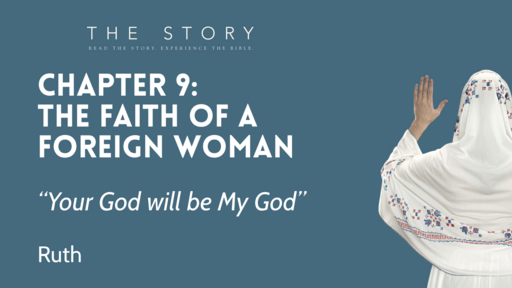
Chapter 9: The Faith of a Foreign Woman (Your God will be My God)
Notes
Transcript
Handout
Main Idea of The Story: God is redeeming a people for himself from every nation, tribe, people, and language, for his own glory through Jesus Christ.
Text for the Chapter:
Text for the Sermon:
Each sermon should answer these questions:
How do these Lower Stories fit into the Upper Story? (FCF)
What do these stories tell us about God, man, and the plan of redemption?
How do these stories point to Christ?
How is my story reflected in these stories?
What do these stories tell me about how my story fits in God’s Story?
Prayer
Intro:
Last week we looked at the book of Judges, and we saw the downward spiral of immorality that Israel is caught up in. There’s no strong leadership uniting the 12 tribes, so everyone is doing whatever they want, and what they want is often really bad.
Last week, we looked at the stories from the perspectives of some of the judges, sort of from a birds-eye view through Deborah, Gideon, Sampson, and others. Well, this week’s chapter zooms in to look at the lives of some ordinary, everyday Israelites during this time period, and we get a glimpse of what life was like for ordinary people, and how God is working, even in the minute details of the lives of regular people, to draw Israel back to himself.
The book of Ruth occurs in the time of the Judges, after Joshua’s Conquest of Canaan and before the establishment of the Kingdom of Israel, somewhere around the years 1300–1050 BC.
We don’t know for sure which Judge or Judges were ruling during the time of Ruth, or if this fell in between the rule of some of the Judges, and that isn’t really pertinent to the story.
But the situation during the time of the Judges and Ruth isn’t great. Israel has failed to drive out the pagan inhabitants of Canaan, and has intermarried with them, resulting in rampant pagan idolatry within Israel. This idolatry results in God’s judgment being poured out upon Israel from invading armies, drought and famine, attacks by wild animals, and such.
It seems that Naomi’s family is in the middle of one of one of these cycles of judgment during the events described in the book of Ruth. The book begins by describing a severe famine in the region, which is so severe that Elimelech and Naomi have to leave Canaan and journey east to Moab to find food.
1 In the days when the judges ruled there was a famine in the land, and a man of Bethlehem in Judah went to sojourn in the country of Moab, he and his wife and his two sons.
2 The name of the man was Elimelech and the name of his wife Naomi, and the names of his two sons were Mahlon and Chilion. They were Ephrathites from Bethlehem in Judah. They went into the country of Moab and remained there.
3 But Elimelech, the husband of Naomi, died, and she was left with her two sons. 4 These took Moabite wives; the name of the one was Orpah and the name of the other Ruth. They lived there about ten years, 5 and both Mahlon and Chilion died, so that the woman was left without her two sons and her husband.
They apparently stayed in Moab for at least 10 years, during which time, Naomi’s husband, Elimelech, dies. Her two sons, Mahlon and Chilion marry Moabite women (Orpah and Ruth). But, Mahlon (Ruth’s husband) and Chilion (Orpah’s husband) both die, as well during this time. So, Naomi’s family has a really bad time in Moab.
Now, we don’t know how Elimelech, Mahlon, and Chilion died or whether their deaths were God’s judgment upon them for sin or idolatry. The Moabites were pagans, so it is possible that their deaths were due to sin or idolatry. Intermarriages with pagans like the Moabites were precisely the kinds of intermarriages that had led Israel into idolatry and led to the cycles we see in the Judges.
And, Moabite women had a long history of leading Israelite men into idolatry. And Naomi herself certainly seems to interpret their deaths as the Lord’s judgment against her and her family. Naomi says at various points...
13 ...the hand of the Lord has gone out against me.”
20 She said to them, “Do not call me Naomi; call me Mara, for the Almighty has dealt very bitterly with me. 21 I went away full, and the Lord has brought me back empty. Why call me Naomi, when the Lord has testified against me and the Almighty has brought calamity upon me?”
Naomi means “pleasant,” and Mara means “bitter.”
But, ultimately, we never get the answer to “why” these men died prematurely. And, whether the deaths of these men was a direct punishment for sin, or if they remained faithful in Moab and their deaths were for some other purpose, it doesn’t ultimately matter.
One of the immediate results of all of this is that Naomi has become bitter because of her suffering.
Naomi is bitter because of her suffering.
Naomi is bitter because of her suffering.
Now, she won’t stay that way, thankfully. By the end of the story, Naomi will learn a valuable lesson and her bitterness will be turned to joy.
What we see in the book of Ruth is that regardless of the cause of the calamity, God is always at work to redeem broken people. And, when God’s people repent of their sins and turn to him, he forgives and he redeems.
But for now, Naomi is bitter. And it’s easy to see why. She’s lost everything.
Staying in Moab, without a husband or male sons to protect and provide for her would have been downright dangerous for her. She was not a Moabite, and the Moabites were not God-fearing people. So, she can’t stay there, she has to return to her people where at least she has some relatives that can perhaps help her out.
Naomi gets word that the famine has abated in Canaan (Ruth 1:6), so she decides to return to her homeland in Israel.
6 Then she arose with her daughters-in-law to return from the country of Moab, for she had heard in the fields of Moab that the Lord had visited his people and given them food.
But this isn’t a victorious, happy reunion. She’s going home in mourning because she has no other options.
But, that doesn’t mean the situation in Israel is going to be much better for her. Without a husband, and without any surviving male children, she’s in a desperate situation. Elimelech would have probably had some kind of property that she’d have the title to, but without any men to work the land, she’s not able to actually use it.
She’s been gone for ten years, so someone else may have been using the land, or it may be so grown up that it would take months of prep to be able to even plant crops, let alone harvest them. She’s an old widow and in no position to start up a farm from scratch.
So, the only way for her to be able to buy food and provide for herself is to sell the land for money, which is what she’ll end up doing (in ch. 4).
In the meantime, her only means of putting food on the table would have been depending upon the generosity of others.
Since it was barley harvest, one of the best means of providing food for the upcoming year would be gleaning in fields that belonged to others.
22 So Naomi returned, and Ruth the Moabite her daughter-in-law with her, who returned from the country of Moab. And they came to Bethlehem at the beginning of barley harvest.
God had provided a law in the Law of Moses that provided for poor people. The law was that you couldn’t harvest the entire field of crops—you had to leave some around the edges unharvested, and if you dropped some crops as you were harvesting, you had to leave them.
22 “And when you reap the harvest of your land, you shall not reap your field right up to its edge, nor shall you gather the gleanings after your harvest. You shall leave them for the poor and for the sojourner: I am the Lord your God.”
This allowed for poor people or travelers to go and harvest their food from the edges of any field in Israel. They had to work for it, it wasn’t a hand out, but if they were willing to work, they could provide for themselves. This was called “gleaning.”
“Gleaning” was the legally permitted harvesting of crops or grain around the edges of someone else’s field or picking up the scraps dropped by harvesters.
Now, if Naomi had eyes to see it, there are already several threads of grace running through her suffering. She’s lost her husband and sons, yes, and that pain runs deep. But, God is also opening a door for her to return to her homeland. And, he’s provided a bountiful harvest that she’s going to be able to take advantage of because of God’s law about gleaning. So, even in the midst of her heartache, God is being gracious to her.
When you are struggling with bitterness, look for the thread of God’s grace in your pain.
The harvest is a brief window of opportunity, though, so Naomi would need to glean as much grain as she possibly could during that time in order to have any hope of having enough grain for the coming year’s bread. This would mean long hours of backbreaking work harvesting grain in the sun.
It mean bending over repeatedly to pick up what the harvesters dropped, using a sickle to bend and cut the grain, and carrying a heavy load of grain back and forth to wherever you were collecting it.
And that was the easy part. Then the grain had to be threshed. They would beat it with sticks to separate the grain kernels from the shaft of the grain.
Threshing left a mixture of grain kernels, chaff, broken straw, and dust.
So, then you had to separate out the grain from all the junk. That was called “winnowing.” They would gather the threshed grain and throw it up in the air so that the wind would blow away the chaff and the stalks and the grain would fall down in a pile.
And that would still usually need to be sifted to get out the small bits of rock or whatever other impurities were in it.
Then, once you had sifted the grain, it was time to mill it into flour.
This was one of the most difficult and time-consuming parts of the process. The small kernels of grain were placed on a stone and then crushed by hand with another rock until they were powderized into flour.
Then, you could cook your bread.
But Naomi was old, and gleaning was hard, manual labor, so as she’s heading back to Israel, she’s in for a tough life. In order to have food, she’ll be doing backbreaking manual labor for long hours every day.
Naomi knows that this is what she’s headed back to. Naomi knows that widowhood in the ancient world, especially if you had no male children to take care of you, is a rough life.
Her daughters in law are, apparently, both young and seem to both be childless still. Naomi knows that the most logical thing for them to do is to stay in Moab, to return to their fathers’ households where they will be provided for and can, likely, get remarried.
So, Naomi releases Orpah and Ruth to return to their father’s homes so they can remarry.
6 Then she arose with her daughters-in-law to return from the country of Moab, for she had heard in the fields of Moab that the Lord had visited his people and given them food.
7 So she set out from the place where she was with her two daughters-in-law, and they went on the way to return to the land of Judah.
8 But Naomi said to her two daughters-in-law, “Go, return each of you to her mother’s house. May the Lord deal kindly with you, as you have dealt with the dead and with me.
9 The Lord grant that you may find rest, each of you in the house of her husband!” Then she kissed them, and they lifted up their voices and wept.
10 And they said to her, “No, we will return with you to your people.” 11 But Naomi said, “Turn back, my daughters; why will you go with me? Have I yet sons in my womb that they may become your husbands?
12 Turn back, my daughters; go your way, for I am too old to have a husband. If I should say I have hope, even if I should have a husband this night and should bear sons,
13 would you therefore wait till they were grown? Would you therefore refrain from marrying? No, my daughters, for it is exceedingly bitter to me for your sake that the hand of the Lord has gone out against me.”
14 Then they lifted up their voices and wept again. And Orpah kissed her mother-in-law, but Ruth clung to her.
So, Orpah agrees and returns to her family. But, Ruth insists on going with Naomi.
15 And she said, “See, your sister-in-law has gone back to her people and to her gods; return after your sister-in-law.”
In Naomi’s mind, there’s nothing for Ruth in Israel. Naomi is in the pits of despair.
Oftentimes, when we are suffering, we feel like Naomi. We can’t see any good in the world around us. Our eyes are clouded with gloom and despair.
But Ruth’s response in the midst of her suffering is a model for us, because while Naomi gave in to despair and bitterness...
Ruth clung to God in her suffering.
Ruth clung to God in her suffering.
14 Then they lifted up their voices and wept again. And Orpah kissed her mother-in-law, but Ruth clung to her. 15 And she said, “See, your sister-in-law has gone back to her people and to her gods; return after your sister-in-law.”
16 But Ruth said, “Do not urge me to leave you or to return from following you. For where you go I will go, and where you lodge I will lodge. Your people shall be my people, and your God my God. 17 Where you die I will die, and there will I be buried. May the Lord do so to me and more also if anything but death parts me from you.”
18 And when Naomi saw that she was determined to go with her, she said no more.
Now, it’s obvious that Ruth had a special relationship with her mother-in-law, Naomi. Verse 14 says that Ruth “clung” to Naomi. But it’s also evident that...
Ruth’s decision was about more than Naomi.
Ruth’s decision was about more than Naomi.
When Orpah leaves and returns to her people, Naomi concludes:
15 And she said, “See, your sister-in-law has gone back to her people and to her gods; return after your sister-in-law.”
Naomi is so bitter and depressed at this point that she things that Ruth would be better off returning to her pagan roots than going on with her to Israel. But look how Ruth replies:
16 But Ruth said, “Do not urge me to leave you or to return from following you. For where you go I will go, and where you lodge I will lodge. Your people shall be my people, and your God my God.
17 Where you die I will die, and there will I be buried. May the Lord do so to me and more also if anything but death parts me from you.”
Formerly, Ruth’s husband (Mahlon) had attached himself to Moab by marrying a Moabite. But now, Ruth expresses her faith by choosing to follow Naomi back to Israel.
Ruth knows that, even in the midst of all the suffering, she’s better off with the one true God than with whatever wealth and comfort might be found without him.
Her decision is a conscious embrace of Israel’s God and covenant. As Ruth clings to Naomi, she’s clinging to Yahweh. She even takes an oath by the name of Yahweh. She has no interest in returning to the gods of her people—she wants to be a part of the people of the one true God.
And we need to understand...
Following God has a high cost.
Following God has a high cost.
This decision cost Ruth. She wasn’t an idiot. She knew what she was signing up for.
Living in a foreign nation and with a stigma as a Moabite
Living in a foreign nation and with a stigma as a Moabite
She’s going to have to live under Jewish law from here on.
And Moabites had a bit of a stigma because of the fighting between the two nations.
This is in the period of the Judges, and one of the nations that had oppressed Israel was Moab, Ruth’s homeland.
14 And the people of Israel served Eglon the king of Moab eighteen years. 15 Then the people of Israel cried out to the Lord...
There had also been that incident in the wilderness wandering where Moab had hired a diviner to try to curse Israel
4 ...Balak the son of Zippor, who was king of Moab at that time, 5 sent messengers to Balaam the son of Beor at Pethor, ...6 Come now, curse this people for me, since they are too mighty for me...”
And when that didn’t work, a bunch of Moabite women seduced a bunch of Israelite men into idolatry.
1 While Israel lived in Shittim, the people began to whore with the daughters of Moab. 2 These invited the people to the sacrifices of their gods, and the people ate and bowed down to their gods. 3 So Israel yoked himself to Baal of Peor. And the anger of the Lord was kindled against Israel.
That resulted in the deaths of 24,000 Israelites by a plague.
9 Nevertheless, those who died by the plague were twenty-four thousand.
So Israel and Moab had a complicated history, and Ruth could probably expect at least some social opposition in Israel. On top of that, she could expect
Backbreaking labor
Backbreaking labor
All the labor that was awaiting Naomi was awaiting Ruth, too. She ends up gleaning in the fields of a neighbor
6 And the servant who was in charge of the reapers answered, “She is the young Moabite woman, who came back with Naomi from the country of Moab.
7 She said, ‘Please let me glean and gather among the sheaves after the reapers.’ So she came, and she has continued from early morning until now, except for a short rest.”
She’s probably working 10-14 hour days between gleaning, threshing, winnowing grain, and then whatever other daily chores she has to do, like fetching water, cooking, cleaning, and so on.
Now, she’d have to do a lot of that anyhow no matter where she lived, but at least if she had a family, she’d have a husband and sons to share some of the more physically demanding work. Instead, she has no men to help with the load, only an aging mother-in-law who will eventually be unable to help with these chores, but still need to be provided for.
Perpetual widow-hood & childlessness
Perpetual widow-hood & childlessness
She has no children, and little prospects for marriage.
As a widowed foreigner from a poor home, her prospects for remarriage in Israel were not great.
No option for Levirate marriage
When she went back with Naomi, she knew that the chances of living out her days as a widow, never having children, were very high.
And one day, after Naomi was dead and gone and Ruth was old, who would provide for her? Who would care for her? Having no children meant more than just being lonely and unfulfilled, it meant having no caretaker in your old age.
And that meant...
Financial insecurity
Financial insecurity
Ruth had no guarantees of prosperity or stability. She had no promise of a paycheck, no “bright future” to look forward to in Israel.
And yet, despite all of these costs, Ruth concludes that
The cost of not following God is higher.
The cost of not following God is higher.
Ruth is risking everything she has and her future because she believes in the God of Israel.
Naomi concludes that her hardships are evidence of lack of God’s favor in her life, and that her daughters in law would be better off serving their pagan gods.
But Ruth concludes that,
even if she has to suffer the scorn of being an outsider, never fully fitting in or being accepted...
even if she has to endure backbreaking labor and long hours in the sun scavenging for food every day...
even if she has to live single for the rest of her life and never have the companionship of a spouse or children again...
even if she has to grow old and die alone with no one to care for her...
it’s all worth it so long as she can be under the covenant of the one true God.
When Ruth says, “your people will be my people, and your God my God,” she’s saying “I’ve seen what that other life has to offer, and God is worth it.”
Better to be a beggar in the fields of God than to live like a king or queen in a godless nation. Or, as the Psalmist says it,
10 A single day in your courts is better than a thousand anywhere else! I would rather be a gatekeeper in the house of my God than live the good life in the homes of the wicked.
Jesus put it this way,
24 Then Jesus told his disciples, “If anyone would come after me, let him deny himself and take up his cross and follow me. 25 For whoever would save his life will lose it, but whoever loses his life for my sake will find it.
26 For what will it profit a man if he gains the whole world and forfeits his soul? Or what shall a man give in return for his soul? 27 For the Son of Man is going to come with his angels in the glory of his Father, and then he will repay each person according to what he has done.
Better to carry the cross of Christ, than to sit on the thrones of this world.
Being a Christian is not about simply believing the right list of things. I hear so many people say, “I’m a Christian because I believe in God.” Well, good for you.
19 You believe that God is one; you do well. Even the demons believe—and shudder!
See, even the demons believe in God, but that belief doesn’t save them. The demons are more confident in the existence of God than you ever have been. They don’t have a doubt in the world that God exists. They don’t have a doubt in the world that Jesus is the Son of God, that he died for the sins of man, and that he rose again the third day. They believe all of that, and it has not done a thing for them. They will still spend eternity in Hell. Why?
Because there are two kinds of belief/faith. There’s the kind of belief that says, “I believe God exists, but I’m not willing to give him control of my life. I believe he exists, but I’m going to continue living my life for myself, without regard to him.” That kind of belief will send you straight to Hell. In fact, the stronger your belief of this kind, the worse your punishment will be, because you knew better. That’s the kind of belief Orpah had. The kind that has experienced God, knows that he’s real, and yet turns their back and walks right back to their idols and false gods. It’s the kind of belief that knows that planes can fly, but refuses to get on one. It’s the kind of belief that exists in the head, but not in the heart, hands, or feet. And there are tens, probably hundreds of thousands of people sitting in church pews today that have that kind of belief, and if that’s you, and if you don’t repent, you will go straight to Hell.
22 On that day many will say to me, ‘Lord, Lord, did we not prophesy in your name, and cast out demons in your name, and do many mighty works in your name?’ 23 And then will I declare to them, ‘I never knew you; depart from me, you workers of lawlessness.’
See, there is a difference between knowing about God and knowing God.
But, there’s a second kind of belief. This is the kind of belief that not only believes that God exists, but places their trust in him. It’s the kind of faith that places their life and their future in God’s hands and says, “I’ll follow you wherever you lead me.” It’s the kind of faith that hands the controls over to God and says “Even if...I’ll follow you.” It’s the kind of faith that Ruth had. It’s the faith that says “Better to be a doorman in God’s house than a king elsewhere.”
Imagine that today you were confronted with a choice of two doors.
Behind Door 1 is a future that entails a life of singleness, childlessness, a life of loneliness, poverty, and living out the remainder of your life in a foreign country with little to nothing you can call your own, but the guarantee of a relationship with the one true God and eternal life with him. Behind Door 1 is a cross.
Behind Door 2 is a future that entails companionship, a family, financial success and stability, and living out the remainder of your life in your homeland with your relatives and friends, and all the good things that this life has to offer, but separated from a relationship with the one true God. Behind Door 2 is a crown.
Which Door would you walk through?
The answer to that question is the answer to whether or not you are a true believer in Christ.
And the reason this test works is because it reveals your heart, it reveals what you truly love. No one can choose Door 1 without being enraptured by the Spirit of God living within them. No one can choose Door 1 unless they have seen and tasted that the Lord is good.
We have a word for this in English, it’s called “worship.” Worship is an Old English word that means “to ascribe worth/value to something.” When Ruth made the choice that going to Israel and enduring the hardships of that life was worth the cost, she was worshipping God.
Any time you make a choice that costs you something to follow God, that’s worship.
When someone says, “I’m going to cut off this relationship with this boy or girl, man or woman, that I really like but isn’t a believer in Christ, because Scripture commands me to and I value my walk with the Lord more than my relationship with that person, that’s worship.”
When someone says, “I’m going to maintain my integrity in this business deal or at work, even though no one else knows and it’s going to cost me, because God knows and I want to stay pure for him, that’s worship.”
When someone says, “I’m going to surrender my life to the call to ministry or missions and embrace the uncertainty of the future and give up a good paying career and a life of comfort for service to God, that’s worship.”
When someone says, “I’m going to endure mistreatment and not strike back in revenge because I trust in God, that’s worship.”
If you are a believer, and you have walked through that first door, but like Naomi, you’re wallowing in self-pity this morning, I want you to remember what is really behind these doors. Yes, you may have given up some temporary comforts in this world by following Christ. Yes, it may mean long hours, hard labor, and loneliness at times. It may entail loss and suffering. There is a cross to carry behind Door 1.
All those who choose the cross, receive a crown.
But, the mystery of faith is this—all who choose the cross, end up getting a crown. And all who choose the crown in this life end up getting the cross. Behind Door 2 is an eternity separated from God. Eternity without Jesus. And all of the difficulties that you encounter along the road in Door 1 are nothing compared to what is waiting for you one day in heaven.
25 For whoever would save his life will lose it, but whoever loses his life for my sake will find it.
And if you’re here this morning and you can’t honestly say which door you’d choose, my prayer for you is that God would open your eyes to see and behold his beauty, and that you would fling open Door 1 and cling to God like Ruth did. Because he is worth it.
And like Ruth, those who cling to God experience...
God graciously Redeems.
God graciously Redeems.
What neither Ruth nor Naomi realized was that while the hand of the Lord had, indeed, been behind all that had happened, his hand was not against them.
God had taken Naomi’s husband and sons, that was true. Not a sparrow falls to the ground apart from God’s say, after all. There is no tragedy that enters our lives that God has not permitted.
And sometimes God permits tragedy in our lives as discipline. But that doesn’t mean he is against us.
What Naomi and Ruth couldn’t see at first was that God was working all things together for their good.
And that begins to become apparent when they meet a man named Boaz. Ruth goes out and gets to work gleaning in the fields nearby and just happens to come to the land belonging to a man named Boaz, who is a relative of her deceased husband and father-in-law.
3 So she set out and went and gleaned in the field after the reapers, and she happened to come to the part of the field belonging to Boaz, who was of the clan of Elimelech.
Ruth knows that the harvest season is short, and she has a limited amount of time to gather enough grain to last them through the next year, so she’s working hard. And Boaz takes notice and asks who she is.
5 Then Boaz said to his young man who was in charge of the reapers, “Whose young woman is this?” 6 And the servant who was in charge of the reapers answered, “She is the young Moabite woman, who came back with Naomi from the country of Moab.
7 She said, ‘Please let me glean and gather among the sheaves after the reapers.’ So she came, and she has continued from early morning until now, except for a short rest.”
Boaz has heard about Ruth. Her loyalty and love for her mother in law have apparently made impressions among the locals. Now, seeing her work ethic, he’s doubly impressed.
11 But Boaz answered her, “All that you have done for your mother-in-law since the death of your husband has been fully told to me, and how you left your father and mother and your native land and came to a people that you did not know before.
12 The Lord repay you for what you have done, and a full reward be given you by the Lord, the God of Israel, under whose wings you have come to take refuge!”
So he tells her not to bother going to any other field. He assures her that she’ll be safe and well cared for in his fields.
He even invites her to eat with him and all of his hired workers for dinner, and then he instructs his servants that they are to let her glean and even pull out some picked bundles of grain for her to give her as extra.
By the end of the day, she walks away with well more than double what you’d typically be able to harvest in a day—enough grain for two weeks worth of bread for her and Naomi—and some leftovers from lunch for Naomi.
When Ruth gets home, Naomi realizes that someone has blessed Ruth, and when Ruth tells her who it is, Naomi’s eyes light up.
20 And Naomi said to her daughter-in-law, “May he be blessed by the Lord, whose kindness has not forsaken the living or the dead!” Naomi also said to her, “The man is a close relative of ours, one of our redeemers.”
For the first time, Naomi realizes that God has not forsaken them. Boaz is one of her kinsmen, a close relative. In fact, he is what the Law of Moses calls a “Kinsman Redeemer.”
We will go more in depth on exactly what that means on Wednesday night, so I’m not going to explain the whole situation right now.
Suffice it to say that Boaz is one of the few people who can fix Naomi and Ruth’s situation—but only if he’s willing to do so at great cost to himself. He’ll have to buy Naomi’s property with his own money, marry Ruth, and then the first son he has with Ruth will actually be considered the child of her deceased husband, Mahlon, and the property Boaz purchased will go to him as his inheritance. If Boaz has any other kids, they will not be eligible to inherit any of this property.
Because of the cost of redeeming land in situations like this, a lot of eligible Kinsman Redeemers would choose not to fulfill their obligations. There wasn’t a lot in it for Boaz. Boaz didn’t need the land, wouldn’t really benefit from it much in the long run anyhow, and probably had no shortage of options for wives.
But, in the sovereignty of God, Boaz wants to help, and he does.
So, Boaz buys the land—which provides financial security for Naomi—and he marries Ruth, which provides security for Ruth. She’s no longer a “Moabite,” she’s married into Israel.
And, in time, Ruth has a son.
13 So Boaz took Ruth, and she became his wife. And he went in to her, and the Lord gave her conception, and she bore a son.
14 Then the women said to Naomi, “Blessed be the Lord, who has not left you this day without a redeemer, and may his name be renowned in Israel!
15 He shall be to you a restorer of life and a nourisher of your old age, for your daughter-in-law who loves you, who is more to you than seven sons, has given birth to him.” 16 Then Naomi took the child and laid him on her lap and became his nurse.
Ruth’s stigma as a Moabite has been redeemed—she’s now an Israelite. She is part of the people of God.
Ruth’s labor has been redeemed—she’s been rewarded with a husband, and a son.
Ruth and Naomi’s suffering and loss have been redeemed—they’ve been given a family and children. Naomi’s loss of her sons is redeemed by a daughter in law worth more than seven sons, and Ruth’s childlessness has been redeemed with a son.
Ruth and Naomi’s financial insecurity has been redeemed—they’re well provided for now through Boaz. The Lord did not leave them without a redeemer.
And remember in your suffering and trials, that...
The Lord has not left you without a Redeemer.
Ruth and Boaz have a son named Obed. Obed father’s Jesse, and Jesse father’s David—THE David, King David, the one who wrote Psalm 23 and half the Psalms in the book, the most famous King of Israel, and the founder of the Davidic Dynasty. So, Ruth becomes the great grandma, and Naomi the great, great grandma of David the King.
17 And the women of the neighborhood gave him a name, saying, “A son has been born to Naomi.” They named him Obed. He was the father of Jesse, the father of David.
And David’s descendants ultimately culminate in another famous King—Jesus, the Messiah.
1 The book of the genealogy of Jesus Christ, the son of David, the son of Abraham.
Ruth clung to God and God redeemed her situation. She chose the cross, and she received the crown.
Conclusion:
If you’re in the midst of trials right now, don’t give in to self-pity or regret or bitterness. Look for the thread of grace running through the pain. God is providing for you even if you can’t see it.
Remember that Jesus is your redeemer. He has given you a family, a new life, a hope and a future.
And if today you are struggling betwen the two doors, put your faith in God. He doesn’t promise an easy life—quite the opposite, he promises a cross. But for all who choose the cross gladly and cling to him, a crown awaits you in eternity.
