God is Worthy

Notes
Transcript
Worthy
Rev. Derek Geldart
God / Revelation 4:1-11
The Apostle John was no stranger to the Lord Jesus Christ. He had been one of the three disciples in Jesus' inner circle, privileged to witness moments few others experienced. He reclined near Jesus at the Last Supper, stood near the cross as his Saviour suffered and died, hurried to the empty tomb, and recognized the risen Lord beside the Sea of Galilee (John 13:23; 19:26; 20:2; 21:7, 20). Throughout his Gospel, John identifies himself as "the disciple whom Jesus loved." He had walked with Jesus, witnessed His miracles, and experienced firsthand the grace and power of the Son of God.
Yet despite his close relationship with Jesus and his faithful service as an apostle, we find John many years later exiled to Patmos, a small, rocky island in the Aegean Sea, approximately fifty miles off the coast of Asia Minor [1]. Early Christian tradition associates his exile with the reign of Emperor Domitian, and some accounts suggest he may have been subjected to forced labour in the quarries. John himself tells us that he was there "because of the word of God and the testimony of Jesus" (Revelation 1:9). Imagine the circumstances. Here was a man who had walked beside the Son of God and devoted his life to proclaiming the gospel, now isolated on a remote island under Roman authority. Yet this place of isolation would become the setting for one of the most extraordinary revelations ever given to humanity.
The opening words of Revelation explain that this revelation originated with God the Father, was given to Jesus Christ, and communicated through His angel to John, who faithfully recorded what he saw and heard (Revelation 1:1-2) [2]. The resulting book contains messages to seven churches, magnificent visions of heaven, and prophetic revelations concerning God's judgment and the ultimate triumph of Jesus Christ [3]. Though rich in symbolism and sometimes difficult to interpret, one truth shines throughout: God is sovereign, His purposes will prevail, and He alone is worthy of all glory, honour, and praise.
In today's sermon, entitled "Worthy," we will examine Revelation 4:1-11. John is permitted to glimpse the throne room of heaven itself, where he witnesses the majesty of God and the worship that continually surrounds the Creator of all things. The Christian author A. W. Tozer warned that the essence of idolatry is entertaining thoughts about God that are unworthy of Him. When we imagine God according to our own preferences and limitations, we risk creating a false image that reflects ourselves rather than the God revealed in Scripture. We begin thinking of Him primarily in terms of what He can do for us, rather than worshipping Him simply for who He is. But God is infinitely greater than anything the human mind could imagine. As the Lord declares, "To whom will you compare me? Or who is my equal?" (Isaiah 40:25). And while the finite mind cannot fully comprehend the Infinite [4], God has graciously revealed Himself so that we might truly know Him.
The Apostle Paul reminds us, "For now we see only a reflection as in a mirror; then we shall see face to face" (1 Corinthians 13:12). Our understanding of God's glory remains incomplete, yet what He has revealed is more than sufficient to lead us into reverence, humility, and worship. And that is what makes Revelation 4 so remarkable. John is not invited into heaven to discover how important humanity is, but to behold how glorious God is. Everything in this vision directs our attention toward the One seated upon the throne. The heavenly creatures proclaim His holiness, the elders bow before His majesty, and all of heaven declares that He alone is worthy.
For God is not worthy because we worship Him; we worship Him because He is worthy.
Worthy Because God Reigns
Revelation 4:1-3 NIV
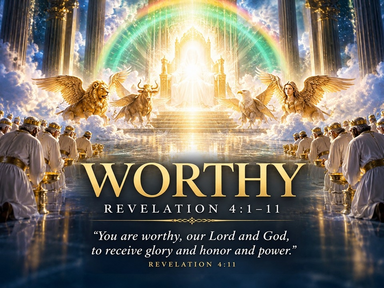
After this I looked, and there before me was a door standing open in heaven. And the voice I had first heard speaking to me like a trumpet said, "Come up here, and I will show you what must take place after this." At once I was in the Spirit, and there before me was a throne in heaven with someone sitting on it. And the one who sat there had the appearance of jasper and ruby. A rainbow that shone like an emerald encircled the throne.
What an extraordinary privilege for an elderly apostle, exiled on the lonely island of Patmos, to receive such a revelation [5]! John describes a door standing open in heaven and a voice, sounding like a trumpet, inviting him to witness what must take place after this [6]. Much like the Apostle Paul, who spoke of being caught up to the third heaven (2 Corinthians 12:2-4), John was permitted to behold the heavenly realm. But unlike Paul, who was forbidden to repeat what he heard, John was instructed to record what was revealed. And of all the extraordinary things John could have described about heaven, what captured his attention first? A throne. And more importantly, Someone was seated upon it. John did not see a throne waiting for a king to arrive. He saw a throne already occupied. Heaven was not waiting for someone to take control. The sovereign Lord was already reigning.
Remarkably, John makes no attempt to describe God's physical features. Instead, he speaks of precious stones, reflecting the limitations of human language when confronted with divine glory. God had told Moses, "You cannot see my face, for no one may see me and live" (Exodus 33:20). Likewise, Ezekiel described his heavenly vision as "the appearance of the likeness of the glory of the LORD" (Ezekiel 1:26-28) [7]. Isaiah saw the Lord seated upon a throne, with the train of His robe filling the temple (Isaiah 6:1-7). John compares the appearance of the One seated upon the throne to jasper and ruby, conveying extraordinary brilliance and splendour, while a rainbow resembling an emerald encircles the throne [9]. Even these magnificent descriptions offer only a glimpse of God's infinite majesty.
Yet the most significant feature of John's vision is not the precious stones or the rainbow, but the throne itself. The throne declares that God reigns, and His sovereignty extends over everything He has created. The psalmist proclaims that the Lord has established His throne in heaven and that His kingdom "rules over all" (Psalm 103:19). Even Nebuchadnezzar, one of history's most powerful kings, eventually acknowledged that God "does as he pleases with the powers of heaven and the peoples of the earth," and that no one can "hold back his hand" (Daniel 4:35).
Think about what John is seeing. On earth, Roman emperors claimed supreme authority. Their commands could determine whether people lived in freedom or suffered in exile. John himself knew the consequences of their power. But when heaven was opened before him, he saw something infinitely greater than Rome. Above every emperor, every kingdom, and every earthly authority stood the throne of the eternal God. Rome could exile John to Patmos, but Rome could never threaten the throne of heaven. And God's sovereignty extends beyond earthly rulers to the unfolding of history itself. He declares, "I make known the end from the beginning," and assures us that His "purpose will stand" (Isaiah 46:9-10). Nothing takes God by surprise, and no earthly power can overturn His eternal purposes. The God revealed in Revelation 4 is not anxiously watching history unfold, wondering what will happen next. He is the sovereign Lord whose purposes cannot be defeated.
Earthly kingdoms will rise and fall. Governments will change, rulers will come and go, and the powers of this world will eventually pass away. But the throne John saw will never be vacant, its authority will never be successfully challenged, and its King will never be replaced. Our God reigns-and He always will.
Worthy Because God is Holy
Revelation 4:4-8 NIV
Surrounding the throne were twenty-four other thrones, and seated on them were twenty-four elders. They were dressed in white and had crowns of gold on their heads. From the throne came flashes of lightning, rumblings and peals of thunder. In front of the throne, seven lamps were blazing. These are the seven spirits of God. Also in front of the throne there was what looked like a sea of glass, clear as crystal.
In the center, around the throne, were four living creatures, and they were covered with eyes, in front and in back. The first living creature was like a lion, the second was like an ox, the third had a face like a man, the fourth was like a flying eagle. Each of the four living creatures had six wings and was covered with eyes all around, even under its wings. Day and night they never stop saying:
" 'Holy, holy, holy
is the Lord God Almighty,'
who was, and is, and is to come."
As John's vision unfolds, our attention moves outward from God's throne to the extraordinary scene surrounding it. Twenty-four elders sit upon thrones, clothed in white and wearing golden crowns. Their identity has been widely debated, with interpretations ranging from heavenly rulers and angelic beings [10] to a symbolic representation of the fullness of God's people [11]. Yet their identity is not the central message. John describes lightning, thunder, and rumblings proceeding from the throne, recalling God's awesome presence at Mount Sinai (Exodus 19:16-19). Seven blazing lamps represent the seven spirits of God, commonly understood as the fullness of the Holy Spirit, while a sea of glass, clear as crystal, adds to the majesty of heaven.
Surrounding the throne are four living creatures resembling those in Ezekiel's vision (Ezekiel 1:5-14). Their unusual appearance, with numerous eyes and six wings, emphasizes their extraordinary nature. Yet what matters most is their proclamation. Day and night they declare, "Holy, holy, holy is the Lord God Almighty" (Revelation 4:8). Notice that they do not proclaim God's love, mercy, or compassion, although He possesses these attributes in infinite perfection. Instead, their worship emphasizes His holiness. The threefold repetition of holy expresses God's supreme holiness, just as the seraphim proclaimed in Isaiah's vision: "Holy, holy, holy is the LORD Almighty" (Isaiah 6:3).
To understand God's holiness, we must recognize two closely connected dimensions of His nature. First, God's holiness speaks of His absolute uniqueness and transcendence above everything He has created [12]. He is not merely greater than all other beings; He is fundamentally distinct from creation itself. Jeremiah declares, "No one is like you, LORD" (Jeremiah 10:6). And God Himself asks, "To whom will you compare me? Or who is my equal?" (Isaiah 40:25). He alone is the eternal, self-existent Creator, while everything else depends upon Him.
Second, God's holiness speaks of His absolute moral perfection and purity. God is entirely good, completely righteous, and utterly without evil [13]. Scripture declares, "There is no one holy like the LORD" (1 Samuel 2:2). The Apostle John reminds us that "God is light; in him there is no darkness at all" (1 John 1:5). Unlike humanity, whose goodness is imperfect and whose motives are often mixed, God's character is perfectly pure. He never acts unjustly, never speaks falsely, and never compromises His righteousness. His holiness characterizes everything He is and does. His love is holy, His justice is holy, and His mercy is holy.
Consider for a moment what these heavenly creatures are proclaiming. They dwell in the presence of God, surrounded by a glory that we can scarcely imagine. Yet their response is not casual familiarity or indifference. They never cease declaring His holiness. And perhaps that should cause us to consider how easily we can become casual in our own approach to God. We can sing familiar hymns, offer familiar prayers, and hear familiar Scriptures without pausing to consider the majesty of the One before whom we stand. If the heavenly creatures never cease to proclaim His holiness, how much more should we, who know Him only in part, approach Him with reverence and wonder?
This is why the heavenly creatures never cease their proclamation. They stand before the One whose glory is beyond comparison and whose character is without imperfection. God is worthy of our worship because there is no one like Him-He is infinitely glorious in His being and perfectly holy in all His ways.
Worthy Because God is Eternal
Revelation 4:9 NIV
Whenever the living creatures give glory, honor and thanks to him who sits on the throne and who lives for ever and ever,
As John's vision continues, our attention returns to the four living creatures surrounding God's throne. Their appearance resembles the heavenly beings described in Isaiah's and Ezekiel's visions (Isaiah 6:2-3; Ezekiel 1:5-25) [14]. Their many eyes have sometimes been understood as symbolizing extraordinary knowledge and watchfulness [15]. Yet what matters most is not their unusual appearance, but the One they continually worship. Revelation 4:8 declares that He is the One "who was, and is, and is to come," while verse 9 describes Him as the One "who lives for ever and ever." These words reveal something extraordinary about God. He is not simply a being who will continue to exist forever. He is the eternal God, without beginning and without end. Everything else has a beginning, but God has always existed. He does not grow older, become weaker, or diminish in power. Moses expressed this magnificent truth when he declared, "Before the mountains were born or you brought forth the whole world, from everlasting to everlasting you are God" (Psalm 90:2).
Consider for a moment the world around us. On one of my walks in the Caledonia Mountains, I stopped to look across the vast horizon. As I stood there, I wondered how many generations before me had gazed upon that same magnificent landscape. People have come and gone, nations have risen and fallen, yet those mountains remain. Standing there, they seemed almost timeless. But even those ancient mountains had a beginning. I sometimes wonder how many of the stars Abraham saw when God promised him descendants as numerous as the heavens are still shining today (Genesis 15:5). The universe may seem unimaginably old to us, but it too had a beginning. Before the first mountain rose, before the first star began to shine, before the universe itself existed, God already was. The psalmist captures this contrast beautifully when he declares that the heavens are the work of God's hands and will one day perish, "But you remain the same, and your years will never end" (Psalm 102:25-27).
And this is why we must be careful never to worship creation in place of the Creator. The beauty of nature is not something to worship, but a magnificent signpost pointing us toward the One who made it. Psalm 19:1 declares, "The heavens declare the glory of God; the skies proclaim the work of his hands." And Romans 1:20 reminds us that God's eternal power and divine nature are revealed through what He has made. The mountains, oceans, and stars testify to His greatness, but none of them can compare with Him. They are temporary expressions of His power, while He remains eternally unchanged.
Now consider what this meant for John. He was an elderly man living in exile on Patmos. He had witnessed the passing of years, the deaths of fellow believers, and the power of earthly rulers. Yet when heaven was opened before him, he saw the throne of the One who had never known a beginning and would never know an end. The Roman Empire that seemed so powerful in John's day would eventually pass into history. Its emperors would die, its armies would disappear, and its authority would come to an end. But the God whom John saw upon the throne would remain forever. Our world is constantly changing. Generations come and go, circumstances change, and everything around us bears the marks of time. But God does not change with the passing of the years. As He declares through the prophet Malachi, "I the LORD do not change" (Malachi 3:6). And perhaps that is what makes the worship of these heavenly creatures so remarkable. They do not worship a God whose greatness belongs only to the past or whose glory might one day fade. They worship the eternal Lord, whose majesty never diminishes and whose reign will never end. As Paul declares, "Now to the King eternal, immortal, invisible, the only God, be honor and glory for ever and ever. Amen" (1 Timothy 1:17). God is worthy of our worship because He alone is eternal. Before anything existed, He was God; when everything else has passed away, He will still be God.
Worthy Because God Alone Deserves our Worship
Revelation 4:9-10 NIV
Whenever the living creatures give glory, honor and thanks to Him who sits on the throne and who lives for ever and ever, the twenty-four elders fall down before Him who sits on the throne and worship Him who lives for ever and ever.
As John's vision continues, the worship of the four living creatures is joined by that of the twenty-four elders. These elders occupy thrones of their own, clothed in white and wearing golden crowns. Yet whenever the living creatures give glory and honour to God, the elders fall before His throne in worship. Revelation 4:10 tells us that they also lay their crowns before Him. What an extraordinary picture! Here are beings who have been granted positions of honour and authority, yet in the presence of Almighty God, they willingly surrender every symbol of their own greatness. Some interpreters understand these elders as representing the redeemed people of God, with their thrones and crowns suggesting royal authority and their worship reflecting a priestly calling. In this understanding, they represent God's people as a kingdom of priests, privileged to serve in His presence [16]. But regardless of their precise identity, the meaning of their actions is unmistakable. Their crowns, symbols of honour and authority, are laid before the One from whom every honour ultimately comes. Those who have received everything from God acknowledge that all glory belongs to Him [17]. Even in heaven, where others may be honoured, God alone is worshipped.
Consider what this reveals about the nature of true worship. The elders do not lay their crowns before the throne because those crowns are worthless. They lay them down because, however precious those honours may be, they cannot compare with the infinite worth of the One seated upon the throne. Their worship is not merely the performance of a heavenly ceremony. It is the recognition that God possesses a glory and majesty that no created being can ever share in the same way. And perhaps this should cause us to examine our own understanding of worship. We sometimes think of worship primarily as something we do when we gather on Sunday morning, when we sing hymns, offer prayers, or listen to Scripture. These are important expressions of worship, but true worship begins with recognizing who God is and responding to Him with reverence, humility, and adoration. Jesus declared that the Father seeks those who will worship Him "in the Spirit and in truth" (John 4:23-24). Worship is not simply an outward activity; it is the response of a heart that recognizes God's supreme worth.
And there is another important lesson in the crowns laid before the throne. Whatever abilities we possess, whatever positions we occupy, and whatever accomplishments we achieve, none of these things makes us worthy of the glory that belongs to God alone. Even the opportunities we have to serve Him are gifts of His grace. The Apostle Paul asks, "What do you have that you did not receive?" (1 Corinthians 4:7). The elders remind us that everything we possess ultimately comes from God, and therefore everything should be used for His glory. The highest honour any creature can receive is not to be worshipped, but to worship the One who alone is worthy.
Worthy Because God is the Creator of all Things
Revelation 4:10-11 NIV
They lay their crowns before the throne and say:
"You are worthy, our Lord and God,
to receive glory and honor and power,
for you created all things,
and by your will they were created
and have their being."
We now come to the magnificent conclusion of John's vision. The twenty-four elders have fallen before the throne, laying their crowns at the feet of Almighty God. And what reason do they give for declaring Him worthy of glory, honour, and power? Because He created all things, and everything exists by His will. This is the great declaration with which Revelation 4 concludes. God is worthy of worship because He is the source of everything that exists. Nothing in heaven or on earth exists independently of Him. Everything owes its existence to His sovereign will. Think about the extraordinary power of our Creator. Whenever we make something, we must begin with materials that already exist. A carpenter needs wood, an artist needs paint, and an engineer needs materials from which to construct something. But when God created the universe, He did not need materials that someone else had provided. Genesis 1:1 declares, "In the beginning God created the heavens and the earth." And Psalm 33:9 tells us, "For he spoke, and it came to be; he commanded, and it stood firm." The vast universe, with its countless stars and galaxies, came into existence through the power of His word.
And consider this remarkable truth: God did not create the universe because He needed it. He was not lonely, incomplete, or lacking anything before creation. As Paul declared to the people of Athens, God is not served by human hands as though He needed anything, because He Himself gives everyone life and breath and everything else (Acts 17:24-25). God depends upon nothing He has made, yet everything He has made depends entirely upon Him. The Apostle Paul tells us that all things were created through Christ and for Him, and that in Him all things hold together (Colossians 1:16-17). The universe does not merely owe its beginning to God; it continues to exist because of His sustaining power. And perhaps that is the great truth John wants us to see as we leave this heavenly throne room. We have seen the throne that declares God's sovereignty. We have heard the living creatures proclaim His holiness. We have considered the One who lives forever and ever. We have watched the elders lay their crowns before Him in worship. And now we hear heaven declare the reason all creation owes Him glory: He is the One who made it all.
One day, every earthly throne will be empty. Every human crown will lose its significance. The kingdoms of this world will pass away. But the throne of heaven will remain, and the One seated upon it will reign forever. So as we leave this passage, perhaps the greatest question is not what God can do for us, but whether we have truly considered who He is. He is sovereign over all things, infinitely holy, eternally unchanging, worthy of every honour, and the Creator upon whom everything depends. And when we begin to see God as John saw Him, even through this small glimpse of His infinite glory, there is only one fitting response: worship. For God is not worthy because we worship Him. We worship Him because He is worthy.
Footnotes
[1] Ranko Stefanovic, Revelation of Jesus Christ: Commentary on the Book of Revelation (Berrien Springs, MI: Andrews University Press, 2009), 3-4.
[2] Gwyn Pugh, "Commentary on the Book of Revelation," in 1, 2, 3 John & Revelation, ed. Robert E. Picirilli, The Randall House Bible Commentary (Nashville, TN: Randall House, 2010), 149.
[3] Thomas R. Schreiner, "Revelation," in Hebrews-Revelation, ed. Iain M. Duguid, James M. Hamilton Jr., and Jay Sklar, ESV Expository Commentary (Wheaton, IL: Crossway, 2018), 12:529-531.
[4] Rienk Bouke Kuiper
[5] Daniel L. Akin, Exalting Jesus in Revelation, ed. Daniel L. Akin, David Platt, and Tony Merida, Christ-Centered Exposition Commentary (Nashville, TN: Holman Reference, 2016), 112.
[6] Clinton E. Arnold, Zondervan Illustrated Bible Backgrounds Commentary: Hebrews to Revelation. (Grand Rapids, MI: Zondervan, 2002), 279.
[7] Ian Boxall, The Revelation of Saint John, Black's New Testament Commentary (London: Continuum, 2006), 84.
[8] James M. Hamilton Jr., Preaching the Word: Revelation-The Spirit Speaks to the Churches, ed. R. Kent Hughes (Wheaton, IL: Crossway, 2012), 143-144.
[9] Alan F. Johnson, "Revelation," in The Expositor's Bible Commentary: Hebrews through Revelation, ed. Frank E. Gaebelein, vol. 12 (Grand Rapids, MI: Zondervan Publishing House, 1981), 462.
[10] Alan F. Johnson, "Revelation," in The Expositor's Bible Commentary: Hebrews through Revelation, ed. Frank E. Gaebelein, vol. 12 (Grand Rapids, MI: Zondervan Publishing House, 1981), 462.
[11] Alan F. Johnson, "Revelation," in The Expositor's Bible Commentary: Hebrews through Revelation, ed. Frank E. Gaebelein, vol. 12 (Grand Rapids, MI: Zondervan Publishing House, 1981), 462.
[12] Joel R. Beeke and Paul M. Smalley, Reformed Systematic Theology: Revelation and God (Wheaton, IL: Crossway, 2019), 1:568-569.
[13] Ibid.
[14] Alan F. Johnson, "Revelation," in The Expositor's Bible Commentary: Hebrews through Revelation, ed. Frank E. Gaebelein, vol. 12 (Grand Rapids, MI: Zondervan Publishing House, 1981), 463.
[15] Robert Vacendak, "The Revelation of Jesus Christ," in The Grace New Testament Commentary, ed. Robert N. Wilkin (Denton, TX: Grace Evangelical Society, 2010), 1272-1273.
[16] John Rea, "Elder," in The Wycliffe Bible Encyclopedia, ed. Charles F. Pfeiffer and Howard F. Vos (Moody Press, 1975).
[17] Joseph C. Dillow, The Reign of the Servant Kings: A Study of Eternal Security and the Final Significance of Man (Monument, CO: Paniym Group, 2011), 583.
Page . Exported from Logos Bible Study, 9:54 AM October 22, 2026.
