Come, Follow Me
Notes
Transcript
Father, as we open Your Word today, help us hear clearly the call of Jesus Christ.
Show us what it means to repent, believe the gospel, and follow Him with our whole lives.
Guard us from being content to simply know about Jesus without truly following Him. Expose anything in us that competes with His lordship, and give us hearts ready to obey wherever He leads.
Thank You for the grace that saves us, the Savior who calls us, and the promise that He will continue shaping those who follow Him.
Speak through Your Word, deepen our faith, and make us faithful disciples of Christ.
In Jesus’ name, amen.
Text: Mark 1:14–20
For the past several weeks, we have been looking at what it means to live together as the family of God.
We learned to love one another, welcome one another, bear one another’s burdens, forgive one another, and encourage one another.
But all of those commands raise an even more basic question:
Who are the people who are supposed to live that way?
They are disciples.
They are followers of Jesus Christ.
So today we begin a new series:
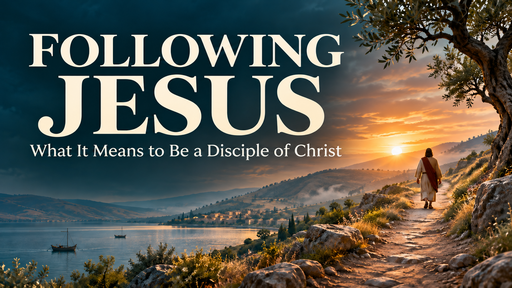
FOLLOWING JESUS: What It Means to Be a Disciple of Christ.
And there may be no more important question for us to ask than this:
What does it actually mean to follow Jesus?
There are people who admire Jesus but do not follow Him.
They respect His teaching.
They appreciate His compassion.
They may attend church.
They may own a Bible.
They may even call themselves Christians.
But Jesus never called people simply to admire Him from a distance.
He said:
“Follow Me.”
And there is a world of difference between admiring Jesus and following Jesus.
You can admire somebody while standing still.
But you cannot follow somebody without moving.
Following means somebody else sets the direction.
Following means somebody else leads.
Following means you are no longer in front.
And in Mark 1:14–20, Jesus shows us three things about the life of a disciple:
The Conversion of the Disciple
The Call of the Disciple.
The Cost of the Disciple.
First, listen to verses 14 and 15:
14 Now after John was put in prison, Jesus came to Galilee, preaching the gospel of the kingdom of God,
15 and saying, “The time is fulfilled, and the kingdom of God is at hand. Repent, and believe in the gospel.”
1. THE CONVERSION OF THE DISCIPLE
1. THE CONVERSION OF THE DISCIPLE
Before Jesus says, “Follow Me,” He first says:
“Repent, and believe in the gospel.”
That order matters.
Discipleship begins with conversion.
Jesus announces:
“The time is fulfilled, and the kingdom of God is at hand.”
The King has come.
God’s promises are being fulfilled.
And because the King has come, there must be a response.
Jesus gives two commands:
Repent.
Believe.
Repentance is more than being sorry.
You can be sorry you got caught and never repent.
You can regret the consequences and still love the sin.
Biblical repentance means a change of mind that results in a change of direction.
If you are walking west and turn east, you cannot keep going west at the same time.
Repentance says:
“I was going my way. Now I turn toward God.”
And then Jesus says:
“Believe in the gospel.”
Faith means trusting the good news of what God has done in Christ.
Notice the movement:
Turn from sin.
Trust in Christ.
That is conversion.
Christianity is not God helping good people become a little better.
Christianity is God saving guilty sinners through Jesus Christ.
Our deepest problem is not that we need improvement.
Our deepest problem is that we need forgiveness.
We have sinned against a holy God.
Religion cannot remove that guilt.
Good works cannot remove it.
Church attendance cannot remove it.
We need a Savior.
And that is why the gospel is good news.
Jesus Christ came.
He lived without sin.
He went to the cross.
He bore the judgment sinners deserved.
He died.
He was buried.
And He rose again.
So hear this carefully:
We do not follow Jesus in order to become saved.
We follow Jesus because the saving grace of God has brought us to Him.
But grace never leaves us walking in the same direction.
The gospel that saves us also turns us.
Repent and believe.
That is the conversion of the disciple.
But conversion is not the end of discipleship.
It is the beginning.
Jesus does not simply save us from something.
He calls us to Someone.
Listen to verses 16 through 18:
16 And as He walked by the Sea of Galilee, He saw Simon and Andrew his brother casting a net into the sea; for they were fishermen.
17 Then Jesus said to them, “Follow Me, and I will make you become fishers of men.”
18 They immediately left their nets and followed Him.
2. THE CALL OF THE DISCIPLE
2. THE CALL OF THE DISCIPLE
Jesus walks into the ordinary world of Simon and Andrew.
They are not sitting in a synagogue waiting for something dramatic to happen.
They are working.
They are casting nets.
They are fishermen doing what fishermen do.
And Jesus says:
“Follow Me.”
Notice what He does not say.
He does not say:
“Follow a system.”
“Follow a philosophy.”
“Follow a list of rules.”
He says:
“Follow Me.”
Christianity is centered on a Person.
Jesus Christ.
A disciple learns from Him.
A disciple listens to Him.
A disciple obeys Him.
A disciple follows Him.
And then comes one of the great promises of discipleship:
“Follow Me, and I will make you become fishers of men.”
Do not miss the words:
“I will make you.”
Jesus does not say:
“Fix yourself, then follow Me.”
He says:
“Follow Me, and I will make you.”
That ought to encourage every believer in this room.
You may look at your life and see how far you still have to go.
Jesus already knows.
Peter was not finished when Jesus called him.
Far from it.
Peter would speak when he should have listened.
He would misunderstand Jesus.
He would act impulsively.
He would even deny the Lord.
But Jesus was not finished with Peter.
The fisherman would become a preacher.
The impulsive man would become a shepherd of God’s people.
Why?
Because Jesus said:
“I will make you.”
Church, Jesus does not call finished products.
He calls people and then transforms them.
That transformation happens through His Word, His Spirit, His discipline, His church, and His grace.
But let us not misuse that truth.
Jesus receives us where we are, but He never intends to leave us where we are.
If you follow Christ, He will change you.
Your desires.
Your priorities.
Your attitudes.
Your relationships.
Your purpose.
A disciple who never changes is a contradiction.
The call is:
“Follow Me.”
And the promise is:
“I will make you.”
But if we follow Him, sooner or later His direction will conflict with something we want to keep.
That brings us to the cost.
Listen to verses 19 and 20:
19 When He had gone a little farther from there, He saw James the son of Zebedee, and John his brother, who also were in the boat mending their nets.
20 And immediately He called them, and they left their father Zebedee in the boat with the hired servants, and went after Him.
3. THE COST OF THE DISCIPLE
3. THE COST OF THE DISCIPLE
Simon and Andrew left their nets.
James and John left the boat.
They left their father with the hired servants and followed Christ.
Now Jesus is not commanding every Christian to quit a job or abandon a family.
These men were receiving a particular call.
But the principle applies to every disciple:
Jesus Christ has the highest claim on your life.
Nothing gets to sit above Him.
Not career.
Not money.
Not comfort.
Not plans.
Not relationships.
Not even your own will.
Everything comes beneath Christ.
Imagine trying to follow Jesus while holding tightly to a post in the ground.
Jesus moves forward.
You say, “Lord, I’m coming.”
But you refuse to release the post.
Sooner or later you discover something:
You cannot follow Christ and stay where you are at the same time.
And that is where discipleship becomes costly.
We often want Jesus without surrender.
Jesus without change.
Jesus without inconvenience.
Jesus without losing control.
But Jesus does not say:
“Follow Me as long as I go where you wanted to go.”
He says:
“Follow Me.”
These men did not know where the road would lead.
They did not understand everything about the cross.
They did not know every hardship ahead.
But they knew who was calling.
And faith does not need to know every mile of the road.
Faith needs to know the One who leads.
CONCLUSION
CONCLUSION
So what does Mark 1 teach us about discipleship?
There is:
The Conversion of the Disciple.
“Repent, and believe in the gospel.”
There is:
The Call of the Disciple.
“Follow Me.”
And there is:
The Cost of the Disciple.
They left and followed Him.
Here is the whole message:
The gospel brings us to Christ.
The call puts us behind Christ.
And the cost places everything beneath Christ.
So let me ask you plainly:
Are you following Jesus?
Not:
Do you admire Jesus?
Not:
Do you know facts about Jesus?
Not:
Do you attend church?
But:
Are you following Him?
If you have never trusted Christ, His word to you is:
“Repent, and believe in the gospel.”
Turn from sin.
Trust the Savior who died and rose again.
And if you already belong to Him, then ask:
What am I holding that keeps me from following Christ wholeheartedly?
My plans?
My comfort?
My habits?
My fear?
My control?
Jesus still says:
“Follow Me.”
And remember His promise:
“I will make you.”
You do not have to know every turn in the road.
You need to know the One leading you.
The King has come.
The gospel has been proclaimed.
The call has been given.
And Jesus Christ says:
“Come, follow Me.”
Father, thank You for the gospel of Jesus Christ.
Thank You that Christ came for sinners, died in our place, rose again, and calls us to follow Him.
Help us not to hold tightly to the things that keep us from wholehearted obedience. Give us grace to turn from sin, trust Christ fully, and place every part of our lives beneath His lordship.
Where we are weak, strengthen us.
Where we are hesitant, give us faith.
Where we desire control, teach us surrender.
And as we follow Jesus, continue making us into the people You intend us to become.
May our lives show that we do not merely admire Christ—we belong to Him, trust Him, and follow Him.
In Jesus’ name, amen.
