Who is Like Our God
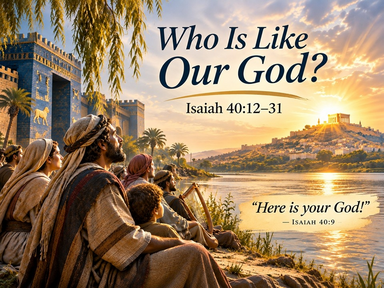

Sermon • Submitted • Presented • 31:39
0 ratings
· 2 viewsFiles
Notes
Transcript
Who is Like our God?
Rev. Derek Geldart
God / Isaiah 40:12-31
Have you ever experienced the presence of God so profoundly that the moment became forever etched upon your heart? I hope you know what it is like to walk upon those spiritual mountaintops, those precious seasons when God seems so near that your heart overflows with gratitude, peace, and unspeakable joy. Perhaps you have experienced that peace which surpasses all understanding (Philippians 4:6-7), when the Good Shepherd seemed to lead you beside quiet waters and restore your weary soul (Psalm 23:2-3). You found refuge beneath the shadow of His wings (Psalm 91:4), and your heart was filled with a longing to know Him more deeply. His Word became sweeter, prayer became a delight, and you found yourself wanting nothing more than to walk in step with the Holy Spirit (Galatians 5:25). If only we could remain upon those mountaintops forever!
But what happens when the mountaintop gives way to the valley? Have you ever gone through a season when the God who once seemed so near suddenly felt so far away? When your prayers seemed to rise no higher than the ceiling? When you opened your Bible, longing to hear from God, but the words that once brought such comfort seemed strangely distant? Even David knew something of that darkness when he cried out, "How long, LORD? Will you forget me forever? How long will you hide your face from me?" (Psalm 13:1). There are many reasons why God may seem distant. Sometimes we are overwhelmed by suffering, grief, or exhaustion. Sometimes we have prayed earnestly for deliverance, but our circumstances remain unchanged, and we begin to mistake God's silence for His absence. At other times, our own disobedience may have disrupted our fellowship with Him, and we experience the loving discipline of our heavenly Father (Hebrews 12:5-11). Yet even faithful believers can walk through seasons of spiritual darkness, as Job discovered when he searched for God but could not perceive Him (Job 23:8-10). The absence of a feeling is not the absence of God. And that raises an important question: When God seems absent, has He truly abandoned us, or have we forgotten who our God really is?
That is the very question Isaiah confronts in the fortieth chapter of his prophecy. For generations, God's covenant people had turned away from Him. They worshipped false gods, oppressed the vulnerable, and repeatedly ignored His warnings through the prophets (2 Chronicles 36:15-16). Eventually, the judgment God had warned them about came upon the nation. Jerusalem would be destroyed, the temple would lie in ruins, and the people would be carried away into Babylonian captivity. Through Jeremiah, God would instruct the exiles to build houses, plant gardens, and raise families in Babylon, for their captivity would not end quickly (Jeremiah 29:4-10). Imagine their despair. Had God finally given up on them? Had their sins exhausted His mercy? Would they ever again experience the joy of His presence? It is into this anticipated season of exile that Isaiah speaks, proclaiming God's message of comfort and restoration. Yet in Isaiah 40:27, we hear the complaint of a people who feel forgotten: "My way is hidden from the LORD; my cause is disregarded by my God."
And notice how God responds. He does not explain every detail of their circumstances. Instead, He reminds them of who He is. It is as though God is saying, "You are looking at the greatness of your problems, but have you forgotten the greatness of your God?" He is the One who measures the oceans in the hollow of His hand, rules over the nations, and calls every star in heaven by name. He is the everlasting Creator whose wisdom has no limits and whose strength can never be exhausted (Isaiah 40:12-28). So this morning, whether you are enjoying the blessings of the mountaintop or struggling through the darkness of the valley, I invite you to lift your eyes above your circumstances and behold the greatness of your God. For the answer to our deepest fears is not always found in understanding what God is doing, but in remembering who God is. And that brings us to the question God Himself asks in Isaiah 40:25: "To whom will you compare me? Or who is my equal?" says the Holy One. This morning, let us consider four wonderful truths as we discover together: Who Is Like Our God?
God's Power is Beyond Measure
Imagine what it must have been like for God's people to endure decades of exile in Babylon. Jerusalem had been conquered, its walls torn down, and the magnificent temple of the Lord reduced to ruins. Now they lived in a foreign land, surrounded by people who worshipped other gods. Had the God who delivered their ancestors from Egypt been defeated by the gods of Babylon? Had He abandoned His covenant people? Or had their rebellion placed them beyond the reach of His mercy? Psalm 137 gives us a heartbreaking picture of their sorrow. They sat beside the rivers of Babylon and wept as they remembered Zion. They hung their harps upon the trees, asking, "How can we sing the songs of the LORD while in a foreign land?" (Psalm 137:1-4). Yet as the years passed, many began building homes, planting gardens, and raising families, just as God had instructed through Jeremiah (Jeremiah 29:4-7). Some even prospered through agriculture and trade, enjoying a measure of economic stability and freedom.
But prosperity could never satisfy the longing of a people who had lost their homeland. They might build houses in Babylon, but Babylon was not Jerusalem. The temple where their ancestors had worshipped still lay in ruins. Would God ever forgive His people and bring them home? And even if God intended to restore them, how could such a thing happen? Babylon had conquered nations and carried entire populations into captivity. Persia would eventually rise to overthrow it. Israel had no army capable of securing its freedom and no political influence sufficient to demand its return. From a human perspective, their future rested in the hands of powerful kings. But that was precisely what they needed to understand. Their deliverance had never depended upon their own strength or the willingness of earthly kings. It depended upon the power and faithfulness of the living God. And so Isaiah directs their attention beyond the armies of Babylon and the thrones of earthly rulers to the One who would accomplish their restoration. For their God was not merely greater than Babylon or Persia. He was the Creator of the heavens and the earth.
Listen to how Isaiah describes His immeasurable power in Isaiah 40:12-17.
Isaiah 40:12-17 NIV
Who has measured the waters in the hollow of his hand,
or with the breadth of his hand marked off the heavens?
Who has held the dust of the earth in a basket,
or weighed the mountains on the scales
and the hills in a balance?
Who can fathom the Spirit of the LORD,
or instruct the LORD as his counselor?
Whom did the LORD consult to enlighten him,
and who taught him the right way?
Who was it that taught him knowledge,
or showed him the path of understanding?
Surely the nations are like a drop in a bucket;
they are regarded as dust on the scales;
he weighs the islands as though they were fine dust.
Lebanon is not sufficient for altar fires,
nor its animals enough for burnt offerings.
Before him all the nations are as nothing;
they are regarded by him as worthless
and less than nothing.
Through Isaiah, God was assuring His people that exile would not be the end of their story. Notice the extraordinary imagery Isaiah uses. The oceans that seem boundless to us are pictured as resting in the hollow of God's hand. The heavens are measured by the span of His hand, and even the mountains are weighed upon scales (Isaiah 40:12). What overwhelms humanity presents no difficulty to the Creator. And God's power is matched by perfect wisdom. Who has ever instructed the Lord or taught Him understanding? No one! God needs no advisers to determine His purposes or earthly rulers to explain how He should accomplish them (Isaiah 40:13-14). His greatness is so immeasurable that even all the forests of Lebanon and all its animals would be insufficient for an offering worthy of His majesty (Isaiah 40:16).
What, then, were the mighty empires of Babylon and Persia before such a God? Isaiah declares that the nations are like a drop in a bucket, dust upon the scales (Isaiah 40:15-17). The kings who seemed to hold Israel's future in their hands were themselves subject to the One who removes kings and establishes kings (Daniel 2:21). The God who measures the oceans in His hand does not need the permission of kings to fulfill His promises. And history would demonstrate that truth. God would raise up Cyrus, king of Persia, to authorize the return of the Jewish exiles to Jerusalem (Isaiah 44:28; Ezra 1:1-4). The empire that overthrew Babylon would become God's instrument of restoration. Jerusalem's destruction would not be the final word, because God had not abandoned His covenant promises. That is why Isaiah 40:9 calls the herald of good news to lift up a voice and declare to the cities of Judah, "Here is your God!" And perhaps that is what some of us need to remember today. The circumstances before us may seem impossible, the obstacles too great, and the future uncertain. But the God who held Israel's future in His hands is the same God who holds ours. What overwhelms us has never overwhelmed Him.
God's Glory is Beyond Comparison
Having revealed God's immeasurable power, Isaiah now asks a remarkable question: Who could possibly be compared to the living God? What image fashioned by human hands could ever capture the glory of the One who created all things? Listen to how Isaiah describes the incomparable majesty of our God in Isaiah 40:18-26.
Isaiah 40:18-26 NIV
With whom, then, will you compare God?
To what image will you liken him?
As for an idol, a metalworker casts it,
and a goldsmith overlays it with gold
and fashions silver chains for it.
A person too poor to present such an offering
selects wood that will not rot;
they look for a skilled worker
to set up an idol that will not topple.
Do you not know?
Have you not heard?
Has it not been told you from the beginning?
Have you not understood since the earth was founded?
He sits enthroned above the circle of the earth,
and its people are like grasshoppers.
He stretches out the heavens like a canopy,
and spreads them out like a tent to live in.
He brings princes to naught
and reduces the rulers of this world to nothing.
No sooner are they planted,
no sooner are they sown,
no sooner do they take root in the ground,
than he blows on them and they wither,
and a whirlwind sweeps them away like chaff.
"To whom will you compare me?
Or who is my equal?" says the Holy One.
Lift up your eyes and look to the heavens:
Who created all these?
He who brings out the starry host one by one
and calls forth each of them by name.
Because of his great power and mighty strength,
not one of them is missing.
Notice how Isaiah exposes the foolishness of idolatry. A craftsman casts an image, a goldsmith covers it with precious metals, and someone with fewer resources selects wood that will not decay. Then they must secure their creation so that it will not fall over (Isaiah 40:19-20)! Think about the absurdity of that picture. People were worshipping gods they had made with their own hands, gods that could not even stand without assistance! Yet the living God needs no one to sustain Him. He sits enthroned above the earth, stretches out the heavens like a canopy, and brings the mightiest rulers to nothing (Isaiah 40:22-24). Then Isaiah asks, "To whom will you compare me? Or who is my equal?" (Isaiah 40:25). The answer is no one! God is not simply greater than the idols of Babylon; He is altogether unlike them. They are the work of human hands, but He is the Creator of the hands that fashioned them. They must be supported, but He sustains the universe. Isaiah tells His people to look toward the heavens and consider the countless stars. God calls each one by name, and not one is missing (Isaiah 40:26). The gods of Babylon could not even keep themselves standing, but the God of Israel keeps the heavens in their place! How could such a God have been defeated by an earthly empire or forgotten His covenant people?
As I consider Isaiah's words, I cannot help but think of Job. When God confronted Job with the greatness of His creation, He asked, "Where were you when I laid the earth's foundation?" (Job 38:4). Like Isaiah, God was reminding Job that the One who created and sustains the universe is infinitely greater than anything His creatures can comprehend. And perhaps that is what we need to remember when we consider the majesty of our God. Isaiah says humanity is like grasshoppers before God's majesty, but that does not mean we are insignificant to Him. We are created in His image (Genesis 1:26-27), and those who belong to Christ have been redeemed by His grace (Ephesians 1:7). The God who calls every star by name knows His children personally. His ways are infinitely higher than ours (Isaiah 55:8-9), yet His greatness is not a reason to fear that He has forgotten us. It is a reason to trust that He knows what we cannot see. Too often, when circumstances seem beyond our control, we rely upon our own understanding or the wisdom of this world. But Isaiah calls us to lift our eyes above our circumstances and remember who our God is. We may not understand why He allows certain trials, but we can trust that He works for the good of those who love Him (Romans 8:28), ultimately shaping us into the likeness of His Son (Romans 8:29). When we cannot understand what God is doing, we can still trust who God is.
God's Understanding is Beyond Comprehension
But knowing that God is infinitely greater than we are does not mean we will always understand His ways. And when His purposes remain hidden and our prayers seem unanswered, even the strongest believers can begin to wonder whether God has forgotten them. That is precisely the struggle Isaiah addresses next. He reminds God's people that although His wisdom is beyond our comprehension, nothing about our lives escapes His attention. Listen to what Isaiah says in verses 27-28.
Isaiah 40:27-28 NIV
Why do you complain, Jacob?
Why do you say, Israel,
"My way is hidden from the LORD;
my cause is disregarded by my God"?
Do you not know?
Have you not heard?
The LORD is the everlasting God,
the Creator of the ends of the earth.
He will not grow tired or weary,
and his understanding no one can fathom.
After years of exile, God's people were still waiting for the restoration He had promised. And as the years passed without deliverance, they began to wonder whether God had forgotten them. Their suffering was real, and His apparent silence was difficult to understand. Had their circumstances escaped His attention? Had their rebellion exhausted His mercy? Yet Isaiah confronts their despair with a wonderful truth: Although Israel had been unfaithful to God's covenant, God had not forgotten His promises. The everlasting Creator had neither grown weary nor lost sight of His people. He was still sovereign over their circumstances, and when His appointed time came, He would accomplish their restoration.
And isn't that often where we struggle in our own walk with God? When suffering enters our lives, when prayers seem unanswered, or when difficulties continue far longer than we expected, we begin to question what God is doing. Our troubles can become so overwhelming that we struggle to see beyond them. Yet the God who is everlasting to everlasting (Psalm 90:2) sees what we cannot. He is not limited by our understanding or confined to our circumstances. His character does not change with the passing of time (Malachi 3:6), for with Him there is no variation or shifting shadow (James 1:17). What appears uncertain to us has never been uncertain to Him. We may not understand His purposes, but we can trust the wisdom and faithfulness of the One who holds our lives in His hands.
Sometimes we stand at the edge of circumstances that seem unbearable, wondering whether the pain will ever end. Yet Scripture reminds us that our present suffering, however real and difficult, must be viewed in the light of eternity. The Apostle Paul, who knew extraordinary suffering himself, encourages believers with these words:
2 Corinthians 4:17-18 NIV
For our light and momentary troubles are achieving for us an eternal glory that far outweighs them all. So we fix our eyes not on what is seen, but on what is unseen, since what is seen is temporary, but what is unseen is eternal.
Paul was not suggesting that suffering is painless or insignificant. He was reminding us that even our deepest trials cannot compare with the eternal glory awaiting those who belong to Christ. And Isaiah offers that same hope to God's discouraged people. The God whose understanding no one can fathom had not abandoned them, and His promises had not failed. He is the same God who heals the brokenhearted and binds up their wounds (Psalm 147:3). Indeed, the very next verse reminds us that He determines the number of the stars and calls each one by name (Psalm 147:4). The God who knows every star in heaven has not forgotten a single one of His children.
And if His wisdom is sufficient to govern the universe, surely it is sufficient to guide us through the circumstances we cannot understand. But Isaiah does not stop by reminding us that God understands our struggles. He goes one step further, revealing that the everlasting God not only knows our weariness, but possesses the strength to sustain us through it.
God's Strength is Never Exhausted
And that brings us to the final wonderful truth Isaiah wants God's people to understand. The everlasting God not only possesses immeasurable power, incomparable glory, and unfathomable wisdom, but He graciously shares His strength with those who are weary. Think about that for a moment. The God who measures the oceans in the hollow of His hand, who stretches out the heavens and calls every star by name, is the very same God who reaches down to strengthen His struggling children. His greatness does not make Him indifferent to our suffering. Rather, His greatness assures us that He is more than able to sustain us through it. Listen to the wonderful promise Isaiah gives in the closing verses of this chapter.
Isaiah 40:29-31 NIV
He gives strength to the weary
and increases the power of the weak.
Even youths grow tired and weary,
and young men stumble and fall;
but those who hope in the LORD
will renew their strength.
They will soar on wings like eagles;
they will run and not grow weary,
they will walk and not be faint.
Notice the wonderful contrast Isaiah makes. In verse 28, he declares that the everlasting God never grows tired or weary. Yet in verse 29, he tells us that this same God gives strength to those who do. The psalmist declares that God is our refuge and strength, an ever-present help in trouble (Psalm 46:1). But Isaiah also reminds us that our own strength will eventually fail. Even the young grow tired, and those who seem full of strength can stumble and fall (Isaiah 40:30). No matter how capable or determined we may be, there are limits to what we can endure. Our greatest strength is not found in becoming self-sufficient, but in recognizing how completely we depend upon the Lord. As Jesus reminds us in John 15:5, apart from Him we can do nothing.
And perhaps that is exactly what someone here needs to hear this morning. You may be exhausted from caring for someone you love, discouraged by a prayer that seems unanswered, grieving a loss, or facing a future filled with uncertainty. You have tried to remain strong, but the truth is that you are tired. Yet God does not turn away from His children because they have reached the end of their strength. He invites them to depend upon His. When the Apostle Paul pleaded with the Lord to remove the thorn that troubled him, the Lord answered, "My grace is sufficient for you, for my power is made perfect in weakness" (2 Corinthians 12:9). Paul discovered that God's strength was not always demonstrated by removing his suffering, but by sustaining him through it. Sometimes the greatest evidence of God's power is not that the burden disappears, but that He gives us the strength to keep carrying it. And notice the promise Isaiah gives in verse 31: those who hope in the LORD will renew their strength. To hope in the Lord means placing our confidence in His character, depending upon His promises, and patiently trusting Him to accomplish His purposes. That was precisely what God's people needed to learn in Babylon. Their restoration would not come through their own strength, but through the faithfulness of the God who had delivered their ancestors from Egypt. Indeed, the picture of soaring on eagles' wings may have reminded them of God's earlier deliverance, when He declared that He had carried Israel on eagles' wings and brought them to Himself (Exodus 19:4). The God who had carried His people before was more than able to carry them again.
I love the picture Isaiah gives us as this chapter comes to an end. Those who hope in the Lord will soar on wings like eagles; they will run and not grow weary; they will walk and not be faint. And isn't that a beautiful picture of the Christian life? There are seasons when our hearts seem to soar, when God's blessings are evident and our faith feels strong. There are other seasons when we are running, faithfully serving the Lord and pressing forward in the work He has given us. But there are also seasons when life becomes so difficult that simply taking the next step requires more strength than we seem to possess. Perhaps that is where someone finds themselves today. You are not soaring above your troubles, and you certainly do not feel like running. You are simply trying to keep walking. Yet even there, God's promise remains. The same God who gives strength to soar is the God who gives strength to take one more step. And as we come to the end of this wonderful chapter, remember where we began this morning. We spoke about those precious mountaintop experiences when God seems so near, but also about the valleys when He seems distant and we wonder whether He has forgotten us. If you find yourself in one of those valleys today, remember what Isaiah has shown us. The God who measures the oceans in His hand has not lost control of your circumstances. The God who calls every star by name has not forgotten you. The God whose understanding no one can fathom knows exactly what you are facing. And the God whose strength is never exhausted is able to sustain you.
And nowhere do we see God's love more clearly than in Jesus Christ. The God who sustains the universe sent His Son to save sinners, and through His death and resurrection, we can be reconciled to Him (Romans 5:8-10). To those who are weary and burdened, Jesus extends this wonderful invitation: "Come to me, all you who are weary and burdened, and I will give you rest" (Matthew 11:28). Our greatest hope is not that life will become easier, but that through repentance and faith in Jesus Christ, we can be reconciled to God and belong to the One who will never leave us (Acts 20:21). So whether you are standing upon the mountaintop or struggling through the darkest valley, lift your eyes above your circumstances and behold the greatness of your God. You may not understand what tomorrow will bring, but you can know this: His promises have not failed. His wisdom has not diminished. And His strength has not run out.
For when we cannot understand what God is doing, we can still trust who God is.
Who is like our God? There is no one like Him!
Bibliography
[1] Daniel Isaac Block, The Book of Ezekiel, Chapters 1-24, The New International Commentary on the Old Testament (Grand Rapids, MI: Wm. B. Eerdmans Publishing Co., 1997), 6-8.
[2] Richard A. Taylor and E. Ray Clendenen, Haggai, Malachi, The New American Commentary (Nashville: Broadman & Holman Publishers, 2004), 21a:209-210.
[3] Ibid.
[4] John N. Oswalt, Isaiah, The NIV Application Commentary (Grand Rapids, MI: Zondervan Publishing House, 2003), 444-445.
[5] Geoffrey W. Grogan, "Isaiah," in The Expositor's Bible Commentary: Isaiah, Jeremiah, Lamentations, Ezekiel, ed. Frank E. Gaebelein, vol. 6 (Grand Rapids, MI: Zondervan Publishing House, 1986), 241-242
[6] John Goldingay, Isaiah, ed. W. Ward Gasque, Robert L. Hubbard Jr., and Robert K. Johnston, Understanding the Bible Commentary Series (Grand Rapids, MI: Baker Books, 2012), 225-226.3
[7] John N. Oswalt, Isaiah, The NIV Application Commentary (Grand Rapids, MI: Zondervan Publishing House, 2003), 446.
[8] Geoffrey W. Grogan, "Isaiah," in The Expositor's Bible Commentary: Isaiah, Jeremiah, Lamentations, Ezekiel, ed. Frank E. Gaebelein, vol. 6 (Grand Rapids, MI: Zondervan Publishing House, 1986), 245.
[9] Shalom M. Paul, Isaiah 40-66: Translation and Commentary, Eerdmans Critical Commentary (Grand Rapids, MI; Cambridge, UK: William B. Eerdmans Publishing Company, 2012), 153.
[10]John N. Oswalt, Isaiah, The NIV Application Commentary (Grand Rapids, MI: Zondervan Publishing House, 2003), 448.
[11] Ibid.
Page . Exported from Logos Bible Study, 6:59 PM November 4, 2026.
