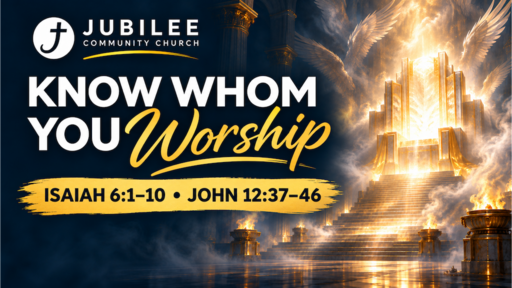
KNOW WHOM YOU WORSHIP
Sermon • Submitted • Presented • 48:36
0 ratings
· 23 viewsFiles
Notes
Transcript
KNOW WHOM YOU WORSHIP
KNOW WHOM YOU WORSHIP
PRIMARY SCRIPTURE — ISAIAH 6:1–10 AND JOHN 12:37–46 ESV
1 In the year that King Uzziah died I saw the Lord sitting upon a throne, high and lifted up; and the train of his robe filled the temple. 2 Above him stood the seraphim. Each had six wings: with two he covered his face, and with two he covered his feet, and with two he flew. 3 And one called to another and said:
“Holy, holy, holy is the Lord of hosts;
the whole earth is full of his glory!”
4 And the foundations of the thresholds shook at the voice of him who called, and the house was filled with smoke. 5 And I said: “Woe is me! For I am lost; for I am a man of unclean lips, and I dwell in the midst of a people of unclean lips; for my eyes have seen the King, the Lord of hosts!”
6 Then one of the seraphim flew to me, having in his hand a burning coal that he had taken with tongs from the altar. 7 And he touched my mouth and said: “Behold, this has touched your lips; your guilt is taken away, and your sin atoned for.”
8 And I heard the voice of the Lord saying, “Whom shall I send, and who will go for us?” Then I said, “Here I am! Send me.” 9 And he said, “Go, and say to this people:
“ ‘Keep on hearing, but do not understand;
keep on seeing, but do not perceive.’
10 Make the heart of this people dull,
and their ears heavy,
and blind their eyes;
lest they see with their eyes,
and hear with their ears,
and understand with their hearts,
and turn and be healed.”
37 Though he had done so many signs before them, they still did not believe in him, 38 so that the word spoken by the prophet Isaiah might be fulfilled:
“Lord, who has believed what he heard from us,
and to whom has the arm of the Lord been revealed?”
39 Therefore they could not believe. For again Isaiah said,
40 “He has blinded their eyes
and hardened their heart,
lest they see with their eyes,
and understand with their heart, and turn,
and I would heal them.”
41 Isaiah said these things because he saw his glory and spoke of him. 42 Nevertheless, many even of the authorities believed in him, but for fear of the Pharisees they did not confess it, so that they would not be put out of the synagogue; 43 for they loved the glory that comes from man more than the glory that comes from God.
44 And Jesus cried out and said, “Whoever believes in me, believes not in me but in him who sent me. 45 And whoever sees me sees him who sent me. 46 I have come into the world as light, so that whoever believes in me may not remain in darkness.
KEY VERSE — JOHN 12:41
41 Isaiah said these things because he saw his glory and spoke of him.
SUPPORTING SCRIPTURES — Deuteronomy 6:4–5, Isaiah 43:10–11, Matthew 1:21, Matthew 28:18–20, Mark 12:28–30, John 4:21–24, John 20:27–29, Acts 2:36–39, Acts 4:10–12, Romans 6:3–4, Colossians 2:9.
CENTRAL MESSAGE — John identifies Jesus with the glory Isaiah saw when he beheld the LORD of hosts. The one God has made Himself known in Jesus Christ. Knowing who Jesus is should shape how we worship Him, how we respond to His Word, and why we call on His name in baptism.
INTRODUCTION — DO YOU KNOW WHOM YOU WORSHIP?
INTRODUCTION — DO YOU KNOW WHOM YOU WORSHIP?
When Jesus met the woman at the well, she wanted to talk about where people ought to worship.
Her people worshiped on one mountain. The Jews said Jerusalem was the place to worship. Each side had a history. Each side could tell you what their fathers had done.
But Jesus brought the conversation to something deeper.
John 4:22 says:
“Ye worship ye know not what: we know what we worship: for salvation is of the Jews.”
Then Jesus told her that the Father seeks people who will worship Him in spirit and in truth.
Church, a person can grow up around worship and still need to come to know the One they worship.
You can know when to stand.
You can sing every verse without looking at the words.
You can know what your family has always believed.
But when you say, “Lord, I worship You,” who do you believe is hearing you?
Isaiah saw the Lord on a throne. John saw Jesus walk among men. Isaiah heard the seraphim call Him holy. John heard the risen Jesus receive Thomas’s confession, “My Lord and my God.”
And there is a single verse in John 12 that brings those two passages together.
1. ISAIAH SAW THE KING WHEN AN EARTHLY KING DIED
1. ISAIAH SAW THE KING WHEN AN EARTHLY KING DIED
SCRIPTURE — ISAIAH 6:1–5
“In the year that king Uzziah died I saw also the Lord sitting upon a throne, high and lifted up, and his train filled the temple.”
— Isaiah 6:1, KJV
Uzziah had reigned over Judah for fifty-two years. For many people in Judah, his was the only reign they had ever known. Then the king died.
Isaiah remembers the year by naming the king they lost. He remembers the vision by naming the King he saw.
Above the throne stood the seraphim. They covered their faces and their feet, and they called to one another:
“Holy, holy, holy, is the LORD of hosts: the whole earth is full of his glory.”
— Isaiah 6:3, KJV
In verse 1, the Hebrew word translated Lord is Adonai (Strong’s H136), a title of lordship. In verse 3, LORD in capital letters represents the divine name, YHWH (Strong’s H3068). By verse 5, Isaiah leaves us in no doubt about whose throne he saw.
“Mine eyes have seen the King, the LORD of hosts.”
— Isaiah 6:5, KJV
WHAT THE GLORY REVEALED ABOUT ISAIAH
WHAT THE GLORY REVEALED ABOUT ISAIAH
Isaiah saw the King, and suddenly he saw himself clearly.
“Woe is me! for I am undone.”
He confessed that he was a man of unclean lips dwelling among a people of unclean lips. Then a seraph took a live coal from the altar and touched Isaiah’s mouth. The Lord provided cleansing at the very place Isaiah had confessed his uncleanness.
Before Isaiah ever said, “Here am I; send me,” he heard that his iniquity had been taken away.
Some of us know exactly what we need to confess. We know what we said. We know what we have kept hidden. And we have wondered whether the Lord would still receive us if we brought it into the light.
Look at what happened to Isaiah. The holy God before whom he trembled was the very One who provided his cleansing.
THE GOD WHO EXPOSES OUR SIN IS THE GOD WE CAN COME TO FOR MERCY!
2. JOHN TELLS US WHOSE GLORY ISAIAH SAW
2. JOHN TELLS US WHOSE GLORY ISAIAH SAW
SCRIPTURE — JOHN 12:37–43
Jesus had performed many signs before the people, and still many refused to believe in Him.
John reaches back to Isaiah to explain what is happening. First, he quotes Isaiah 53:1: “Lord, who hath believed our report?” Then he draws from Isaiah 6:10, where the prophet is sent to people whose hearts have grown hard.
And then John says:
“These things said Esaias, when he saw his glory, and spake of him.”
— John 12:41, KJV
Who did Isaiah say he saw?
THE KING, THE LORD OF HOSTS.
Who had done the miracles John was talking about?
JESUS CHRIST.
John says Isaiah saw His glory and spoke of Him. The Jesus who stood before those people is the One whose glory Isaiah saw in the temple.
Think about what that means.
A man could stand close enough to hear Jesus speak and still miss the glory that made Isaiah cry, “Woe is me!”
He could watch Jesus perform a miracle and still go home thinking he had seen an interesting man do a remarkable thing.
And even among the rulers who believed, many would keep it to themselves. John tells us why. They loved the praise of men more than the praise of God.
WHAT WILL WE DO WITH THE LIGHT WE HAVE?
WHAT WILL WE DO WITH THE LIGHT WE HAVE?
Church, we ought to ask ourselves what we do when the truth costs us something.
Maybe the Lord has shown you that you need to make something right with a person you hurt. Maybe you know there is an area of your life you have refused to surrender. You can agree with what the Lord said and still put off the very thing He asked you to do.
John wants us to see Jesus clearly enough to trust Him openly.
When Thomas saw the risen Christ, he said to Him, “My Lord and my God” (John 20:28).
That confession belongs in our worship. When I call Jesus Lord, I am speaking to the One who has the right to rule my life. When I call Him God, I am confessing what Thomas confessed when he stood before the risen Savior.
THE GLORY ISAIAH SAW ON THE THRONE IS THE GLORY JOHN RECOGNIZED IN JESUS CHRIST!
3. THE LORD OUR GOD IS ONE
3. THE LORD OUR GOD IS ONE
SCRIPTURE — DEUTERONOMY 6:4–5, MARK 12:28–30, COLOSSIANS 2:9
“Hear, O Israel: The LORD our God is one LORD.”
— Deuteronomy 6:4, KJV
When Jesus was asked which commandment was first, He began with those words.
Then He said to love the Lord with all your heart, all your soul, all your mind, and all your strength.
The one Lord calls for the whole heart.
So what are we saying when we worship Jesus?
Paul says:
“For in him dwelleth all the fulness of the Godhead bodily.”
— Colossians 2:9, KJV
The word translated Godhead is theotēs (Strong’s G2320). It refers to deity, to what it is to be God. And Paul says all the fulness dwells in Christ bodily.
That is why Jesus can say in John 12:45, “And he that seeth me seeth him that sent me.” To see Jesus is to see the Father made known through Him.
WHY THIS MATTERS FOR OUR WORSHIP
WHY THIS MATTERS FOR OUR WORSHIP
The Roman Catholic Catechism and many Protestant churches confess one God in three distinct persons. The Catechism explicitly rejects belief in three gods. I want to represent their teaching accurately, because we can disagree plainly and still speak truthfully.
Here is where I differ. I understand the Father, Son, and Holy Ghost in light of the one God making Himself known to us in Jesus Christ. I believe Jesus’ prayers to the Father show the reality of His human life and obedience. I believe the Spirit truly dwells in His people. And I believe that when Thomas called Jesus “my God,” he was confessing the very God Israel had been commanded to love with the whole heart.
My concern is that people can hear the language of three persons and come away picturing three separate divine beings. A person might imagine a reluctant Father who has to be persuaded by a compassionate Jesus. But when Jesus welcomed sinners, touched the leper, and gave Himself for us, He was showing us the heart of the God who sent Him.
What you believe about God shapes whether you run to Him when you fail or spend your life hiding from Him.
In Jesus you see holiness that calls you to repentance. You also see mercy that makes it possible for you to come home.
4. THE NAME OF JESUS TELLS US WHO HAS COME TO SAVE
4. THE NAME OF JESUS TELLS US WHO HAS COME TO SAVE
SCRIPTURE — ISAIAH 43:10–11, MATTHEW 1:21, ACTS 4:10–12
In Isaiah 43:11, the LORD says:
“I, even I, am the LORD; and beside me there is no saviour.”
Then the angel tells Joseph:
“And thou shalt call his name JESUS: for he shall save his people from their sins.”
— Matthew 1:21, KJV
The name Jesus comes to us through the Greek Iēsous (Strong’s G2424), from the Hebrew name Yeshua, associated with the meaning “the LORD saves.” Matthew tells us why the child bears that name. He shall save His people from their sins.
In Acts 4, Peter is questioned after a man who had been lame was healed. Peter tells the leaders plainly that the man stood before them whole through the name of Jesus Christ of Nazareth, the One they crucified and God raised from the dead.
Then Peter goes from the healing of one man to the need of every person:
“Neither is there salvation in any other.”
— Acts 4:12, KJV
Church, when we call on Jesus, we are calling on the One who has the authority to forgive us and the power to bring us out of bondage. We are calling on the Savior who took our sins to the cross and rose from the grave.
Maybe you have spent years trying to get yourself together so you could feel worthy to come to God.
Isaiah’s cleansing came from the altar God provided. Our forgiveness comes through the blood of Jesus Christ.
You can come to Him today and tell Him the truth about where you are. You can ask Him to forgive what you cannot undo and give you the strength to walk in a new way.
5. THE APOSTLES CALLED PEOPLE TO BE BAPTIZED IN JESUS’ NAME
5. THE APOSTLES CALLED PEOPLE TO BE BAPTIZED IN JESUS’ NAME
SCRIPTURE — MATTHEW 28:18–20, ACTS 2:36–39, ROMANS 6:3–4
Before Jesus gave the baptismal commission, He said, “All power is given unto me in heaven and in earth” (Matthew 28:18).
Then He told His disciples to baptize:
“In the name of the Father, and of the Son, and of the Holy Ghost.”
— Matthew 28:19, KJV
The word name is singular.
At Pentecost, Peter tells the people that the Jesus they crucified is both Lord and Christ. They are cut to the heart and ask, “Men and brethren, what shall we do?”
Peter answers:
“Repent, and be baptized every one of you in the name of Jesus Christ for the remission of sins, and ye shall receive the gift of the Holy Ghost.”
— Acts 2:38, KJV
Jesus gave the commission. Peter, preaching that Jesus is Lord and Christ, called people to be baptized in His name.
And Luke keeps bringing the same name before us.
Acts 8:16 — Believers in Samaria were baptized in the name of the Lord Jesus.
Acts 10:48 — Peter commanded the Gentiles at Cornelius’s house to be baptized “in the name of the Lord,” as the KJV reads.
Acts 19:5 — Disciples at Ephesus who had previously received John’s baptism were baptized in the name of the Lord Jesus.
Acts 22:16 — Ananias told Saul to arise and be baptized, calling on the name of the Lord.
WHY I TEACH THAT WE SHOULD SPEAK THE NAME
WHY I TEACH THAT WE SHOULD SPEAK THE NAME
Many churches today use the words of Matthew 28:19 at baptism. That practice has early precedent. An early Christian teaching manual called the Didache records that wording. Christians who follow that practice often understand the language in Acts as identifying Jesus’ authority over the baptism.
I understand Peter’s words as showing us how to carry out the commission Jesus gave. That is why I teach that the name of Jesus Christ should be spoken when a person is baptized.
If Jesus is the One whose death we are being buried into, whose resurrection gives us hope, and whose authority we are publicly confessing, why leave His name unspoken at the water?
Romans 6 says we are buried with Christ by baptism into death so that we might walk in newness of life.
Think about that next time you see someone go down into the water. That person is confessing, “Jesus Christ died for me. My old life belongs in the grave. The risen Lord has called me to a new life, and I belong to Him.”
And that confession has to go home with you. It matters in the way you speak to your family. It matters in what you do when temptation comes back. It matters when the people who knew the old you want to know whether anything has truly changed.
The One whose name you confess at the water is the One you follow out of the water.
CLOSING — WHAT WILL YOU DO WITH THE GLORY YOU HAVE SEEN?
CLOSING — WHAT WILL YOU DO WITH THE GLORY YOU HAVE SEEN?
Isaiah saw the King, confessed his uncleanness, and received mercy.
In John 12, some of the rulers believed but kept quiet because they feared what people would do.
At Pentecost, people were cut to the heart and asked what they should do.
Their question is still worth asking.
Lord, now that I see who You are, what will I do with what You have shown me?
Some of us need to quit putting off repentance. Some of us have believed privately and need to confess Christ openly. Some of us need to ask whether the Jesus we sing to on Sunday is the Lord we obey on Monday.
There is one Lord who is worthy of your worship. And the Jesus who is worthy of your worship is worthy of your obedience.
CALL ON THE NAME OF JESUS
CALL ON THE NAME OF JESUS
If you have been carrying sin in secret, you can bring it to Jesus today. Tell Him what you have done. Ask Him to forgive you and give you the grace to turn from it.
If you have never surrendered your life to Christ, you can call on Him today. The One who died for you is alive. Put your trust in Him.
And if you have never been baptized, or if these passages have raised questions about your baptism, come talk with me. We can open the Word together and talk about what it means to be baptized in the name of Jesus Christ.
ISAIAH SAW THE KING. JOHN TELLS US WHOSE GLORY HE SAW. AND THE APOSTLES TELL US WHOSE NAME TO CALL UPON.
JESUS CHRIST IS MY LORD AND MY GOD!
13 For “everyone who calls on the name of the Lord will be saved.”
